


 Updated on 11 February 2026

Healthcare providers lose an average of $150 per missed appointment. With no-show rates hovering between 20-30% in outpatient settings, the annual cost runs into millions yet most appointment scheduling systems are designed only to enable booking, not to prevent absences. The platforms that succeed don't just automate calendar slots; they engineer behavior change through predictive intelligence, multi-channel engagement, and architectural decisions that treat no-shows as a product problem, not an operational afterthought.
If no-shows are costing your organization $500k+ annually, this is no longer just Ops issue it's a product decision that requires product engineering services to address root causes at the system level. Every quarter spent iterating on the wrong architecture compounds lost revenue, clinician downtime, and patient churn.
The Hidden Cost of Missed Appointments Goes Beyond Revenue
A missed doctor appointment doesn't just create an empty slot. It disrupts staff workflows, delays care for waitlisted patients, and compounds scheduling inefficiencies that ripple through the day. In 2025, 73% of practices reported stable or reduced no-show rates thanks to technology interventions, but economic pressures and transportation barriers persist for high-risk patient segments.
The operational tax is steep: wasted prep time, unused resources, and clinician downtime that could have served patients searching for "doctor appointment near me" or trying to book doctor appointment slots weeks in advance. For hospital groups managing multiple locations, a 25% no-show rate across 200 daily appointments means 50 lost slots per day equivalent to turning away patients who desperately need access.
What most platforms miss is that no-shows are predictable. Historical patterns, demographic markers, and appointment type correlate strongly with absence risk. Yet traditional patient appointment scheduling tools treat every booking equally, applying the same reminder cadence and no follow-up intelligence. This is where product engineering thinking diverges from feature implementation: the question isn't "Can we send a reminder?" but "What intervention architecture minimizes friction for this specific patient at this specific moment?"
Why Patients Miss Appointments: Root Causes That Technology Can Address
Forgetfulness accounts for 38% of no-shows a surface-level symptom of deeper scheduling friction. Transportation issues, scheduling conflicts, and unclear appointment value create barriers that compound for new patients or those managing chronic conditions across multiple specialists. High-risk cohorts share identifiable traits: first-time visits, long booking lead times, certain age demographics, and appointment types requiring extensive prep.
The traditional response sending an email 24 hours before assumes patients engage with healthcare notifications the same way they respond to e-commerce alerts. They don't. Appointment reminders for patients must account for cognitive load, channel preferences, and the fact that a reminder without actionable options (reschedule, confirm, get directions) is just noise.
This is where Software Product Development must address behavioral science, not just calendar logic. Platforms that reduce no-shows engineer confirmation flows that feel effortless: one-click rescheduling, embedded maps for first-time visitors, and prep instructions that reduce appointment anxiety. The technical implementation microservices handling notifications separately from booking state ensures these interventions scale without creating system bottlenecks.
Feature Architecture That Actually Prevents No-Shows
Multi-Channel Reminder Systems With Confirmation Logic
Sending an SMS reminder is table stakes. Platforms that cut no-shows by 30-50% use multi-interval alerts (72 hours, 24 hours, 2 hours) across SMS, email, and push notifications, with each message including a confirmation link. "Reminder plus" variants add contextual value: directions for new patients, parking details, or pre-visit instructions that reduce friction.
The engineering challenge isn't sending messages it's orchestrating timing, channel preference, and fallback logic when patients don't engage. A well-designed healthcare scheduling software uses a notification queue (Kafka or RabbitMQ) to decouple reminder dispatch from booking state, ensuring scale during peak periods and enabling retry logic for failed deliveries.
Confirmation links drive 17-26% higher rescheduling rates, freeing slots 27-40% more effectively than passive reminders. This requires real-time availability checks when patients click to reschedule, inventory management that prevents double-booking, and UI flows that complete rescheduling in under 30 seconds. These are Product Design and Prototyping decisions, not backend tasks every extra click in the reschedule flow increases abandonment.
Predictive Analytics That Flag Risk Before Booking
AI models using random forests on EHR data achieve 86% accuracy in forecasting no-shows by analyzing 16 features: appointment type, patient history, booking lead time, demographics, past cancellations, and time of day. This enables proactive outreach calling high-risk patients 48 hours before instead of relying on automated reminders alone.
The business impact is measurable: 50.7% reductions in no-shows when prediction models trigger human intervention for flagged appointments. But accuracy alone doesn't guarantee outcomes. The model must integrate into clinic workflows without creating staff burden, surface insights at the right moment (during scheduling or 72 hours pre-appointment), and respect patient experience overly aggressive outreach can feel invasive.
| Feature | Technical Mechanism | No-Show Reduction Impact |
|---|---|---|
| Automated SMS/Email | Multi-interval alerts with confirmation links | 30–50% reduction |
| AI Prediction Models | Random forest models using 16 EHR features | 50.7% reduction |
| Patient Self-Service Portal | One-click reschedule or cancellation | 20–40% slot recovery |
| Deposit / Incentive Systems | Secure payment gateway integration | Variable, up to 25% |
From a Cloud and DevOps Engineering perspective, predictive models require retraining pipelines that ingest new appointment outcomes weekly, A/B testing frameworks to validate prediction accuracy across patient cohorts, and monitoring dashboards that alert when model drift degrades performance. This isn't a one-time data science project it's ongoing infrastructure.
The Architecture Decisions That Determine Long-Term Success
Monolithic scheduling systems couple booking logic, notifications, patient portals, and analytics into a single codebase. This creates three problems: feature changes risk breaking core functionality, scaling one component (like reminder volume) requires scaling the entire system, and integrating third-party tools (EHR systems, payment gateways, online doctor consultation platforms) becomes a migration project instead of an API call.
Modern appointment scheduling system platforms use microservices to decouple concerns:
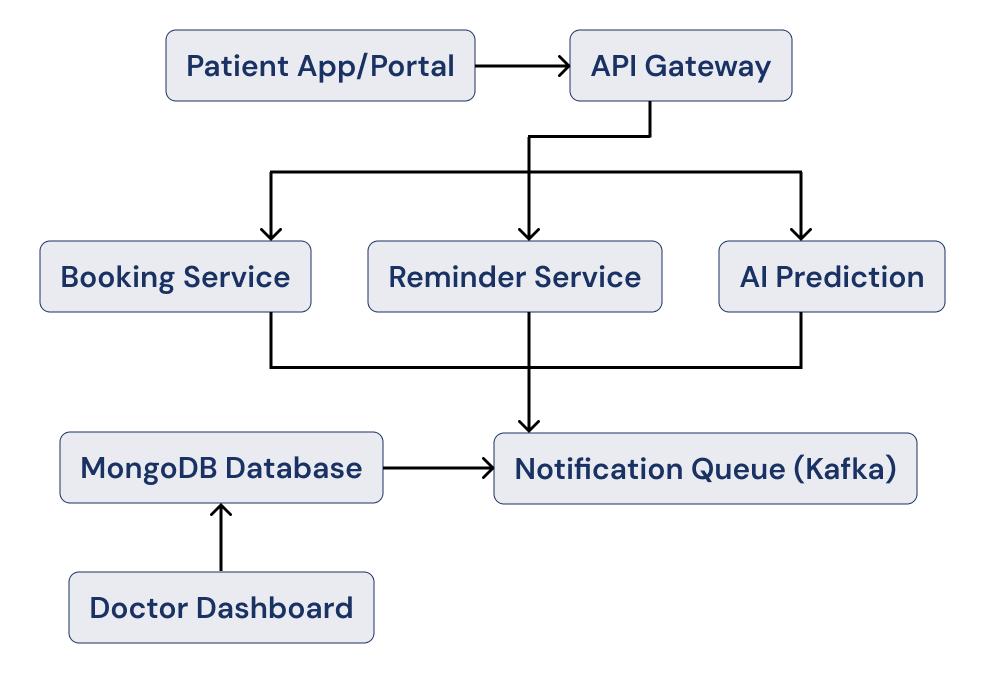
This architecture enables independent scaling (reminder service handles 10x volume during flu season without touching booking), faster feature deployment (new notification channels don't require full-stack releases), and easier compliance auditing (PHI access logs isolated per service). A MERN stack (MongoDB, Express, React, Node.js) provides real-time updates for availability checks, while FHIR standards ensure interoperability with existing EHR systems.
The trade-off is operational complexity: monitoring five services instead of one, managing inter-service communication, and ensuring data consistency across distributed databases. This is where teams without Product Strategy & Consulting experience struggle the decision isn't just "Should we use microservices?" but "Which services justify the overhead, and which features stay in the monolith for now?"
Is Your Appointment Platform Architected to Reduce No-Shows?
Take this 10-question self-assessment to identify gaps in your current system:
Does your platform predict high-risk appointments before they're booked?
Can patients reschedule in under 30 seconds without calling?
Are your reminders personalized by patient behavior patterns?
Does your architecture support FHIR integration with major EHR systems?
Can you A/B test reminder timing without engineering sprints?
Integration Points That Turn Scheduling Into a System
EHR Syncing That Prevents Data Silos
Patients expect their book doctor appointment action to appear instantly in their provider's system, with visit history, medications, and allergies already populated. This requires bidirectional FHIR APIs that sync appointment creation, updates, and cancellations between the scheduling platform and EHR systems like Epic or Cerner. Without this, staff manually reconcile schedules daily reintroducing the friction technology was supposed to eliminate.
The engineering challenge is handling inconsistent FHIR implementations across EHR vendors, rate limits on API calls, and error recovery when sync fails mid-appointment. Robust healthcare appointment management system platforms implement retry logic with exponential backoff, dead letter queues for failed syncs, and admin dashboards that surface sync errors before they cascade into scheduling conflicts.
Payment Integration That Deters Last-Minute Cancellations
Deposit systems (refundable if patients show) reduce no-shows by introducing financial accountability. Stripe or Square integration enables $10-25 holds during booking, released after the appointment or applied to the visit cost. The UX complexity is balancing deterrence with accessibility high deposits disproportionately affect low-income patients who most need care.
| Integration Type | Use Case | Technical Stack |
|---|---|---|
| EHR / FHIR APIs | Bidirectional patient record synchronization | REST/FHIR APIs, OAuth 2.0 |
| SMS / Email Gateways | Multi-channel appointment reminders | Twilio, SendGrid |
| AI / ML Pipelines | No-show prediction and risk scoring | Random Forest, TensorFlow |
| Payment Gateways | Appointment deposit holds and incentives | Stripe API, Square API |
| Wearables / IoT | Health event–based triggers and alerts | HL7, proprietary SDKs |
IoT wearables feed vitals to predict health events that trigger urgent doctor appointment needs chronic condition flare-ups detected through glucose monitors or heart rate spikes. This requires real-time data ingestion pipelines, anomaly detection algorithms, and patient consent workflows that comply with HIPAA.
Security and Compliance: Non-Negotiable for Healthcare Platforms
HIPAA mandates end-to-end encryption for protected health information (PHI), role-based access control (RBAC) limiting who views patient data, and audit logs tracking every access event. A breach exposes providers to $50,000+ fines per violation and reputational damage that erodes patient trust.
Encryption at rest (AES-256) and in transit (TLS 1.3) protects data during storage and transmission. RBAC ensures front desk staff see scheduling details but not clinical notes, while doctors access full records. Business Associate Agreements (BAAs) with cloud providers (AWS, Azure, GCP) establish legal accountability for PHI handling, with contractual obligations to report breaches within 24 hours.
From an architectural perspective, security can't be bolted on post-launch. Consent workflows, data retention policies, and patient data export features (GDPR compliance even in US healthcare) must be scoped during wireframing. Otherwise, retrofitting compliance becomes a six-month engineering lift that blocks feature development.
When Internal Teams Stall and Partnering Makes Sense
Legacy System Constraints: Existing scheduling tools built on outdated tech stacks (PHP monoliths, MySQL databases without indexing) can't scale to handle AI model inference or real-time availability checks across multi-clinic networks.
Multi-Clinic Scaling: A scheduling platform that works for one location breaks under 10+ clinics with different specialties, staff schedules, and patient populations. Distributed databases, clinic-specific customization layers, and centralized analytics require architectural rewrites.
Compliance Complexity: Healthcare regulations (HIPAA, state-specific telehealth laws, consent management) require legal interpretation that informs technical implementation. Teams without healthcare domain expertise spend months researching compliance before writing a single line of code.
Data Quality Issues: AI prediction models are only as good as their training data. Dirty EHR data (duplicate patient records, inconsistent appointment type labeling) requires ETL pipelines, data normalization scripts, and deduplication logic before machine learning adds value.
If your team is stuck on any of these, strategic product engineering accelerates timelines by 6-12 months. The alternative iterating through architectural mistakes costs more in opportunity loss and technical debt than partnering upfront.
Measuring What Matters: KPIs Beyond No-Show Rates
Track no-show rate reductions (target: <10% from baseline), but also measure:
Reminder open rates (>70% indicates effective channel selection)
Slot fill rates (95%+ means optimal overbooking logic)
Revenue recovery from rescheduled appointments
Staff time saved on manual reconciliation
Analytics dashboards should surface trends by patient cohort, appointment type, and clinic location aggregate metrics hide which interventions work for which populations.
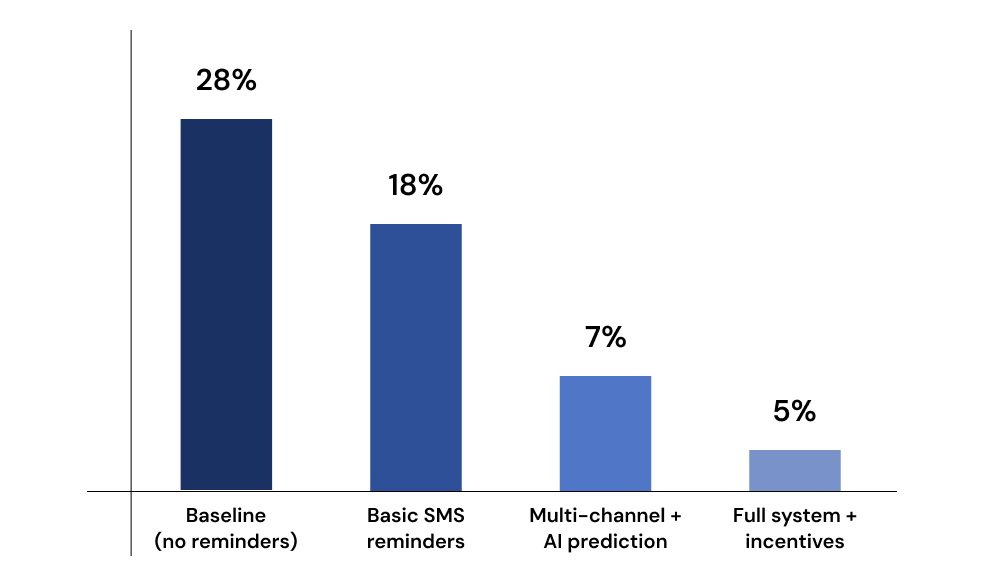
A/B testing reminder timing (24 hours vs. 48 hours before), message copy (transactional vs. conversational), and confirmation flow (email link vs. SMS reply) reveals what drives behavior change for your patient base. This requires feature flagging infrastructure and event tracking that captures patient interactions across the entire scheduling journey.
What Comes Next for Appointment Intelligence
AI personalization will tailor reminder content based on patient communication preferences learned from past interactions. Blockchain-secured patient data enables cross-provider scheduling without centralized EHR dependencies. Voice assistants (Alexa, Google Home) frictionlessly handle online scheduling software bookings through conversational interfaces, reducing no-shows by making rescheduling as easy as asking aloud.
Edge computing brings real-time availability checks to remote clinics with limited connectivity, processing scheduling logic locally and syncing when bandwidth allows. These aren't distant possibilities early adopters are already piloting voice-based rescheduling and seeing 15% higher engagement from older patient demographics.
Executive Summary: The Product Engineering Decision
Reducing no-shows requires behavioural design, AI intelligence, and scalable architecture not more reminders. The platforms that succeed treat this as a product problem requiring:
Microservices architecture that scales independently
Predictive models that flag risk before appointments
FHIR integration that eliminates data silos
Compliance-first design that prevents costly retrofits
If your goal is reducing no-shows by 40%+ while maintaining HIPAA compliance, EHR integration, and multi-clinic scalability, the technical scope is clear. The decision isn't whether to build these features it's whether your internal team has the healthcare domain expertise, compliance knowledge, and architectural experience to build them correctly the first time.
For teams navigating legacy constraints, compliance complexity, or scaling beyond single-clinic deployments, partnering with experienced product engineers provides the strategic roadmap and execution velocity to launch in 4-6 months instead of 18. The platforms that win don't just enable booking they engineer the behavior change that keeps patients showing up.