


 Updated on 24 December 2025

Introduction: The Invisible Anchor Dragging Down Your Tech Team
Consider employing a group of top-tier architects to create a skyscraper. For their vision, structural knowledge, and inventiveness, you pay them top dollar. However, they manually mix cement and count bricks for 40% of the day rather than designing.
For many software engineering teams nowadays, this is the situation. This article explains how AI and machine learning are reducing manual, repetitive engineering work from coding and testing to operations so product teams can ship faster without growing headcount. A developer's day is still largely devoted to "toil" manual, repetitive, tactical work that scales linearly with service growth but adds no long-term value to the business despite the quick development of frameworks and tools.
Who this is for: CTOs, VPs of Engineering, and Product Leaders looking to reduce engineering costs while maintaining or improving delivery speed and quality.
1. AI Coding Assistance: From Blank Canvas to Working Code in Minutes
Key takeaway: AI coding assistants reduce development time by automating boilerplate code, allowing engineers to focus on business logic instead of setup.
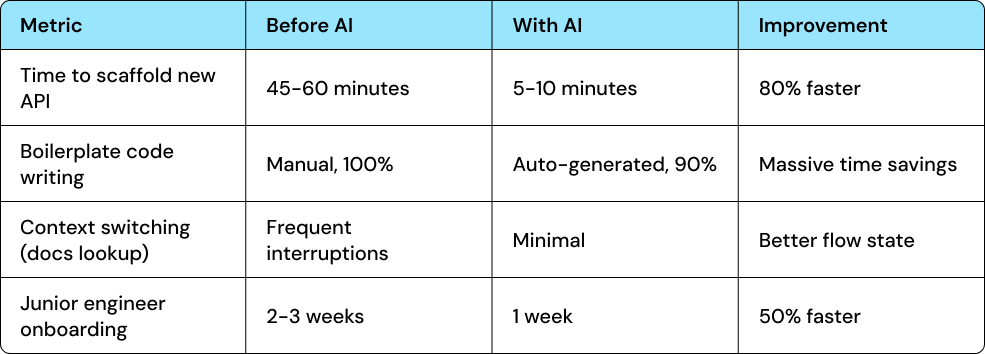
The IDE (Integrated Development Environment) is where AI's effects in engineering are most apparent. Cursor, ChatGPT, GitHub Copilot, and other tools have successfully resolved the "Blank Canvas Syndrome." Before artificial intelligence, launching a new microservice or API endpoint required writing a substantial amount of boilerplate code, including database connection strings, server configurations, and standard route definitions. This work has little leverage.
An engineer can now write the following comment:
The AI produces 90% of the scaffolding in a matter of seconds. This is how AI automation in product engineering is changing the game.
How It Works
Boilerplate Reduction: AI excels at recognizing patterns. It detects that a React component or Python Flask route typically has a certain structure. By automating this, engineers can bypass the "typing" process and proceed directly to the "logic" phase. This is particularly valuable during Product Design and Prototyping when speed matters.
Context-Aware Suggestions: Modern coding assistants do more than just guess the next word; they also read the surrounding files. When you call a function defined in another module, the AI recognizes the parameters and return types, eliminating context switching and documentation lookups.
Efficiency Gain: According to studies, using AI assistants allows engineers to perform coding tasks 30-55% faster. This is more than just speed; it's about preserving flow. Instead of becoming bogged down in syntax, the engineer stays focused on the subject at hand. Teams implementing automation in product development report faster onboarding and fewer bottlenecks in initial setup phases.
2. Automated Quality Assurance: The AI That Never Sleeps
Key takeaway: AI reduces outage resolution time and catches quality issues by identifying root causes instead of symptoms, before human reviewers even look at the code.
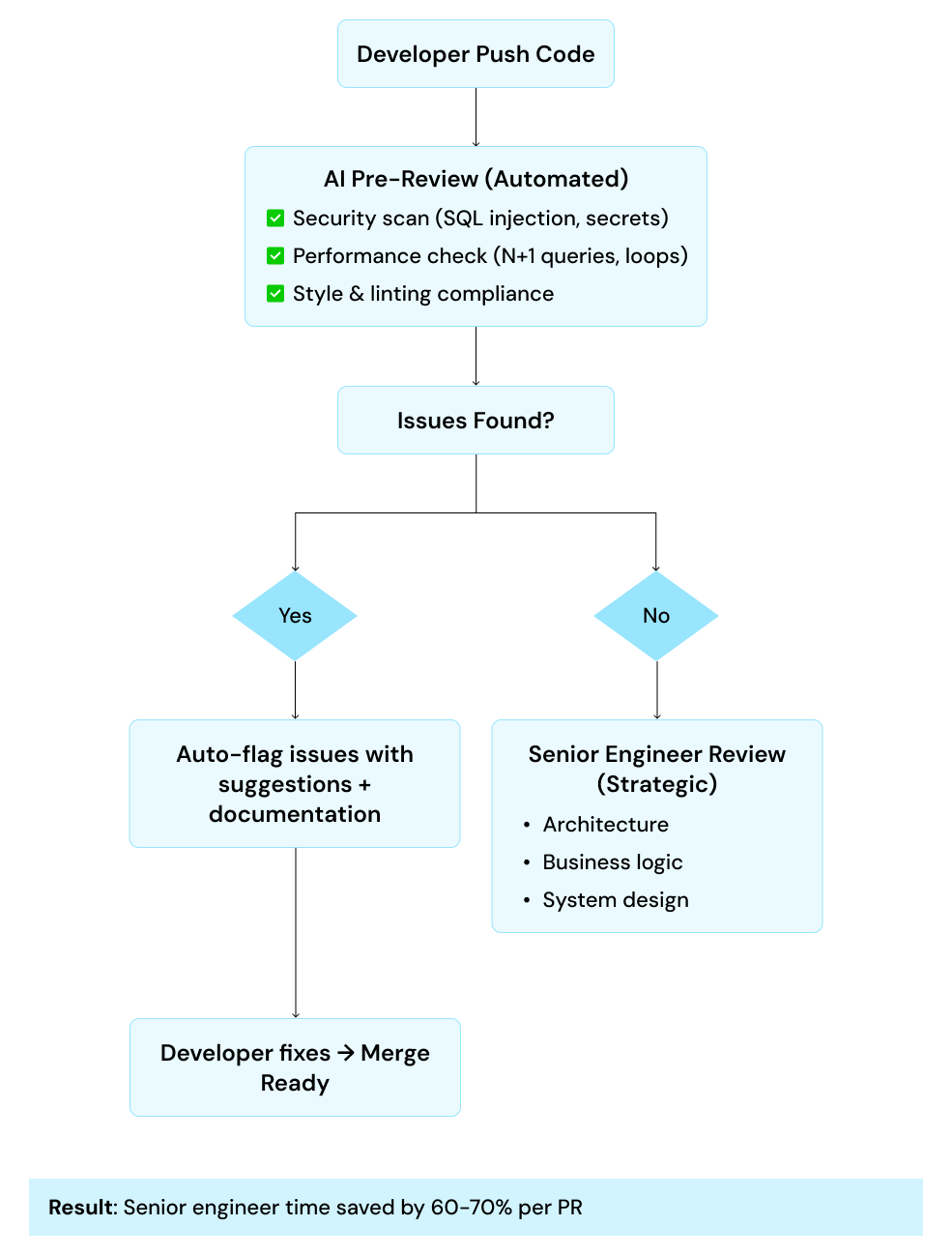
Code reviews and testing are engineering's guardrails, but they are also significant bottlenecks. A Senior Engineer may spend hours examining pull requests (PRs) for small syntax problems or style violations, which could be spent on architectural design.
The "New" Code Review
AI agents can now serve as the "first line of defense" during code reviews. Before a human looks at a PR, an AI can scan the changes for:
Security Vulnerabilities: Detecting SQL injection risks and hardcoded secrets
Performance Anti-patterns: Detecting nested loops and wasteful database searches
Style Compliance: Ensuring the code follows the team's linting requirements
This automated layer of engineering efficiency with AI means senior engineers focus only on architectural decisions, not formatting issues.
Revolutionizing Testing
Writing unit tests is commonly referred to as "eating your vegetables" necessary but rarely enjoyable. AI is fundamentally altering this dynamic.
Test Case Generation: You can highlight a difficult function and instruct an AI to "write a Jest test suite for this function, covering edge cases like null inputs and negative integers." What previously took 30 minutes now takes 3 minutes.
Visual Regression Testing: In frontend development, machine learning-powered technologies can compare screenshots of a user interface before and after a code change. Unlike pixel-perfect matchers, which break with little modifications, ML models can "see" like a human, avoiding rendering noise while detecting true layout violations (for example, a button overlapping text). This is crucial during Software Product Development cycles where UI consistency matters.
3. How AI Keeps Technical Documentation Updated Automatically
Key takeaway: AI eliminates documentation debt by auto-generating and updating technical docs, reducing the time senior engineers spend answering repetitive questions.
There's an old engineering joke: documentation is like floss. Everyone understands how vital it is, yet no one does enough. Outdated documentation is a major source of technological debt. When a senior engineer retires, their expertise frequently goes with them because the wiki hasn't been updated in six months.
AI as the Scribe
AI/ML models excel in summarizing. Here's what this means for reducing manual work in engineering teams:
Auto-Doc Generation: Tools may now scan a codebase and generate README.md files, API documentation (Swagger/OpenAPI specifications), and inline comments. This happens continuously, not as a quarterly project.
"Explain This Code": When a young engineer comes across a legacy "spaghetti code" function written five years ago, they can highlight it and request that an LLM explain what it performs in plain English. This significantly reduces the "mean time to understanding" for new employees often cutting onboarding time from weeks to days.
The efficiency boost is clear: by automating documentation, you ensure that your "knowledge base" remains in sync with your codebase. This reduces the number of times senior engineers are interrupted with questions like, "How does this API work?"
Documentation Automation Benefits
Before AI Documentation:
Docs updated quarterly (if at all)
40% of codebase undocumented
Senior engineers interrupted 8-12 times/day with "how does this work?" questions
New hires take 3-4 weeks to become productive
With AI Documentation:
Real-time documentation updates
95%+ coverage automatically maintained
Interruptions reduced to 2-3 times/day
New hires productive in 1-2 weeks
Self-service knowledge base for the team
ROI Impact: Senior engineer time savings = 15-20 hours/month per team member
4. AIOps: Finding the Needle in the Production Haystack
Key takeaway: AIOps reduces mean time to recovery (MTTR) by detecting anomalies before they become outages and pinpointing root causes across thousands of log lines.
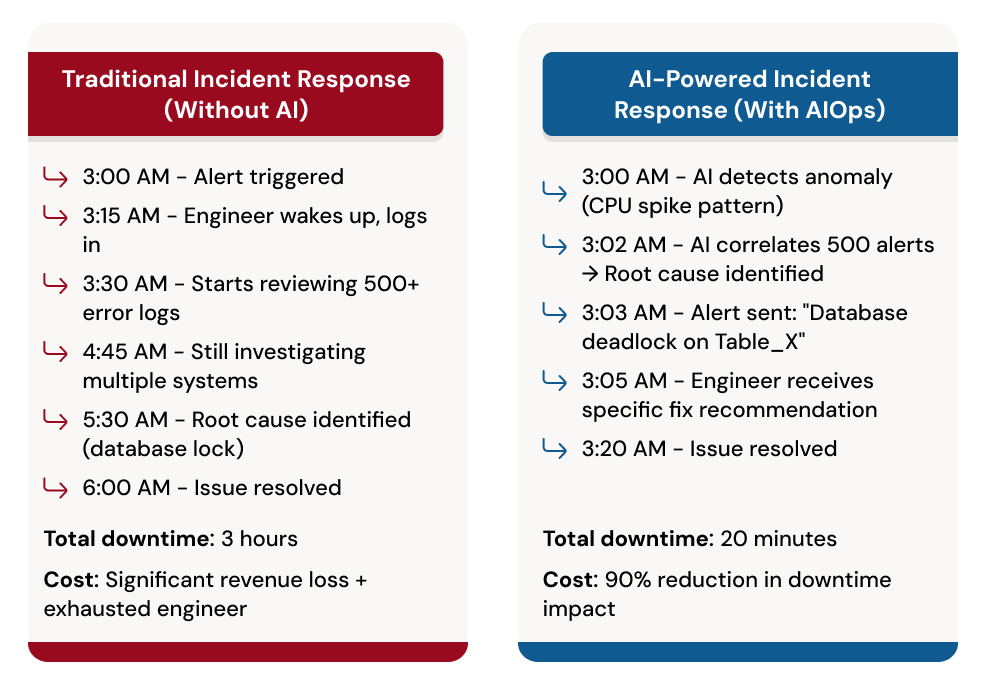
When a production server fails at 3:00 AM, the clock is ticking. Each minute of downtime costs money. The typical method of debugging is a drowsy engineer painstakingly grepping through thousands of lines of log files looking for an error pattern. This is where AIOps (Artificial Intelligence for IT Operations) excels, particularly for teams managing Cloud and DevOps Engineering infrastructure.
Predictive vs. Reactive: How AI Changes Operations
Anomaly Detection: Machine learning algorithms learn the "baseline" behavior of your systems. They understand that CPU use climbs to 80% every Monday at 9:00 a.m. (login rush), and that this is typical. However, if the CPU climbs to 80% on a Sunday at 3:00 AM, the AI detects this as an abnormality and notifies the team before the server fails.
Event Correlation: During a large outage, you may receive 500 warnings from several systems the database is sluggish, the API is stalling out, and the load balancer is sending 500s. A person perceives pandemonium. An AI recognizes a pattern. It can compare these timestamps and tell you, "The database locked up first. The remaining 499 notifications are simply symptoms. Fix the database."
Root Cause Analysis (RCA): Rather than spending four hours looking for the bug, AIOps technologies may direct the engineer to the specific deployment or configuration modification that most likely caused the problem, dramatically lowering Mean Time To Recovery (MTTR). Teams commonly see incident resolution speed improve from hours to minutes.
Key Metrics:
MTTR Reduction: 75-90% faster incident resolution
False Positives: Reduced by 80%
Proactive Prevention: 60% of issues caught before user impact
5. How AI Changes the Engineer's Role: From Writer to Strategic Decision-Maker
Key takeaway: Engineers shift from writing boilerplate code to reviewing AI-generated solutions and focusing on high-level architecture the work that requires human judgment and business context.
The addition of AI to the engineering workflow causes a significant shift in the function of a software engineer.
The Editor Mindset
Previously, an engineer's worth was typically determined by their ability to memorize syntax and build sophisticated logic from scratch. The position is now moving from "writer" to "editor." The AI creates the draft (code, test, and documentation), which the engineer analyzes, refines, and verifies. This transformation is central to modern AI-driven engineering workflows.
Architectural Focus: Where Human Expertise Matters Most
With AI doing the "grunt work," engineers can focus on high-level system design questions that require business context:
How does the microservice scale under peak load?
What is your data retention policy for compliance?
How do we handle failovers between regions?
What security model protects customer data?
This is the task that needs human judgment, corporate context, and inventiveness. AI integration in existing products helps your most costly resources (engineers) to focus on high-value challenges rather than creating boilerplate. This is where strong product engineering services become essential having the right team structure and processes in place to leverage AI effectively.
6. Why AI Alone Isn't Enough: The Product Engineering Foundation
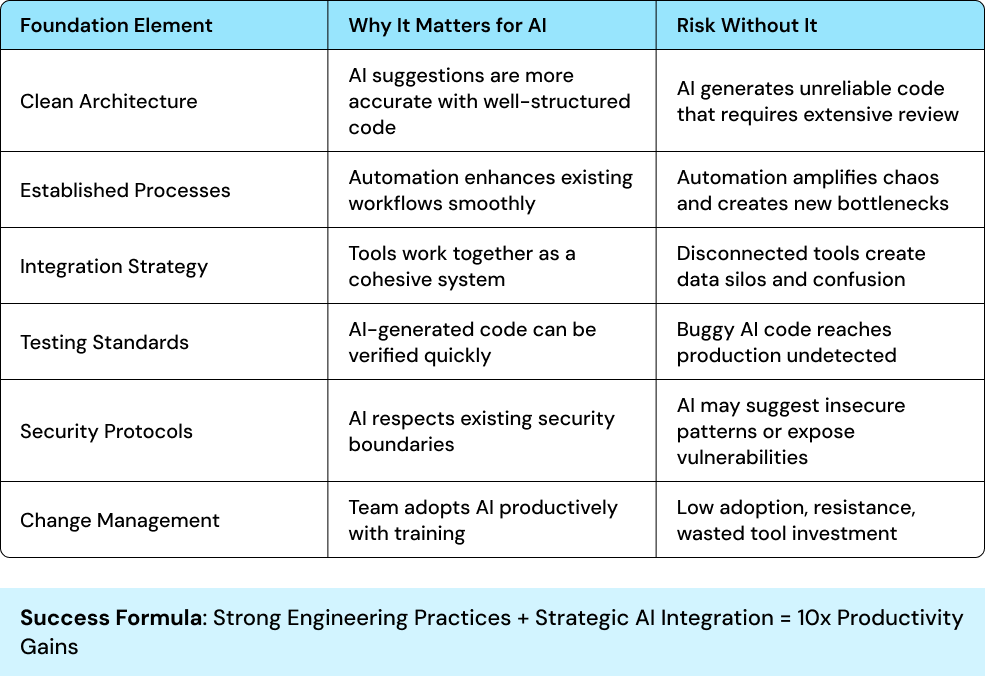
What this means for teams: AI amplifies existing processes if your engineering practices are weak, AI will amplify those weaknesses. Strong product engineering creates the foundation AI needs to succeed.
Many organizations adopt AI tools expecting immediate transformation, only to find mixed results. The reason is simple: AI automation in product engineering requires a solid foundation to be effective.
What Strong Product Engineering Provides
Clean Architecture: AI tools work best with well-structured codebases. Messy, tightly-coupled systems make AI suggestions unreliable and harder to verify.
Established Processes: Automation fails without clear workflows. Teams need defined code review practices, testing standards, and deployment pipelines before AI can enhance them.
Integration Strategy: AI tools don't automatically work together. You need someone thinking about how Copilot, automated testing, AIOps, and documentation tools form a cohesive system.
Change Management: Engineers need training on how to effectively prompt AI, when to trust its output, and how to verify results. This requires Product Strategy & Consulting to align teams.
This is precisely where comprehensive product engineering services add value helping organizations implement AI within a framework that ensures reliability, security, and scalability.
7. Real Challenges: What CTOs Need to Know Before Scaling AI
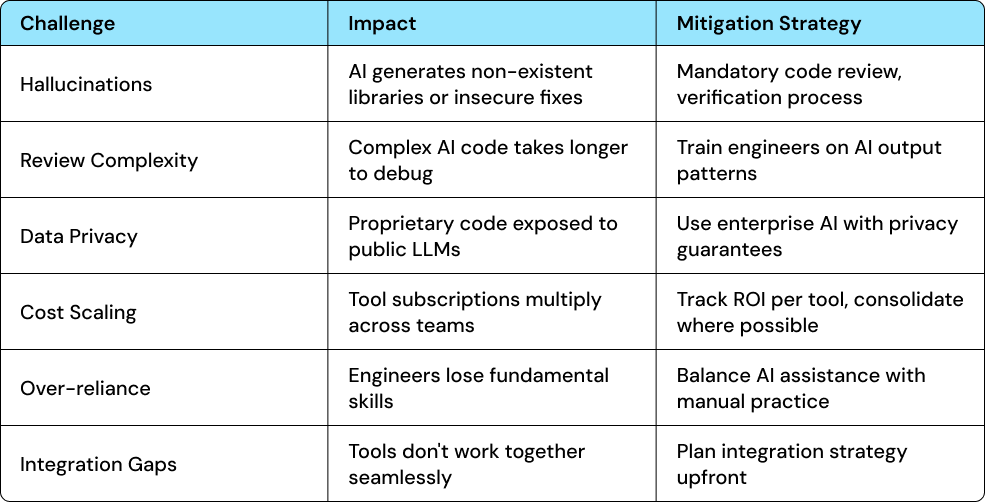
To create a fair picture, we must admit that artificial intelligence is not a magic wand. It presents new problems that IT leaders must manage:
The Hallucination Problem
AI might look confident while being completely inaccurate. It might generate a library that does not exist or offer a "fix" that introduces a security flaw. Engineers must be watchful. You can't simply trust AI output; you have to confirm it. This verification step is non-negotiable.
The "Review Tax"
While generating code is faster, reviewing and debugging AI-written code may take longer, especially if it's complex. Engineers must be able to quickly parse AI-generated code and understand its implications a skill that develops over time.
Data Privacy and Security
Engineering teams must use caution when putting proprietary code or sensitive customer information into public LLMs. Enterprise-grade AI solutions with privacy assurances are required for business use. This becomes particularly critical during AI integration in existing products where legacy systems contain sensitive data.
Cost Management
AI tools have subscription costs that add up across large teams. Leaders need to track ROI and ensure the productivity gains justify the expenses typically they do, but measurement matters.
Industry Impact: How Different Sectors Leverage AI in Engineering
Financial Services
Teams reduce manual testing cycles for regulatory compliance features, cutting validation time from weeks to days while maintaining audit trails.
Healthcare Technology
AI helps maintain HIPAA-compliant documentation automatically, reducing the burden on engineering teams while improving accuracy of security protocols.
HR Technology
Automated testing catches edge cases in complex workflow logic faster, improving reliability of scheduling and notification systems that users depend on daily.
What This Means for Your Engineering Team
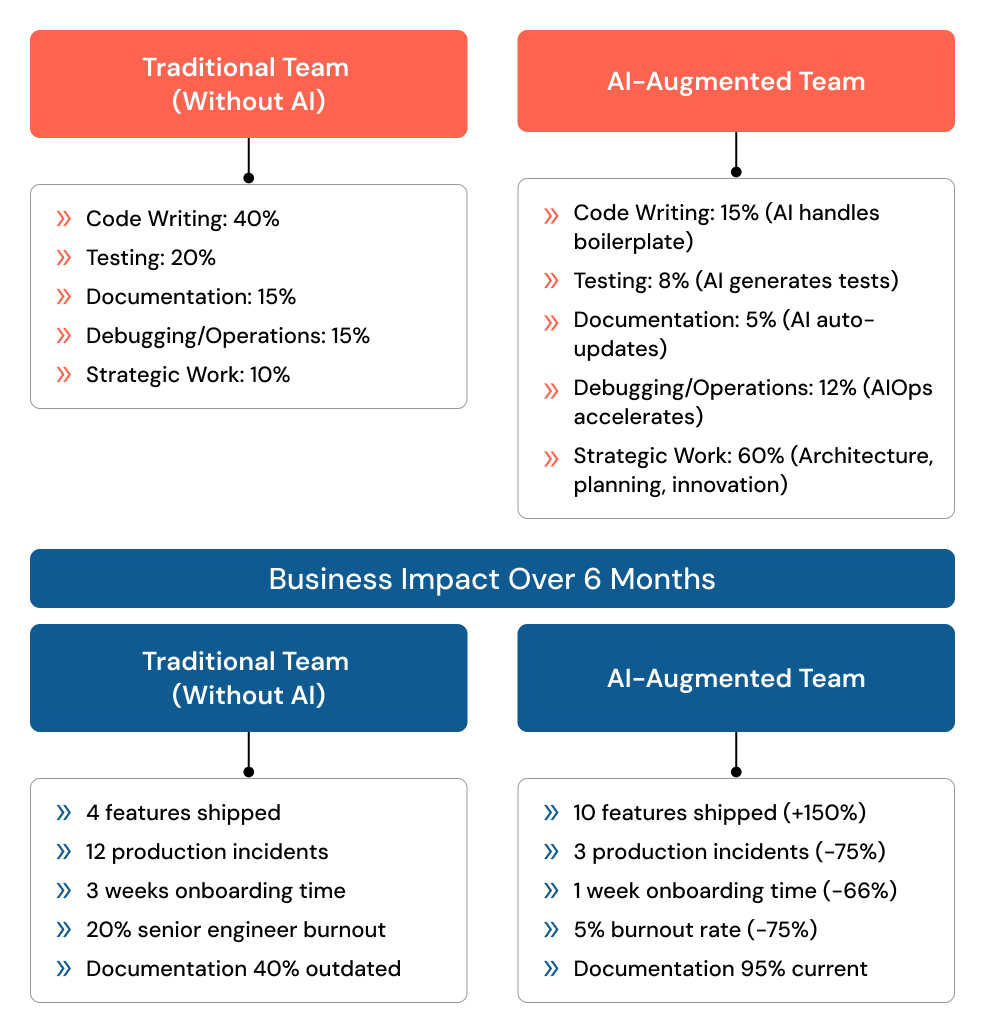
The teams that succeed in the coming years won't necessarily be the ones with the sharpest engineers, but rather the ones who effectively use AI to maximize their engineers' potential through engineering productivity improvement. Here's what typically happens within weeks, not quarters:
Faster onboarding as new engineers use AI to understand existing codebases
Fewer production incidents caught by automated testing and AIOps monitoring
Reduced interruptions to senior engineers for routine questions
More time spent on strategic initiatives like architecture and scalability
The move from "manual builder" to "AI-orchestrator" is well underway. The question isn't whether to adopt AI in your engineering workflow it's how to implement it strategically within strong product engineering practices.
Comparative Impact: Traditional vs. AI-Augmented Engineering Teams
Conclusion: The Future is Hybrid
Integrating AI into your IT team is not intended to replace engineers. It is to replace toil.
By delegating repetitive, laborious, and error-prone activities to machine learning models, you effectively provide a relentless assistant to each developer on your team. This results in happier developers (since they get to work on fascinating challenges), more reliable systems (thanks to AIOps and automated testing), and faster product release cycles.
The path forward requires both AI tools and strong engineering practices. Organizations that combine cutting-edge AI product engineering services with solid foundations in Product Strategy & Consulting, Product Design and Prototyping, Software Product Development, and Cloud and DevOps Engineering will outpace competitors who simply adopt tools without strategy.
Is your team prepared to make this transition strategically?
Ready to leverage AI in your product engineering workflow?
Explore how our product engineering services can help you implement AI automation without disrupting existing systems. Book a discovery call to assess AI opportunities specific to your engineering challenges.
Frequently Asked Questions (FAQ)
1. Will AI replace software engineers?
No. AI is designed to replace toil repetitive, manual tasks not engineers themselves. The role of engineers is evolving from writing boilerplate code to making strategic architectural decisions, reviewing AI-generated solutions, and focusing on problems that require business context and human judgment. AI amplifies engineer productivity rather than replacing their expertise.
2. How long does it take to see ROI from AI tools in engineering?
Most teams see measurable improvements within weeks, not quarters. Initial benefits like faster code generation and automated documentation appear almost immediately. More substantial impacts like reduced production incidents, faster onboarding, and improved team efficiency typically become evident within 2-3 months of consistent use.
3. What's the biggest risk of implementing AI in our engineering workflow?
The biggest risk is implementing AI tools without strong underlying engineering practices. AI amplifies existing processes if your codebase is messy, your testing is weak, or your workflows are chaotic, AI will amplify those problems. The second major risk is over-trusting AI output without proper verification, which can introduce security vulnerabilities or bugs into production.
4. Do we need to replace our entire tool chain to adopt AI?
No. AI tools typically integrate with existing development environments and workflows. Most AI coding assistants work within popular IDEs, automated testing tools plug into existing CI/CD pipelines, and AIOps solutions connect to current monitoring infrastructure. The key is strategic integration rather than wholesale replacement.
5. How do we handle data privacy concerns with AI tools?
For business use, always choose enterprise-grade AI solutions with clear privacy guarantees and data residency options. Avoid putting proprietary code or sensitive customer data into public LLMs. Many enterprise AI tools offer on-premises or private cloud deployment options that keep your data within your security boundaries.
6. What team size benefits most from AI automation in engineering?
Teams of all sizes can benefit, but the impact varies. Small teams (5-15 engineers) gain the ability to ship faster without hiring. Mid-size teams (15-50 engineers) reduce coordination overhead and onboarding time significantly. Large teams (50+ engineers) see massive efficiency gains in code review, documentation maintenance, and incident response. The key is matching AI tools to your specific bottlenecks.
7. Can AI tools work with legacy codebases?
Yes, but effectiveness varies based on code quality. AI tools excel at explaining legacy code to new engineers and can help gradually modernize older systems. However, poorly structured "spaghetti code" may produce less reliable AI suggestions. The best approach is to use AI for understanding and documenting legacy code while gradually improving architecture.
8. How much do AI engineering tools typically cost?
AI tool costs vary widely. Individual coding assistants range from $10-50 per developer per month. Enterprise AIOps platforms can cost thousands monthly depending on infrastructure scale. However, the productivity gains typically justify the investment teams report 30-55% faster development cycles, which far exceeds tool costs in engineer time savings.
9. What happens if the AI generates incorrect or insecure code?
This is why verification remains critical. AI can confidently generate incorrect code, non-existent libraries, or insecure patterns (a phenomenon called "hallucination"). Organizations must maintain code review processes, automated security scanning, and engineer vigilance. AI should be treated as a powerful assistant that requires oversight, not an autonomous system.
10. Do engineers need special training to use AI tools effectively?
Yes, but training requirements are moderate. Engineers need to learn effective prompting techniques, understand when to trust AI output, and develop skills in quickly reviewing AI-generated code. Most teams provide 1-2 weeks of training and best practice documentation. The learning curve is much shorter than learning a new programming language or framework.
11. How does AI automation affect junior engineer development?
This is a balanced consideration. On the positive side, AI helps junior engineers be productive faster and learn from AI-generated examples. However, over-reliance can prevent them from developing fundamental skills. Best practice is to encourage juniors to manually write core functionality first, then use AI for boilerplate and repetitive tasks, ensuring they understand the underlying concepts.
12. What's the difference between implementing AI tools and working with product engineering services?
AI tools provide the technology, but product engineering services provide the strategy, integration, and process design needed to use AI effectively. Product engineering teams help you choose the right tools, integrate them into existing workflows, train your team, establish verification processes, and ensure AI amplifies good engineering practices rather than chaos. It's the difference between buying hammers versus hiring architects who know how to build.
Improve Delivery Speed with AI