


 Updated on 6 February 2026

Healthcare platforms fail not from bad technology, but from treating platform engineering like feature development. When a telehealth provider's patient portal crashes during flu season, or a hospital's EHR integration breaks after a compliance update, the root cause is always the same: engineering decisions were made in isolation from product strategy.
This isn't about building faster. It's about building systems that adapt to regulatory changes, scale with patient demand, and survive technology shifts without full rewrites. Web application development services for healthcare require a fundamentally different approach one that treats compliance, interoperability, and operational resilience as core product features, not afterthoughts.
The distinction matters because most healthcare platforms accumulate technical debt within 18 months. Teams hire software engineering company partners who deliver working code but miss the architectural decisions that determine whether a platform thrives or requires costly rebuilds. The difference lies in product engineering designing systems where business logic, data architecture, and infrastructure decisions reinforce each other.
Why Healthcare Platforms Collapse After Launch
Healthcare platforms rarely fail at launch they fail during step-change growth.
A pediatric network launched a patient engagement platform that handled 50,000 appointments smoothly during beta. Six months later, during flu season, the system couldn't process lab result notifications fast enough. The queue backed up, doctors received outdated alerts, and the platform was pulled offline for emergency refactoring.
The failure wasn't capacity planning. It was architecture. The team had built a monolithic system where scheduling, notifications, and lab integrations all competed for the same resources. When one service experienced load, everything slowed.
Custom healthcare software development company teams encounter this pattern repeatedly: platforms that work beautifully in controlled tests but buckle under real-world clinical complexity. The issue stems from three misconceptions:
Platform engineering requires different thinking than feature delivery. A feature might take two weeks to build, but the architectural decision enabling that feature determines whether your platform can adapt to new regulations, integrate with emerging health devices, or scale to new patient populations.
Compliance isn't a checklist it's operational reality under load. HIPAA certification doesn't mean your platform handles Protected Health Information correctly during peak usage. A mental health platform passed all security audits but logged sensitive session data to an unsecured analytics service during stress tests. The vulnerability only appeared under real-world load conditions.
Clinical workflows expose architectural weaknesses ordinary testing misses. Standard QA validates that a prescription refill button works. Healthcare QA validates what happens when a doctor prescribes medication for a patient with conflicting allergies across three different EHR systems.
The Product Engineering Difference: Decisions That Compound Over Time
When a hospital network needed to connect their telehealth platform to 47 different legacy EHR systems, the initial proposal was straightforward: build custom adapters for each system. It would work. It would also create 47 maintenance points that would break every time a vendor updated their API.
The product engineering services approach looked different. Instead of building adapters, the team implemented a FHIR facade pattern wrapping legacy systems with standardized interfaces. When Epic updated their API, only one adapter needed changes. When the hospital acquired a practice using Cerner, adding support took days instead of months.
This is what product engineering delivers: architectural decisions that reduce future complexity instead of deferring it.
System Design That Anticipates Change
Software product engineering starts with the assumption that requirements will evolve. Healthcare regulations update quarterly. New medical devices enter the market monthly.
| Architectural Approach | Initial Build Time | Adaptation Cost | 3-Year TCO |
|---|---|---|---|
| Monolithic (Traditional) | 6 months | High – full regression testing required for every change | 280% of original budget |
| Modular (Product-Engineered) | 8 months | Low – isolated service updates reduce impact | 140% of original budget |
| Event-Driven (Product-Aligned) | 9 months | Very low – loosely coupled services enable faster changes | 130% of original budget |
The eight-month timeline for modular architecture feels slower initially. But when GDPR requirements changed in year two, the platform updated compliance logic in isolated services without touching clinical features. Competing platforms running monolithic code spent four months in full regression testing.
Infrastructure Aligned with Clinical Operations
A multi-specialty clinic chain used standard auto-scaling: add servers when CPU hits 80%. It worked fine until flu season. Patient check-ins didn't spike CPU usage; they spiked database writes. The platform scaled application servers while the database became a bottleneck.
Cloud engineering services designed for healthcare monitor clinical metrics: appointment completion rates, lab result processing latency, prescription fulfillment times. When immunization appointments surged 300% during a public health campaign, the system scaled database connections and background job processors not web servers.
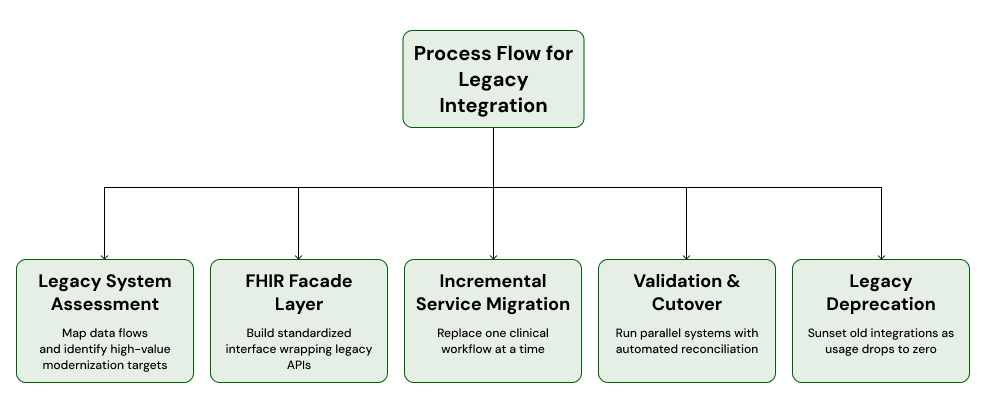
This approach enabled a regional health system to modernize their patient portal while keeping their 15-year-old EHR operational. The Product Strategy & Consulting phase identified that scheduling and lab results were accessed 10x more than other features so those migrated first, delivering immediate value while reducing technical risk.
What Breaks at Scale: Lessons from Healthcare Platform Failures
Most platforms assume linear growth. Healthcare rarely works that way.
A chronic disease management platform handled 100,000 patients smoothly for 18 months. Then a health plan contracted to onboard 500,000 more patients over 90 days. Four weeks later, physicians reported missing medication histories.
The problem: the original architecture assumed patient records were immutable after creation. When the migration team corrected historical data errors, the correction logic didn't account for concurrent access. Updated medication lists sometimes overwrote newer entries.
If your platform is already live and you're experiencing:
Increasing audit friction during compliance reviews
Slower feature delivery despite adding developers
Fear of touching "core" systems because changes break unrelated features
Rising infrastructure costs without proportional user growth
...this is no longer a development problem. It's a product engineering problem.
Data Architecture That Assumes Perfect Interoperability
FHIR is powerful but incomplete. A patient's medication history might exist in FHIR format across three systems, but "Ibuprofen 200mg" appears as:
"ibuprofen 200 MG Oral Tablet" in one EHR
Advil 200mg" in the pharmacy system
IBU 200" in the patient's home monitoring app
When healthcare software development services treat FHIR as plug-and-play, reconciliation breaks.
| Interoperability Challenge | Standard Approach | Product Engineering Solution | Impact |
|---|---|---|---|
| Medication terminology mismatches | Direct FHIR mapping | RxNorm normalization layer | 94% reduction in duplicate medication alerts |
| Lab result unit conversions | Manual provider correction | UCUM standardization with range validation | Zero dosing errors from unit mistakes |
| Patient matching across systems | Exact name and DOB match | Probabilistic matching with MDM | 99.7% correct patient attribution |
The "product engineering solution" column represents architectural decisions made early, during Product Design and Prototyping, that prevent operational failures later.
Building Platforms That Evolve With Healthcare
A hospital system launched a patient portal using a modern tech stack React frontend, Node.js backend, PostgreSQL database, deployed on AWS. It checked every technical box.
Eighteen months later, they needed to add real-time appointment availability from their EHR. The feature required polling the EHR every 30 seconds for 200 provider schedules. The monolithic backend created a new database connection for each poll. Within a week, connection pool exhaustion was causing random failures across unrelated features.
The fix required refactoring to an event-driven architecture where the EHR published schedule changes rather than being polled. But the monolithic design made this a six-month project affecting every service. Software product development services built with product engineering principles would have designed for asynchronous data flows from the start.
How Product Engineering Prevents These Failures
Start with data flows, not features. Before designing the appointment scheduling UI, map how appointment data moves: from EHR to patient portal to reminder service to analytics system. Design your architecture around these flows, ensuring each service can evolve independently.
Build for observable operations. When a physician reports "the portal is slow," engineering teams need to know whether the issue is database queries, third-party API latency, or network problems. DevOps engineering services implement distributed tracing, structured logging, and business metrics that expose the clinical impact of technical issues.
Technical Decisions That Determine Long-Term Viability
The difference between standard web development and product engineering shows clearly in how teams handle the same requirement. Consider: "Add support for patient-uploaded health documents."
Standard Development Approach:
Add file upload endpoint to API
Store files in S3 with encryption
Create UI for upload and viewing
Ship in two weeks
Product Engineering Approach:
Assess clinical workflows: How will documents be accessed during patient record transfers?
Design data model: What metadata enables future AI-powered extraction?
Plan compliance: How long must documents be retained? How do you handle patient data deletion requests?
Consider scale: How do you handle 500MB imaging files versus 50KB lab reports?
The standard approach ships faster but creates technical debt. Six months later, when the platform needs to share documents with specialists outside the health system, files are stored with no standard classification, making selective sharing impossible.
Infrastructure That Supports Clinical Operations
Cloud and DevOps Engineering for healthcare differs from standard DevOps in one critical way: deployments must never interrupt clinical operations.
This requires specific technical patterns:
Blue-green deployments with health validation: Deploy to a parallel environment and route 5% of traffic. Monitor clinical metrics appointment completion rates, prescription processing times, lab result delivery speed. If metrics hold steady for 30 minutes, route more traffic. Any degradation triggers automatic rollback.
Feature flags tied to clinical contexts: A new medication reconciliation feature might work perfectly except for pediatric dosing calculations. Feature flags allow enabling new code for adult medicine while keeping pediatric patients on tested code until edge cases are resolved.
Testing That Catches Healthcare-Specific Issues
QA engineering services designed for healthcare test beyond functionality they validate clinical safety.
| Testing Layer | Standard Web Platform | Healthcare Product Engineering | Why It Matters |
|---|---|---|---|
| Unit Tests | Business logic validation | Clinical rule validation with edge cases | Catches dangerous dosing calculations |
| Integration Tests | API contract verification | Cross-system data reconciliation | Prevents medication duplication across EHRs |
| Performance Tests | Response time under load | Clinical workflow completion under load | Ensures doctors can complete rounds on time |
| Security Tests | OWASP Top 10 scanning | PHI exposure scenarios with audit trail validation | Prevents HIPAA violations in real usage |
Real-World Trade-Offs: When Perfect Architecture Isn't the Answer
Microservices offered perfect isolation and independent scaling. But their engineering team had four developers.
A medical device startup faced a choice: build their patient monitoring platform with full microservices architecture or use a modular monolith. The product engineering decision was modular monolith with clear service boundaries.
Two years later, with 15 engineers and 50,000 patients, they extracted three services appointment scheduling, notifications, and device data processing into independent deployments. The rest remained monolithic because it worked.
This is what software engineering company partners should help you understand: the right architecture depends on team capabilities, timeline constraints, and actual usage patterns, not theoretical best practices.
Migration Strategies That Minimize Risk
Healthcare platforms rarely get clean-slate rebuilds. A regional hospital network needed to replace their 12-year-old patient portal, but physicians had built workflows around specific quirks in the old system.
The Product Strategy & Consulting approach used a strangler fig pattern: build new capabilities around the old system, gradually migrating users as new features proved valuable.
New appointment scheduling launched first (highest user demand)
Secure messaging migrated next (leveraged existing patient identity)
Medication refills followed (required prescription data normalization first)
Health record viewing came last (most complex due to legacy EHR integration)
After 18 months, 85% of users had migrated voluntarily because the new portal worked better.
Infrastructure Modernization Without Rewrites
Cloud engineering services can modernize hosting without rewriting applications. A cancer treatment center ran their research database on dedicated servers with manual backups. Moving to cloud infrastructure provided:
Automated disaster recovery with cross-region replication
Compliance certifications through cloud provider attestations
Elastic scaling during large research data imports
Better security with managed encryption key services
The infrastructure modernization reduced operational overhead by 60% and improved uptime from 99.5% to 99.95% critical when clinical trials depend on data availability.
What Product Engineering Actually Delivers
Software product development for healthcare succeeds when engineering teams understand the clinical context behind technical requirements. When a hospital asks for "real-time lab integration," they're asking for a system where critical lab results trigger clinical workflows automatically and where data quality issues get caught before they affect patient care.
This requires software engineering services that treat healthcare platforms as long-term products:
Architecture that adapts to regulatory changes: HIPAA didn't change substantially for years, then patient data access rules shifted dramatically. Platforms designed with compliance as a feature layer adapted quickly. Those with compliance scattered across code required months of refactoring.
Infrastructure that matches healthcare economics: Video consultations spike during flu season but drop in summer. Lab processing surges Monday mornings. Infrastructure designed for these patterns optimizes costs while maintaining performance.
The ROI of Product Engineering
A pediatric telehealth platform quantified the difference. In year one, built with standard web development practices:
40% of engineering time fixing production issues
$180K on emergency scaling during unexpected demand spikes
6 weeks of development blocked waiting for HIPAA audit remediation
After engaging product engineering services for a platform rebuild, year two metrics shifted:
15% of engineering time on production fixes
$60K infrastructure costs despite 3x user growth
Zero compliance delays (automated checks in CI/CD)
The rebuild took longer initially 9 months versus 5. But total cost of ownership over three years was 35% lower, and the platform could adapt to market changes that competitors couldn't match.
Moving Forward: Questions That Matter More Than Technologies
Healthcare platforms succeed or fail based on architectural decisions made early, often before a line of code is written.
Before starting your next healthcare platform initiative, ask:
How will this platform evolve over the next three years? If your state expands Medicaid, can your eligibility system adapt? If a new medical device standard emerges, can your integration layer support it?
What breaks if we're wrong about usage patterns? If appointment volume doubles, does your architecture scale horizontally?
How do we validate clinical safety before production? What happens when two providers prescribe conflicting medications simultaneously?
These questions define the difference between web application development services that deliver working code and product engineering services that deliver platforms that sustain clinical operations for years.
The choice isn't between moving fast and building right. It's between building with intention or accumulating debt. Healthcare platforms built with product engineering principles ship at reasonable speed but compound value over time.
The healthcare platform market will exceed $549 billion by 2028, but most value will concentrate in platforms that treat compliance, interoperability, and operational resilience as product features not technical constraints.
Partner With Healthcare Platform Experts
AspireSoftServ delivers product engineering services specifically designed for healthcare platforms that must scale securely while maintaining clinical operations. Our approach combines technical depth with healthcare domain expertise from Product Strategy & Consulting through Software Product Development and ongoing Cloud and DevOps Engineering.
We've helped healthcare organizations modernize legacy platforms, launch compliant patient engagement systems, and build interoperability layers that reduce vendor lock-in. Our teams understand that healthcare engineering decisions affect patient outcomes, not just user experience.