


 Updated on 5 March 2026


Scaling a healthcare MVP to serve multiple locations isn't just about adding servers it's about fundamentally rethinking how your product is built. For healthcare founders and CTOs, the architectural decisions you make today determine whether your platform can reliably serve patients across clinics, comply with evolving regulations, and avoid costly rebuilds down the road.
This guide explains what must change in your architecture to support multi-location growth without downtime, compliance risk, or technical debt that slows your ability to innovate.
Why Your MVP Architecture Won't Scale Beyond One Location
Most healthcare MVPs start as monolithic applications focused on proving core value patient registration, appointment scheduling, or basic telehealth functionality. This single codebase approach works well for initial validation with a handful of users at one clinic. However, the moment you expand to a second or third location, architectural cracks appear.
The problem isn't traffic it's coupling. A monolithic setup means every component shares the same database, deployment pipeline, and infrastructure. When one clinic in California experiences a patient surge, the entire system slows down for users in Texas. Adding a new feature for Site B requires redeploying the entire application, risking downtime during peak clinical hours. Without modular design, you're forced to choose between speed and stability a choice no healthcare platform should have to make.
Real-world feedback from early pilots reveals the true pain points: slow page loads during morning check-ins, failed integrations with local EHR systems, and data silos that prevent clinicians from accessing patient histories across locations. These aren't bugs they're symptoms of architectural decisions optimized for validation, not growth. Transitioning from MVP to multi-location platform requires shifting from a prototype mindset to enterprise-grade product thinking.
The Core Architectural Shift: From Monolith to Modular Services
Multi-location healthcare platforms require modular, independently scalable services that replace tightly coupled monolithic architectures. This isn't about adopting buzzwords it's about making your product resilient to growth.
Breaking Down the Monolith with Cloud Native Microservices
The first architectural change is decomposing your application into cloud native microservices. Instead of one large codebase handling appointments, billing, patient records, and notifications, each function becomes its own service. This separation enables independent scaling when insurance billing cycles spike demand, you scale only the billing service without touching clinical modules.
Containerization using Docker packages each service with its dependencies, while Kubernetes orchestrates deployment across multiple sites. This approach, often called cloud architecture, allows you to deploy the same service configuration to clinics in different regions without manual setup. For example, a telehealth service running in Chicago can be replicated to Miami in minutes, not weeks.
Serverless functions complement this model for sporadic tasks like appointment reminders or lab result notifications. You pay only for execution time, reducing idle infrastructure costs by 40-60% compared to always-on servers. This is where Product Design and Prototyping experience matters knowing which services need persistent infrastructure versus event-driven execution prevents over-engineering.
Process Flow: Service Decomposition
Adopting Multi-Tenancy for Cost-Efficient Scaling
Multi-tenancy transforms how your scalable healthcare platform serves different clinics. Instead of deploying separate application instances for each location, one codebase serves all sites through logical isolation. Each clinic becomes a "tenant" with its own data schema or namespace, preventing data bleed while sharing underlying infrastructure.
This architectural choice reduces costs by 30-50% compared to single-tenant deployments. Instead of maintaining 10 separate database clusters for 10 clinics, you maintain one cluster with tenant-specific schemas. Updates deploy once across all locations, eliminating per-site maintenance overhead. For regulated environments, this means one HIPAA compliance audit instead of ten.
The trade-off? Multi-tenancy increases blast radius if isolation is poorly designed. A misconfigured query could expose one clinic's data to another. This is why Product Strategy & Consulting matters experienced product engineers design tenant boundaries at the database and application layer from the start, not as an afterthought.
| Architecture Aspect | Single-Tenant (MVP) | Multi-Tenant (Scaled) |
|---|---|---|
| Data Isolation | Dedicated DB per site | Shared DB with schema separation |
| Infrastructure Cost | High (duplicate resources) | Low (elastic scaling) |
| Deployment Speed | Per-site updates (hours) | Centralized deploys (minutes) |
| Compliance Overhead | Repeated audits per site | Unified controls across tenants |
| Blast Radius Risk | Isolated to one site | Requires strong isolation design |
Infrastructure Evolution: Hybrid Cloud for Healthcare Reliability
Multi-location healthcare solutions require hybrid cloud architectures to balance latency, compliance, and cost. Cloud computing enables the elasticity healthcare platforms need, but not all workloads belong in the public cloud.
When to Keep Workloads On-Premises vs Cloud
Medical imaging processing often stays on-premises due to latency requirements radiologists can't wait 3 seconds for scans to load from distant data centers. However, analytics workloads like population health reporting benefit from cloud-based data warehouses that scale for quarterly analytics without idle infrastructure costs.
Public cloud platforms like AWS and Azure provide auto-scaling groups that provision resources during predictable surges flu season, annual wellness visit campaigns, or telehealth spikes during weather events. A platform with proper cloud scalability for healthcare automatically adds capacity when CPU utilization exceeds 70% and scales down during off-peak hours, maintaining 99.99% uptime without manual intervention.
For true multi-location resilience, deploy across multiple cloud regions. Primary patient data might reside in US-East, with disaster recovery replicas in US-West. This geographic distribution ensures that regional outages don't halt operations across all clinics. The architectural complexity increases, but so does your ability to serve patients reliably exactly what Software Product Development at scale demands.
Data Management: From Single Database to Distributed System
The most critical architectural change for multi-location platforms is evolving your data layer. A single PostgreSQL database that served your MVP won't handle concurrent writes from 15 clinics across time zones.
Implementing a Master Patient Index (MPI)
A Master Patient Index unifies patient identities across locations. When a patient visits Clinic A in January and Clinic B in March, the MPI ensures clinicians see one complete medical history, not fragmented records. Integration happens through FHIR (Fast Healthcare Interoperability Resources) APIs, the healthcare industry standard for data exchange.
Behind the scenes, this requires replacing simple SQL databases with distributed systems. NoSQL databases like Cassandra handle high write volumes thousands of vitals capture per hour across clinics while maintaining consistency. Change Data Capture (CDC) streams ensure updates at one location propagate to others in near real-time.
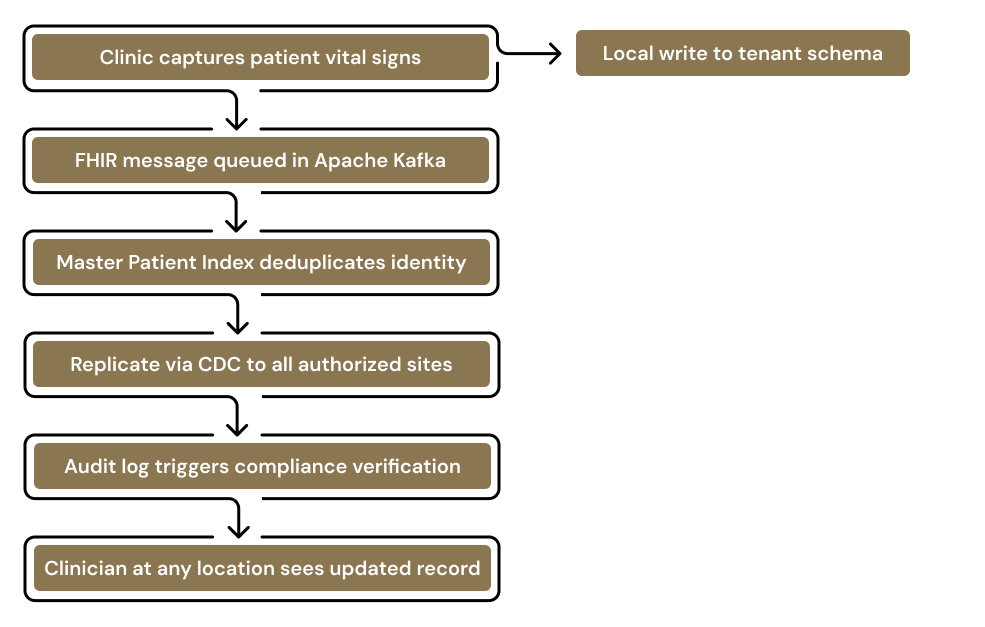
This flow exemplifies healthcare platform scalability distributed writes, centralized identity, and audit trails that satisfy regulators. The architectural complexity is substantial, which is why experienced teams that understand healthcare data governance accelerate implementation by months.
Choosing the Right Database Strategy
Not every dataset needs distributed NoSQL. Appointment scheduling might remain in PostgreSQL with read replicas per region, while patient documents use object storage like S3 with CDN distribution. Modern healthcare software solutions implement polyglot persistence using the right database for each workload rather than forcing everything into one technology.
| Data Type | Database Choice | Reason |
|---|---|---|
| Patient Records | Distributed NoSQL (Cassandra) | High write volume, multi-region access |
| Appointments | PostgreSQL with replicas | Transactional consistency, predictable queries |
| Medical Images | Object Storage (S3) + CDN | Large files, global distribution |
| Audit Logs | Time-series DB (InfluxDB) | Append-only, compliance retention |
| Analytics | Cloud Data Warehouse (Redshift) | Complex queries, historical reporting |
DevOps as Product Architecture, Not Release Process
Too many teams treat DevOps as a release tool rather than a product architecture decision. For healthcare SaaS architecture, DevOps for healthcare software practices must be embedded from the first line of code.
Infrastructure as Code for Consistency Across Sites
Infrastructure as Code (IaC) using Terraform provisions identical Kubernetes clusters across all clinic locations. When you add a new site, you don't manually configure servers you apply a Terraform template that creates networks, load balancers, and compute resources with the same security policies and compliance controls as existing sites.
CI/CD pipelines automate more than deployment. Every code commits triggers automated tests, security scans, and compliance checks. Tools like ArgoCD deploy changes using blue-green strategies new versions run alongside old ones until health checks pass, then traffic switches instantly. If issues emerge, rollback takes seconds, not hours.
For HIPAA-regulated platforms, pipelines include vulnerability scanning and Software Bill of Materials (SBOM) generation. You can't deploy code with critical CVEs or unapproved dependencies the pipeline blocks it. This shift-left security approach catches issues before production, reducing incident response by 70% compared to post-deploy security reviews.
| DevOps Capability | MVP Approach | Scaled Platform Practice |
|---|---|---|
| Build Process | Manual scripts, ad-hoc testing | Automated CI with unit, integration, security tests |
| Deployment | FTP uploads or manual commands | GitOps with Kubernetes rolling updates |
| Monitoring | Basic server logs, reactive alerts | Prometheus metrics + centralized logging (ELK) |
| Security | Post-deployment audits | Shift-left scanning + compliance gates in pipeline |
| Disaster Recovery | Hope and manual backups | Automated DR testing, multi-region failover |
This table shows why DevOps isn't optional it's how modern platforms maintain reliability while moving fast.
Security and Compliance: Architected, Not Added
HIPAA compliant cloud architecture for healthcare services requires encryption at rest (AES-256) and in transit (TLS 1.3), multi-factor authentication for all system access, and zero-trust network policies where no service trusts any other by default. Business Associate Agreements (BAAs) with cloud providers ensure contractual compliance AWS, Azure, and Google Cloud all offer HIPAA-eligible services, but you must configure them correctly.
Multi-location platforms amplify security risks. Network segmentation using VLANs isolates clinic networks from each other and from backend services. IoMT (Internet of Medical Things) devices like smart scales or glucose monitors sit on separate networks with strict firewall rules they can send data to authorized services but can't access patient records or billing systems.
Centralized Security Information and Event Management (SIEM) systems aggregate audit logs from all locations. Anomaly detection flags unusual access patterns like a receptionist account accessing 500 patient records in 10 minutes triggering automated lockouts and security team alerts. These aren't theoretical concerns; the average cost of a healthcare data breach is $10.93 million, with HIPAA violations carrying fines up to $50,000 per record.
Networking for Reliability Across Distributed Sites
Software-Defined Wide Area Networking (SD-WAN) replaces traditional MPLS circuits with intelligent routing. EHR traffic gets prioritized over email, ensuring clinical workflows remain responsive even when bandwidth is constrained. Redundant connectivity primary fiber plus 5G failover means network outages don't halt patient care.
Edge computing brings computation closer to data sources. Patient vital signs captured by bedside monitors are processed locally for immediate alerts, then synchronized to central systems for long-term analysis. This hybrid approach reduces latency while maintaining a complete data record a pattern Cloud and DevOps Engineering teams implement through edge Kubernetes clusters that run the same services as central data centers.
Observability: From Reactive Alerts to Predictive Operations
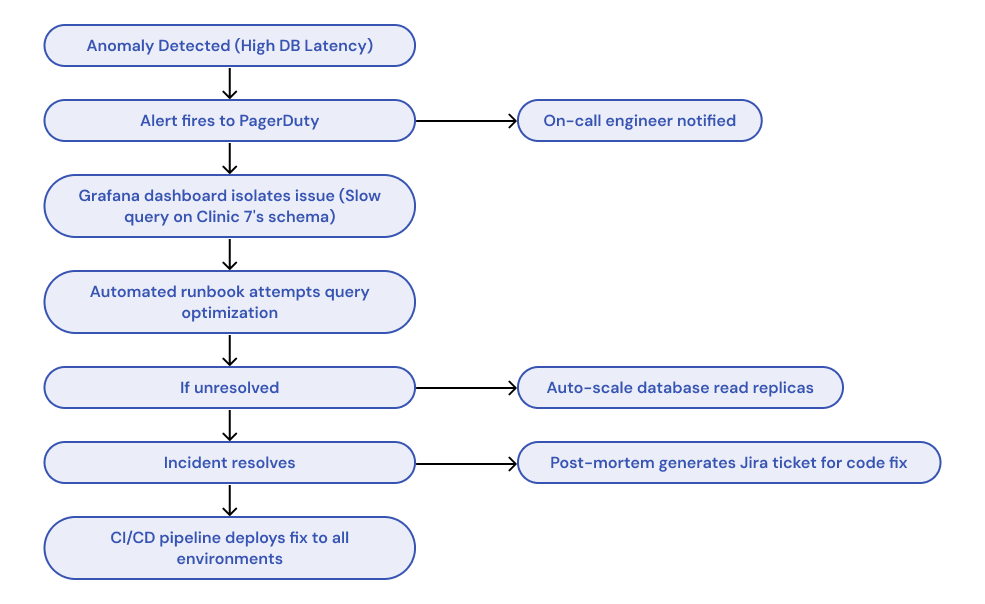
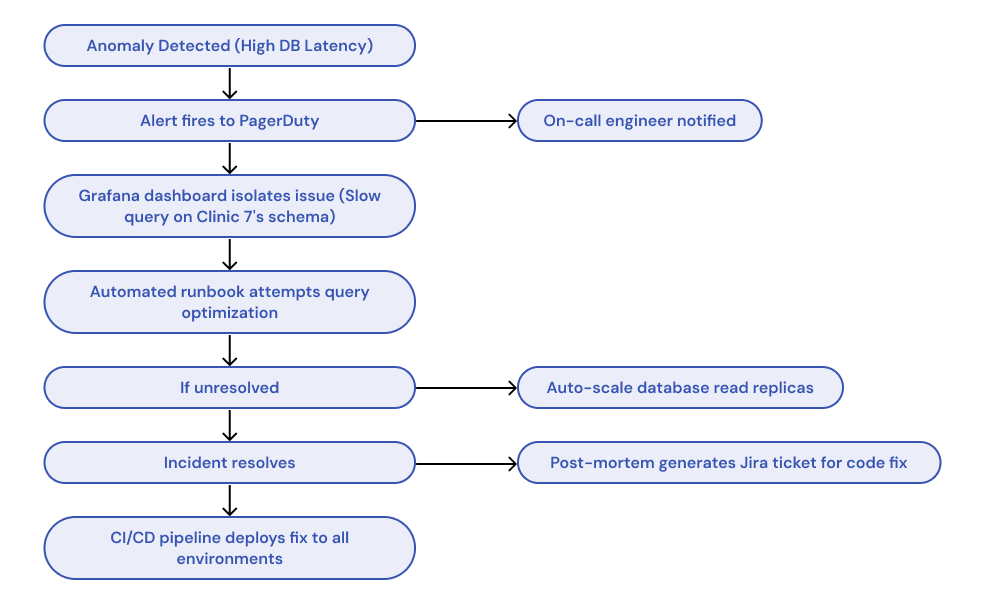
Full-stack observability tracks more than server uptime. Prometheus collects metrics on the four golden signals: latency (response times), traffic (request volume), errors (failure rates), and saturation (resource utilization). Grafana dashboards visualize these metrics per clinic, per service, and per patient workflow.
AI-driven alerting predicts failures before they impact users. When database query times increase 15% over three days, alerts fire before the database crashes. Auto-remediation scripts scale resources or restart failing services without human intervention. This proactive approach reduces mean time to recovery (MTTR) from hours to minutes.
Cost observability matters too. Reserved cloud instances save 40% compared to on-demand pricing for baseline workloads. Auto-shutdown policies turn off non-production environments outside business hours. Tagging resources by clinic enables chargeback reporting, showing which locations drive infrastructure costs critical data for scaling decisions.
Incident Response Process Flow
Real-World Transformation: From Single Clinic to 15-Location Platform
A regional healthcare provider started with an MVP serving one urgent care clinic. As they expanded to 15 locations across three states, their monolithic architecture couldn't keep up. Shared databases caused slowdowns, manual deployments required 4-hour maintenance windows, and compliance audits repeated for each site.
They adopted microservices for scheduling, billing, and clinical documentation. Multi-tenancy reduced infrastructure costs by 45% while maintaining data isolation per clinic. FHIR-based MPI unified patient records, enabling clinicians to see complete histories regardless of which location a patient visited.
DevOps automation cut deployment time from 4 hours to 12 minutes using blue-green deployments. Hybrid cloud kept imaging on-premises for performance while bursting analytics to AWS for seasonal demand. After 18 months, they achieved 99.9% uptime and reduced time-to-market for new features by 80% from concept to production in weeks instead of quarters.
This transformation mirrors what integrated product engineering delivers: products that evolve with business needs rather than requiring complete rewrites.
Choosing the Right Product Engineering Partner
Scaling healthcare platforms demands more than cloud adoption it requires integrated product engineering that balances architecture, compliance, cost, and user experience. The right partner doesn't just build what you specify; they challenge assumptions, propose alternatives, and design for outcomes you haven't anticipated yet.
Look for teams with healthcare domain expertise who understand HIPAA compliance as architectural requirements, not post-launch audits. Strategic consulting should include technology selection that aligns with your three-year roadmap, not just today's features. Implementation must weave security, observability, and DevOps into the product fabric from day one.
Future-Proofing Your Architecture
The healthcare landscape evolves constantly TEFCA interoperability rules, AI diagnostic tools, remote patient monitoring devices. Your architecture must accommodate these changes without fundamental rebuilds. Design APIs with extensibility in mind, maintain separation between core services and integrations, and conduct quarterly architecture reviews to identify technical debt before it compounds.
The difference between an MVP and a multi-location platform isn't scale it's intentional design. Every architectural decision today either expands or limits your options tomorrow. Choose wisely, build deliberately, and partner with teams who understand that great healthcare solutions are products, not projects.
Upgrade Your Healthcare Architecture for Multi-Clinic Growth