


 Updated on 13 February 2026

Healthcare platforms don't fail because of bad technology they fail because DevOps is treated as an afterthought, not as a core capability engineered into the product from day one. When patient records crash during flu season, when telehealth apps go down mid-consultation, or when diagnostic systems bottleneck under routine loads, the root cause is almost always the same: the product was never designed to scale.
This isn't about hiring DevOps engineers after launch. It's about embedding Cloud and DevOps Engineering into Product Strategy & Consulting from the very first architecture decision. Healthcare software operates under unique constraints HIPAA compliance, real-time diagnostics, life-critical reliability and scale failures in this environment don't just cost money. They risk lives.
Key insight: The companies that scale successfully in healthcare share a common trait they don't retrofit DevOps when the platform starts breaking. They engineer it into the product lifecycle before the first line of code is written.
Common Signs Your Healthcare Product Won't Scale
Most healthcare platforms show warning signs long before they catastrophically fail. Recognizing these symptoms early makes the difference between proactive product engineering and expensive crisis management:
EHR response times degrading during peak hours what loads in 2 seconds at 8 AM takes 15 seconds by 2 PM
Manual deployments blocking urgent fixes critical bug fixes wait weeks for scheduled release windows
Compliance audits requiring weeks of preparation HIPAA documentation scattered across wikis, spreadsheets, and tribal knowledge
Infrastructure costs rising faster than actual usage adding servers for every new customer because the architecture doesn't scale efficiently
Performance issues after onboarding new hospitals each facility integration creates new bottlenecks the system wasn't designed to handle
These aren't isolated technical problems. They're symptoms of healthcare software scalability issues baked into the original architecture. A telehealth provider experiencing these patterns spent 18 months building a platform that worked beautifully with 500 concurrent users. During a regional flu outbreak, usage spiked to 8,000 users. The platform collapsed within 36 hours.
Patient appointments were cancelled. Doctors reverted to phone calls. The company lost $2.3M in revenue and faced regulatory scrutiny for HIPAA violations caused by incomplete data backups during the crash. This wasn't a technology failure it was a product engineering failure where DevOps services were never considered during architecture decisions.
When Healthcare Software Hits the Scalability Wall
Healthcare software scalability issues emerge when systems handling electronic health records, real-time diagnostics, or insurance claims processing encounter surging user loads or data volumes they were never architected to support. Monolithic designs create database bottlenecks. Tightly coupled services mean one failing component cascades across the entire platform. Manual deployment processes take weeks when rapid iteration is needed most.
Consider the typical progression: A startup builds an EHR system using a single database instance. It works for the first hospital. Then a health network with 12 facilities adopts it. Suddenly, 40,000 patient records need simultaneous access. Query times spike from 200ms to 18 seconds. Nurses wait for screens to load during patient intake. The CTO realizes the architecture can't be fixed with a patch—it needs to be re-engineered.
Key insight: The hidden cost isn't just the rebuild it's the market opportunity lost while competitors who engineered scalability from day one capture enterprise contracts.
Labcorp's 2019 outage forced thousands of physicians to revert to paper-based diagnostic orders for over a week. Quest Diagnostics experienced similar failures. In both cases, the infrastructure couldn't handle routine load variations because scaling wasn't engineered into the original Software Product Development process. Boulder Community Hospital's 10-day EHR outage revealed another pattern: the vendor had rushed implementation without stakeholder input, skipped load testing, and deployed monolithic updates without rollback capabilities.
These aren't isolated incidents. They're predictable outcomes when DevOps engineering services are hired after the crisis instead of integrated during product design.
The Real Cost of Late-Stage DevOps Adoption
| Aspect | DevOps Engineered Into Product | DevOps Added After Launch |
|---|---|---|
| Deployment Speed | Hours via automated testing and CI/CD pipelines | Weeks due to manual processes |
| Infrastructure Scaling | Auto-scaling enabled through cloud-native engineering | Manual provisioning leading to bottlenecks |
| Compliance Verification | Embedded within pipelines using Infrastructure as Code (IaC) | Ad-hoc audits performed after incidents |
| Failure Detection | Real-time detection through lifecycle monitoring and observability | Often discovered by end users |
| Technical Debt | Minimal architecture designed for continuous iteration | Compounding frequently requires platform rewrites |
Robert Wood Johnson University Hospital's EHR implementation degraded care quality because the product was designed around features, not workflows. Physicians spent 40% more time on documentation. Order entry errors increased. The system technically functioned, but the product engineering approach ignored how humans would use it under time pressure.
Key insight: These aren't DevOps failures they're product engineering failures where DevOps capabilities weren't considered during architecture, design, and implementation phases.
Why DevOps Alone Is Not Enough
Here's the uncomfortable truth most vendors won't tell you: implementing DevOps services on top of poorly engineered products accelerates failure, it doesn't prevent it. You can have perfect CI/CD pipelines, pristine Infrastructure as Code, and world-class automated testing but if the underlying product architecture is monolithic, tightly coupled, and database-centric, DevOps just helps you deploy broken code faster.
This is where product engineering services diverge from traditional development. Product engineering asks: "How will this system behave under 10x load?" before writing the first function. It considers data partitioning strategies during database schema design. It maps failure domains during architecture reviews. It simulates compliance scenarios during Product Design and Prototyping, not after regulatory audits fail.
A diagnostics platform processing medical imaging learned this distinction the hard way. They hired a DevOps team to "fix" performance problems. The team implemented continuous integration, containerization with Docker, and automated deployments. Scan processing times improved by 15%. But the core problem remained: the image processing pipeline was synchronous, single-threaded, and coupled to the web application. Under load, the entire system still locked up.
The breakthrough came when they approached it as a Software Product Development challenge, not a DevOps challenge. They re-architected the pipeline as asynchronous microservices, implemented event-driven processing, and separated compute-intensive tasks from API responses. Then they applied DevOps engineering services automated testing of each microservice, CI/CD for healthcare applications that deployed services independently, and Cloud DevOps infrastructure that scaled processing nodes based on queue depth.
Result: 71% reduction in scan processing time, but more importantly, the system could now handle 5x load without degradation. That's the difference between DevOps as a service and DevOps as an engineered product capability.
Designing Products for Scale From Day One
Key insight: Scale-ready cloud native healthcare applications don't emerge from adding infrastructure later they're designed around three non-negotiable principles that inform every architecture decision, technology choice, and Product Strategy & Consulting conversation.
Principle 1: Infrastructure Is Code, Not Configuration
When a hospital system asks for an EHR deployment, the question isn't "which servers do we need?" It's "how do we define infrastructure that can be replicated across 50 facilities with zero configuration drift?" Infrastructure as Code using tools like Terraform means every environment development, staging, production is provisioned from the same source. When a compliance audit requires infrastructure documentation, you point to the Git repository. When disaster recovery requires rebuilding the entire stack, you run a script.
A regional health network implemented this approach across seven hospitals. When they acquired three more facilities, environment provisioning that previously took IT teams six weeks per site dropped to 4 hours. More critically, security configurations that varied across hospitals creating compliance gaps became identical because they were defined in code, not spreadsheets.
Principle 2: Deployment Is Continuous, Not Event-Based
Cloud native healthcare applications treat deployments as routine, not milestones. When a bug fix or feature enhancement is ready, it moves through automated testing (unit tests, integration tests, security scans), gets validated in staging with production-like data, and deploys to production within hours. If something breaks, rollback is instant because the previous version is one command away.
A telehealth platform that previously scheduled monthly "release windows" transitioned to continuous integration and deployment. Cycle time from code commit to production dropped from 28 days to 4 hours. More importantly, when a critical video connection bug surfaced, the fix was in production within 90 minutes instead of waiting for the next release window while patient consultations failed.
Principle 3: Observability Is Built-In, Not Bolted-On
Systems don't just need to work they need to explain why they're working or why they're failing. Healthcare application performance engineering means every service emits metrics, logs, and traces from day one. When response times degrade, ops teams see which database query slowed down, which API dependency timed out, which microservice is consuming excessive memory.
The Product Engineering Lifecycle That Prevents Scale Failures
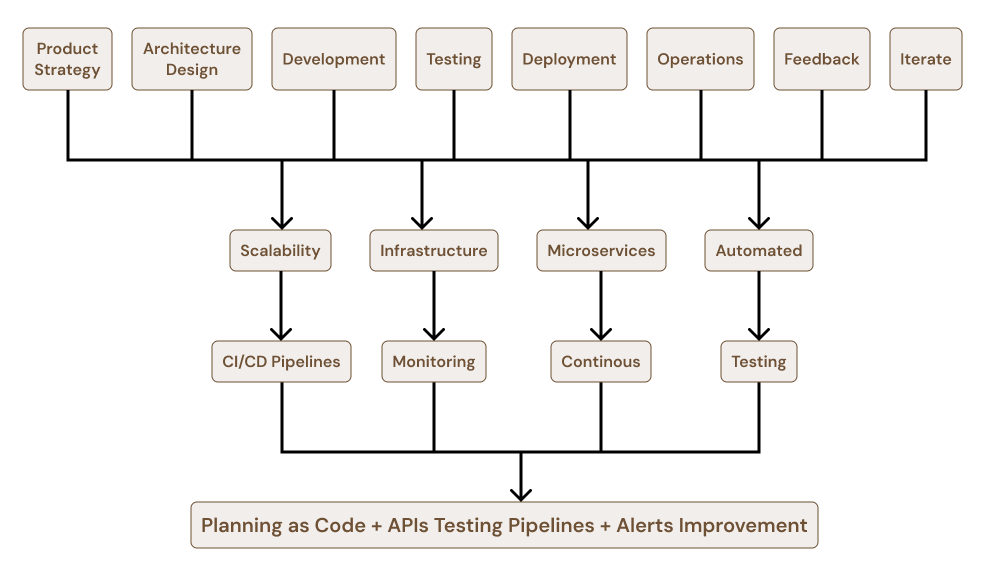
Key insight: Scale-ready product engineering isn't linear it's a cycle where operational insights inform architectural improvements, which enable better features, which generate feedback that drives the next iteration. This is the DevOps lifecycle integrated into product engineering services, not layered on top of them.
Phase 1: Strategy With Scalability Constraints
During Product Strategy & Consulting, the conversation must include questions most early-stage discussions avoid: What happens when we have 100x current users? Which components will become bottlenecks first? How do we partition data for compliance and performance? What's our disaster recovery requirement? How do we deploy across multiple regions?
A healthcare payments platform asked these questions before writing code. They chose multi-tenant architecture with data isolation, event-sourced transaction logs for auditability, and geographic replication for disaster recovery. When they scaled from 50,000 to 2 million transactions monthly, the architecture absorbed the load because those constraints shaped the original design.
Phase 2: Design With Deployment in Mind
Product Design and Prototyping for healthcare must simulate operational reality. This means load testing during prototyping, not after launch. Database schema designed for read replicas and sharding. API contracts that support versioning without breaking clients. Security controls embedded in architecture, not added to code.
Phase 3: Development With Continuous Integration
Software Product Development where developers merge code multiple times daily, automated testing runs on every commit, and integration issues surface within minutes rather than during quarterly QA cycles. This is continuous integration as a product engineering discipline, not an operational afterthought.
Real-World Transformation: From Weeks to Hours
| Metric | Before DevOps-Engineered Product | After Integration |
|---|---|---|
| Deployment Frequency | Every 3–4 weeks | Multiple times daily |
| Scan Processing Capacity | ~12,000 per month with processing delays | 38,000+ per month with <2s response time |
| HIPAA Audit Preparation | Six weeks of manual documentation and evidence collection | Automated using Infrastructure as Code (IaC) |
| Incident Response | 4+ hours to identify root cause | ~12 minutes with built-in observability |
| Infrastructure Scaling | Manual provisioning requiring 2–3 days | Auto-scaling via cloud-native engineering |
A healthcare diagnostics company processing medical imaging faced mounting pressure. Manual deployments took weeks. Compliance documentation was scattered across wikis and spreadsheets. Under seasonal load variations, their infrastructure couldn't scale fast enough.
They partnered with DevOps engineering services focused on product engineering services, not just operations. The transformation integrated Infrastructure as Code using Terraform for reproducible HIPAA-compliant environments across AWS, CI/CD pipelines automating security scans and compliance checks before every deployment, and container orchestration with ECS Fargate enabling automatic scaling based on processing queue depth.
Key insight: The breakthrough wasn't implementing tools it was re-engineering the product to leverage those tools as designed capabilities, not operational band-aids.
Within six months, they processed 38,000+ scans monthly with improved diagnostic accuracy. More importantly, when a hospital network wanted to triple their contract, the platform absorbed the load without architecture changes. That's the return on investing in product engineering services that integrate DevOps in healthcare industry from inception.
Building Products Decision-Makers Can Trust
Healthcare product leaders face a decision: engineer products that can scale, or fix products that break under predictable loads. The difference isn't technical complexity it's approaching product development with DevOps in healthcare industry as a core capability, not an operational add-on.
Key insight: Senior decision-makers don't need DevOps tools explained. They need answers to business questions: When do we need this capability? What happens if we defer this investment? How do we know if our current approach will scale?
The answer depends on where your product is in its lifecycle. If you're pre-launch with ambitious growth targets, engineering DevOps into the product now costs 3-5x less than retrofitting later. If you're post-launch experiencing performance degradation, late-stage DevOps adoption is expensive firefighting that doesn't address architectural constraints.
This guide is for healthcare product teams scaling beyond early traction where reliability, compliance, and speed start breaking down. Where adding engineers doesn't improve velocity. Where infrastructure costs grow faster than revenue. Where customers start asking about disaster recovery, multi-region deployment, and enterprise security compliance.
Those are signals that your product needs product engineering services that integrate Cloud and DevOps Engineering into architecture, not bolt it onto operations.
Who This Approach Is For
This isn't relevant for every healthcare product. If you're building a single-facility practice management tool with 50 users, manual deployments and simple hosting may suffice. But if you're in any of these scenarios, DevOps-engineered product development becomes critical:
Growing SaaS platforms adding enterprise healthcare customers with strict compliance requirements
Telehealth providers experiencing unpredictable usage spikes that crash systems during peak demand
Diagnostic platforms processing increasing imaging volumes where delays impact patient care
Health data aggregators integrating multiple sources where data consistency and performance are critical
Medical device software requiring FDA validation and reproducible deployment processes
The common thread: these products face consequences when they break. Not just lost revenue regulatory violations, patient safety risks, and market credibility damage that can't be easily repaired.
Moving from ad-hoc DevOps to engineered product capabilities follows a progression:
Step 1: Assess Current State
Audit your architecture for scalability constraints, deployment bottlenecks, and operational risks. Most teams discover the issues aren't where they expected.
Step 2: Define Scale Requirements
Quantify what "scale" means for your product. Is it 10x users? Multi-region deployment? Sub-second response times under load? Real requirements inform architecture decisions.
Step 3: Engineer Infrastructure as Code
Transition from manual configuration to Infrastructure as Code. Start with staging environments to validate the approach before touching production.
Step 4: Implement Continuous Integration
Build CI/CD pipelines that automate testing and compliance checks. This often reveals code quality issues that manual QA missed.
Step 5: Establish Observability
Instrument services with metrics, logs, and traces through healthcare application performance engineering. You can't optimize what you can't measure.
Step 6: Iterate Based on Data
Use operational metrics to guide product improvements. The DevOps lifecycle becomes a feedback loop that strengthens the product with every iteration.
Key insight: Companies that execute this transition successfully treat it as Software Product Development, not an infrastructure migration. They involve product teams, not just DevOps engineers. They align architectural changes with business goals, not just technical metrics.
The Future of Healthcare Product Engineering
What is DevOps-Engineered Product Development?
A product engineering approach where deployment, scalability, compliance, and reliability are designed into architecture during Product Strategy & Consulting and Product Design and Prototyping not added after launch as operational fixes.
Healthcare platforms that scale successfully in the next decade will share a common trait: they engineer for change, not stability. They assume usage patterns will shift, compliance requirements will evolve, and technologies will advance. Products designed for one fixed state break when reality changes.
This means cloud native healthcare applications with architecture that supports migration between cloud providers, deployment models that enable edge computing for IoT medical devices, and AI/ML pipelines that improve without requiring product rewrites. It means architecting for regulatory changes like FHIR interoperability mandates or data residency requirements during Cloud and DevOps Engineering phases.
But the foundation remains the same: integrate DevOps capabilities during Product Strategy & Consulting, implement them during Product Design and Prototyping, and refine them throughout Software Product Development. The tools and platforms will change. The principle engineer for scale from inception remains constant.
Moving Forward
Healthcare products break at scale because engineering teams treat DevOps as infrastructure work, not product work. They add DevOps services when systems fail, instead of integrating DevOps engineering services when products are designed.
The companies capturing enterprise healthcare contracts aren't the ones with the most features. They're the ones whose platforms handle enterprise loads without degrading, whose compliance documentation is automated and accurate, whose deployments don't cause outages, and whose architectures absorb change without requiring rewrites.
That capability doesn't come from hiring DevOps teams after launch. It comes from Software product engineering services that design DevOps into the product lifecycle from day one during strategy, architecture, development, testing, and operations. It requires product engineering services that understand healthcare constraints, Cloud engineering services that optimize for compliance and cost, and automated testing that validates every change before it reaches production.
Key insight: If your healthcare product is scaling beyond early traction, experiencing performance issues under load, or preparing for enterprise contracts with strict compliance requirements, the question isn't whether to invest in DevOps-engineered product development. The question is whether you invest now when it prevents failures, or later when it becomes expensive crisis management.
Planning to scale a healthcare product in the next 6-12 months? A product engineering services assessment can reveal where DevOps gaps will break your platform and how to engineer solutions before they become problems.