


 Updated on 29 April 2026

Who This Is For: CTOs and Product Leaders at US-based healthcare platforms payer, provider, or digital health planning AI integration, scaling beyond 100K+ users, or modernizing legacy systems built on outdated processing assumptions.
Not a priority yet if: You're still in MVP stage with no real user load. Come back when you're approaching scale.
In one line: Real-time = instant processing for critical clinical decisions. Batch = scheduled processing for large-scale accuracy and efficiency.
Why Healthcare Systems Become Slow and Expensive
Most healthcare system scalability issues don't start with bad engineering. They start with the wrong architectural assumption made early and compounded over time. In fact, most product engineering services engagements for healthcare clients trace performance failures back to one of three root causes, not code quality.
Three patterns cause this consistently:
Wrong processing model applied to the wrong workflow real-time where batch would suffice, or batch where clinical urgency demands immediacy
Poor data architecture siloed pipelines, inconsistent data formats, and no unified serving layer
No hybrid strategy systems built entirely around one paradigm that breaks under real clinical and operational load
The business impact of ignoring this is concrete:
| Mistake | Business Impact |
|---|---|
| Real-time everywhere | 30–50% higher infrastructure cost |
| Batch for clinical alerts | Patient risk, compliance exposure |
| No hybrid strategy | Scaling bottlenecks, failed AI rollouts |
| Deferred architecture fixes | 2–3x higher refactoring cost later |
A 2025 HIMSS report found that 62% of healthcare data breaches are tied to processing lags meaning slow healthcare systems performance isn't just an IT problem. It's a compliance and patient safety risk with direct financial consequences for US healthcare providers.
The Decision That Shapes Everything
In healthcare software development, few architectural decisions carry more weight than how and when you process data. This isn't purely a backend engineering debate it's a product strategy call that directly impacts patient outcomes, compliance posture, and operating costs.
The core principle real-time vs batch processing in healthcare isn't about which model is better. It's about which is appropriate for each specific workflow and what it costs your organization to get that wrong.
The most common failure mode among US payer and provider platforms is defaulting to real-time everywhere because it sounds more capable. The result is healthcare system scalability issues during peak load flu season surges, emergency volumes, large migrations and cloud bills that grow 30–50% beyond projections with no measurable improvement in clinical outcomes.
Understanding the Two Paradigms
Real-time is best for immediate clinical decisions. Batch is best for large-scale processing where accuracy matters more than speed.
Real-time processing handles data as it arrives milliseconds to seconds of latency. It's event-driven, always-on, and resource-intensive. The right choice when delay directly affects a clinical decision or patient safety outcome.
Batch processing collects data in scheduled chunks and processes them in bulk. It prioritizes throughput over speed, runs on lower-cost compute, and is operationally simpler to maintain at scale.
Comparison at a glance:
| Aspect | Real-Time | Batch |
|---|---|---|
| Latency | Milliseconds–seconds | Minutes–hours |
| Throughput | Lower (event-driven) | Higher (bulk) |
| Cost | Higher (always-on) | Lower (scheduled bursts) |
| Fault Tolerance | Complex (stateful) | Simpler (idempotent) |
| Best Fit | Monitoring, alerts, drug checks | Billing, compliance, analytics |
Most healthcare systems operate best with ~80% batch and ~20% real-time workloads. Teams that invert this ratio or skip the analysis entirely pay for it in infrastructure costs and operational complexity.
Real-Time Processing: When Patient Outcomes Depend on It
Use real-time only for patient-critical workflows where delay directly impacts outcomes.
Core Use Cases
Patient monitoring is the clearest case. ICU wearables stream vitals continuously. Any latency beyond one second risks missed arrhythmia alerts or delayed sepsis flags these are the defining real-time data processing use cases in healthcare, and for HIPAA-compliant US health systems, they carry direct regulatory weight.
Drug interaction alerts at the point of dispensing require live EHR queries. A pharmacist checking a prescription against a patient's active medications needs a response in under a second, not after a batch job completes.
Telemedicine platforms process video, biometric feeds, and session context simultaneously. Healthcare AI data processing layered on top anomaly detection; vitals trending depends on stream-level latency to remain clinically relevant.
Conceptual Real-Time Flow:
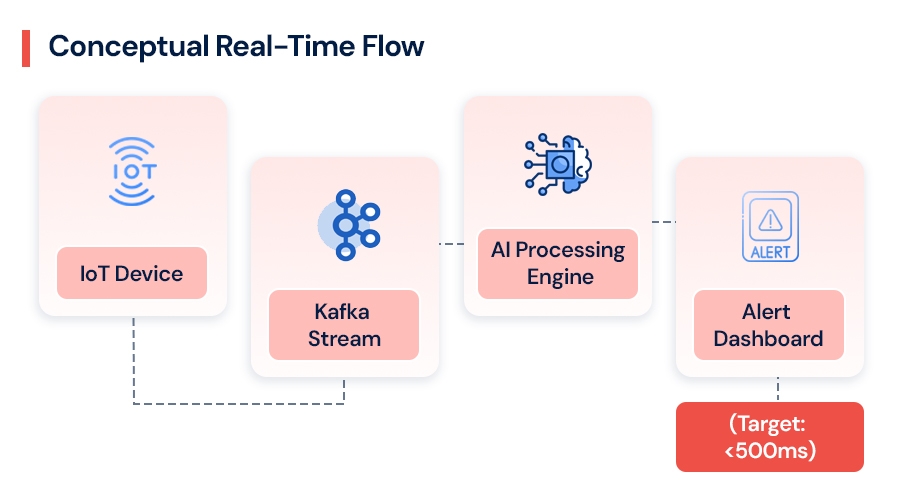
Healthcare predictive analytics also performs best in real-time: ML models on live streams can forecast sepsis onset 30 minutes before standard clinical thresholds trigger, per NEJM research a capability that only exists if the underlying pipeline is stream-based.
Architecture Best Practices
Ingestion: Apache Kafka or AWS Kinesis for durable, high-throughput streams
Processing: Apache Flink for low-latency stateful computation
Storage: Cassandra for hot/active data; S3 for cold archival
The primary operational risk is event storms sudden traffic spikes overwhelming the processing layer. Mitigate with auto-scaling policies and circuit breakers built into the ingestion layer from day one.
Batch Processing: Where Volume and Accuracy Win
Not everything needs to be instant. Forcing real-time onto workflows that don't need it is one of the fastest ways to create unnecessary cost and operational complexity.
Batch processing in healthcare data systems is the right model when completeness and accuracy matter more than speed:
Claims and billing reconciliation Nightly aggregation of millions of transactions where a billing error in a real-time stream is harder to audit than one caught in a structured batch pipeline
Population health analytics Monthly or quarterly cohort studies on de-identified data at petabyte scale, requiring throughput, not latency
HIPAA compliance reporting Scheduled ETL jobs compiling audit trails, access logs, and data lineage for US regulatory review
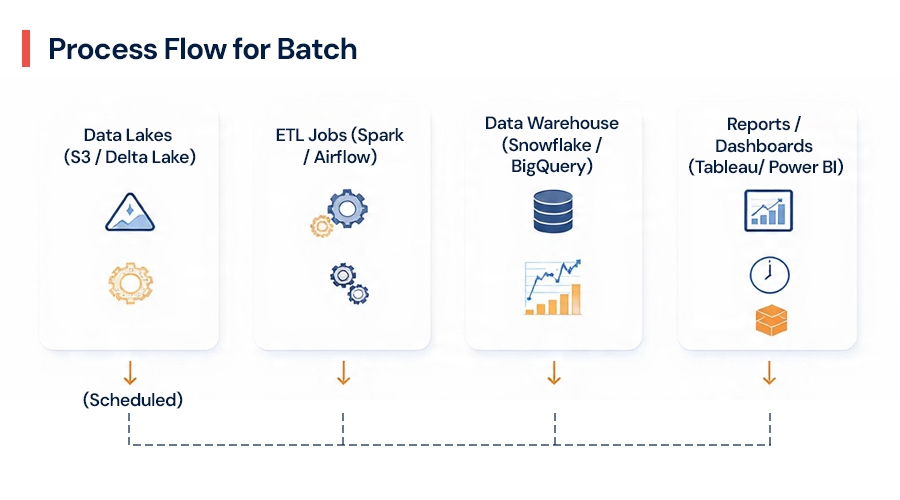
This healthcare data pipeline architecture handles enterprise-scale data engineering at 40–60% lower infrastructure cost than equivalent real-time setups since batch jobs run on spot instances and scheduled compute rather than always-on clusters.
Hybrid Architectures: The Production Standard
Most production healthcare systems use hybrid architecture not purely real-time or batch. Pure paradigms fail under real-world clinical complexity. The question isn't whether to hybridize it's how to structure it correctly.
Lambda Architecture runs both a speed layer (real-time) and a batch layer in parallel, merging results at the serving layer. This delivers low-latency clinical alerts AND accurate historical analytics from the same underlying data.
Kappa Architecture simplifies this by treating everything as a stream, with historical batch runs handled through event log replay operationally cleaner, but requiring more mature stream infrastructure.
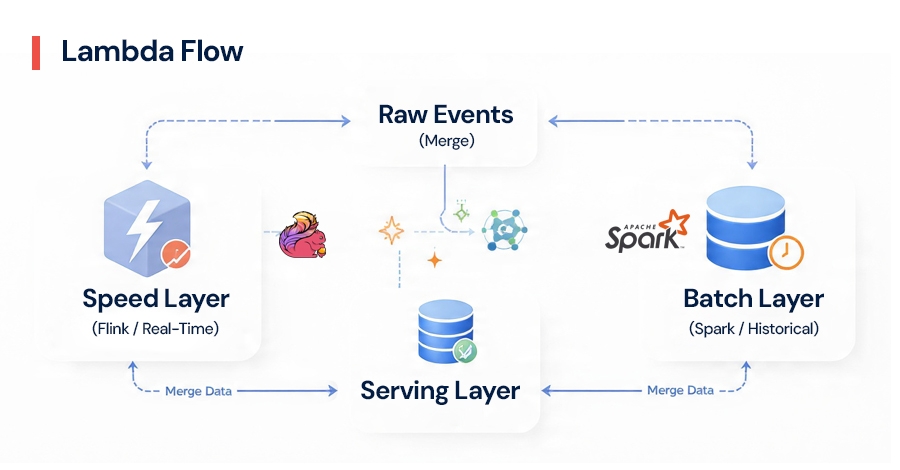
A US hospital chain implemented Kafka for real-time ICU monitoring alongside Spark for nightly population analytics. The outcome: a 70% reduction in data processing delays in healthcare, scaling to 10 million daily events while reducing operational inefficiencies by approximately 30% within the first two quarters.
Real-time analytics in healthcare platforms like Databricks Lakehouse unify both paradigms processing live IoT streams for immediate clinical alerts while running batch pipelines for model retraining and HIPAA-compliant compliance reporting.
The Decision Framework
Simple rule: if delay costs more than processing costs in clinical risk, compliance exposure, or business impact choose real-time. Otherwise, default to batch.
| Decision Factor | Favor Real-Time | Favor Batch |
|---|---|---|
| Latency Tolerance | Zero (life-critical) | High (reporting, audits) |
| Data Volume | Low-to-medium streams | High-volume archives |
| Cost Sensitivity | Lower priority | Higher priority |
| Regulatory Driver | FDA real-time mandates | HIPAA batch audits |
| Complexity Budget | High (stateful systems) | Low (stateless jobs) |
Batch vs Real-Time by Use Case:
| Workflow | Real-Time Fit | Batch Fit |
|---|---|---|
| Vital signs monitoring | Yes | No |
| EHR billing reconciliation | No | Yes |
| Drug trial analytics | Partial | Yes |
| Sepsis prediction | Yes | No |
| Population health reports | No | Yes |
Quick Self-Check: Is Your Healthcare System Using the Wrong Processing Model?
If two or more of these apply to your platform, your healthcare data pipeline architecture almost certainly has a processing model mismatch:
Are lab results or reports delayed by hours when clinicians need them faster?
Are real-time systems driving up cloud costs without measurable outcome improvement?
Are clinical alerts not truly real-time running on batch jobs every few minutes?
Are compliance reports generated from stale or incomplete data?
Does your platform struggle to scale during flu season or emergency demand spikes?
This mismatch compounds over time. Teams that address it before AI integration or a major scaling initiative reduce refactoring costs by 2–3x compared to teams that defer it.
AI and Modern Stacks: Why Architecture Today Determines AI Readiness Tomorrow
The processing model you choose now determines how effectively you can deploy AI later.
For real-time: Edge ML on wearables runs lightweight anomaly detection locally, reducing latency and bandwidth load. Stream-based AI flags deteriorating patients before standard clinical thresholds trigger a capability that requires stream infrastructure as its foundation.
For batch: Large models are trained on historical data genomics, EHR records, imaging datasets using distributed compute. Healthcare predictive analytics for precision medicine and readmission risk management depends entirely on well-structured batch pipelines feeding clean, labeled training data.
Medical software development teams integrating AI need to plan both paths from day one. Key considerations:
Retrofitting AI onto a mismatched pipeline is significantly more expensive than building with AI in mind
Serverless processing (AWS Lambda for event-driven flows) can reduce real-time infrastructure costs by up to 40% for intermittent workloads
US payer and provider platforms planning AI rollouts in the next 12 months should audit processing architecture first not after the AI layer is scoped
If you're planning AI integration or significant platform scaling in the next 6–12 months, fixing the underlying processing architecture now is a prerequisite, not an afterthought.
Implementation Roadmap: From Audit to Production
Most teams can fix processing mismatches in 6–12 weeks depending on system complexity. The roadmap follows four phases:
Phase 1 Assess (Product Strategy & Consulting) Audit current data flows. Map each workflow to its actual latency requirement, volume, and clinical impact. Identify where processing mismatches are creating slow healthcare systems performance or compliance exposure.
Phase 2 Design (Product Design and Prototyping) Prototype the hybrid pipeline. A POC with Kafka and Airflow running in parallel proves the model before full investment and surfaces integration challenges before they become production incidents.
Phase 3 Build (Software Product Development) Leverage healthcare software development services with deep domain knowledge in HIPAA-compliant US healthcare environments. HL7/FHIR integration and clinical workflow requirements are built in not added at the end.
Phase 4 Deploy (Cloud and DevOps Engineering) CI/CD pipelines with Terraform, Kubernetes for auto-scaling real-time tiers, Prometheus and Grafana for observability. Your Cloud and DevOps Engineering layer determines whether the system holds under real clinical load not just in staging.
If you're evaluating this right now, start here:
Audit your top five workflows by latency requirement
Identify where real-time is overused relative to clinical need
Validate hybrid feasibility with a focused POC before full build
Teams that follow this phased approach consistently reduce operational inefficiencies by 20–40% within the first year, with infrastructure cost reductions visible within the first two quarters.
What the Best Healthcare Platforms Have in Common
Mayo Clinic's hybrid architecture combines real-time vitals monitoring with batch genomics processing delivering 25% faster diagnostic turnaround without overbuilding the real-time layer. Epic Systems handles over 2 billion transactions annually on a hybrid EHR backbone, avoiding the healthcare software performance problems that consistently affect legacy platforms locked into a single processing model.
The pattern is consistent across leading US healthcare platforms: no production-grade healthcare IT solution runs purely on one paradigm. The differentiation is in how precisely the boundary between real-time and batch is drawn and how deliberately the architecture is built to evolve as AI, IoT, and regulatory requirements shift.
Frequently Asked Questions
When should healthcare systems use real-time processing?
Use real-time processing when delay in data handling directly affects a clinical decision or patient safety outcome vitals monitoring, drug interaction checks at dispensing, or sepsis prediction. If delay doesn't affect the outcome, batch is almost always more cost-effective.
Is batch processing outdated in healthcare?
No. Batch processing remains the backbone of healthcare data operations billing, compliance reporting, population analytics, and model training all run more efficiently on batch pipelines. The goal is not to replace batch with real-time, but to apply each where it belongs.
What is a hybrid architecture in healthcare data systems?
A hybrid architecture runs both real-time (stream) and batch processing in parallel, serving results from a unified layer. Lambda and Kappa are the two dominant patterns. Most production-grade US healthcare platforms use some form of hybrid architecture to handle the full range of clinical and operational workloads.
How does processing architecture impact AI readiness?
AI models especially those used for predictive analytics or clinical decision support require clean, well-structured historical data (batch pipelines) and low-latency inference infrastructure (real-time pipelines). A mismatched processing architecture is one of the most common reasons AI rollouts stall or require expensive rework.
Architecture Is a Product Decision Not Just an Engineering One
The choice between real-time and batch processing is not a question to delegate entirely to the engineering team. It's a product strategy decision with direct implications for patient outcomes, US compliance requirements, and long-term operating costs and deferring it doesn't make it go away. It makes it more expensive to fix.
Fixing this after scaling or AI rollout costs 2–3x more. The teams that avoid that cost are the ones who audit their processing architecture before the next major initiative not after.
AspireSoftserv partners with US-based healthcare technology teams to design and build custom healthcare software that performs at scale from healthcare data pipeline architecture to clinical AI integration. Our healthcare IT solutions are grounded in real-world production experience across complex payer, provider, and digital health environments.
Optimize your healthcare system architecture today