

 Updated on 15 July 2026

Executive Summary
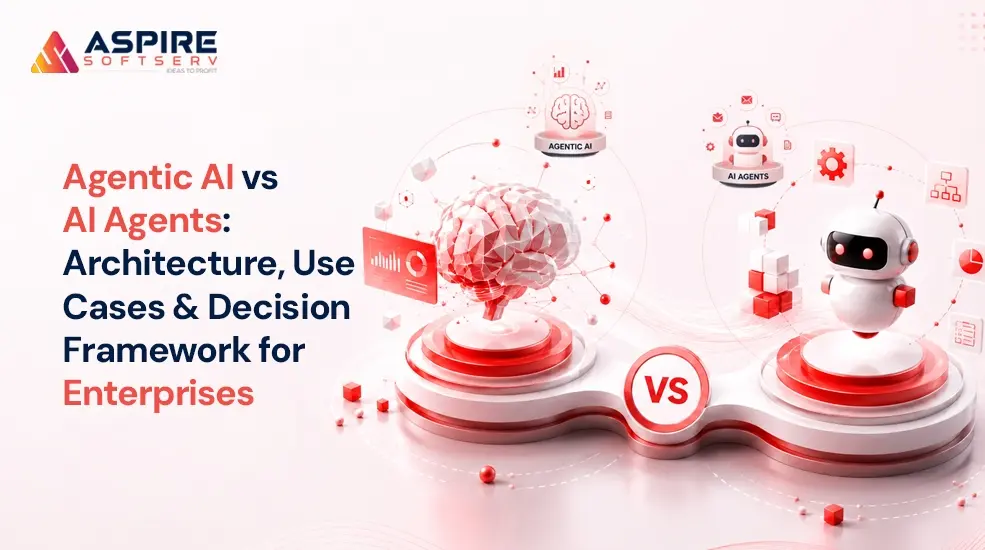
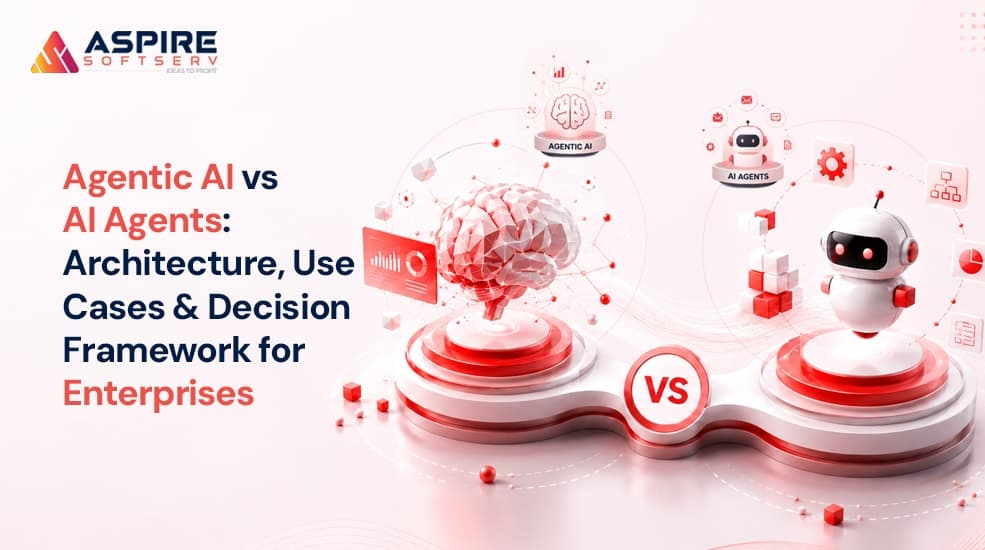
Agentic AI vs AI Agents is one of the most important architectural decisions enterprise CTOs will make in 2026. AI agents and Agentic AI are not interchangeable. AI agents are discrete, task-oriented systems that respond to explicit instructions within pre-defined boundaries, while Agentic AI is the orchestrated system above them a broader architectural paradigm where multiple agents are coordinated to autonomously pursue complex, multi-step business goals without constant human input.
For CTOs navigating a year where Gartner projects 40% of enterprise applications will embed task-specific agents by end of 2026 up from under 5% in 2025 and where CTO confidence in scaling AI has dropped from 82% to 48% in just two years (Akkodis, 2026), understanding this distinction is not academic. It determines your architecture, your governance model, your hiring plan, and the business outcomes your organization can realistically deliver.
A note on the two "40%" stats in this article: You'll see 40% twice, and they measure different things. Gartner's 40% of enterprise apps will embed AI agents by 2026 is an adoption stat. Gartner's separate prediction that 40%+ of agentic AI projects will be canceled by 2027 is a failure-rate stat. Both are real, both are Gartner, and they are not the same number one is about how fast agents are spreading, the other is about how many of the more ambitious agentic builds don't survive.
The Terminology Problem That's Costing Enterprises Millions
Every vendor says "AI agent." Every analyst says "Agentic AI." In boardrooms, architecture reviews, and RFPs across the USA and Canada, the two terms are being used interchangeably to describe everything from a basic chatbot to a fully autonomous multi-agent workflow system. They are not the same thing and the consequences of conflating them are starting to show up in project failures and wasted budgets.
Here is the uncomfortable reality: Gartner predicts that more than 40% of agentic AI projects will be canceled by the end of 2027. The primary causes are escalating costs, unclear business value, and inadequate risk controls. In many cases, organizations built the wrong architecture for the problem they were trying to solve because they never stopped to ask which paradigm they actually needed.
This article draws a clear line between the two. By the end, you will have a working definition of both concepts, an architectural understanding of how they differ, a decision framework for choosing between them, and a practical view of where each one belongs in your technology stack.
Why CTOs Are Confused and Why It Matters
The confusion around Agentic AI vs AI Agents is understandable. The vocabulary around enterprise AI is evolving faster than most organizations can absorb. In 2023, an "AI agent" was a novel concept. By 2025, every SaaS platform was calling its embedded chatbot an "agent." By 2026, Gartner coined a term for this: "agentwashing" the practice of relabeling AI assistants and chatbots as agents without the underlying autonomy to justify the term.
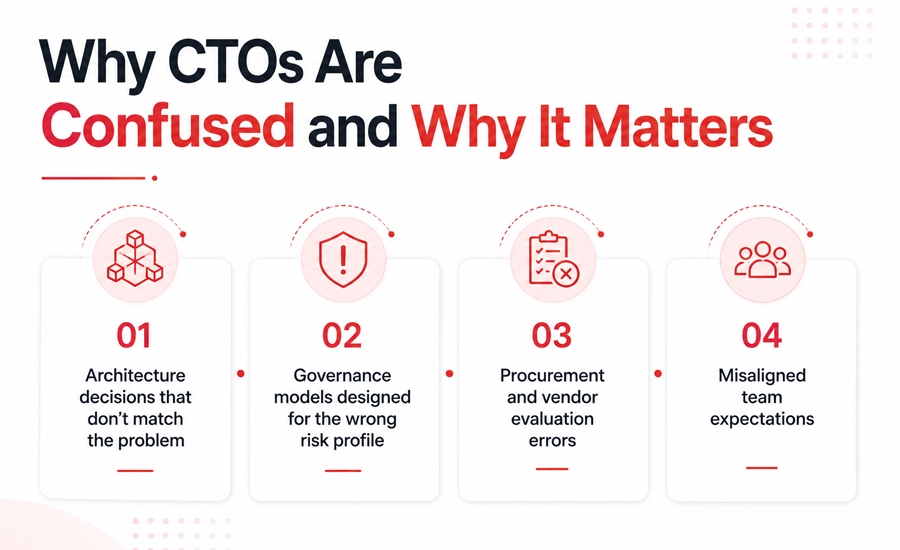
For CTOs and VP Engineering, terminology confusion creates real-world consequences in four areas:
Architecture decisions that don't match the problem: A team that builds a standalone AI agent when they actually need an orchestrated agentic system will hit a wall when the problem scales beyond a single task or system.
Governance models designed for the wrong risk profile: Copilot governance (human reviews every output before action) is inadequate for agentic systems that execute multi-step workflows autonomously.
Procurement and vendor evaluation errors: If your RFP treats "AI agent" and "Agentic AI" as synonyms, you may select a vendor whose capabilities do not match your actual requirements.
Misaligned team expectations: Engineering teams building "AI agents" may be scoped for a narrower problem than what the business actually needs resulting in rework, cost overruns, or pilot abandonment.
A June 2026 IBM study of 2,000 senior technology executives found that two-thirds of CTOs and CIOs report being held accountable for AI systems they do not fully control and only 11% believe they are fully ready for the scale of AI agent deployment expected in the next year. That gap is showing up in governance data too: Deloitte's 2026 State of AI in the Enterprise report found that only 21% of organizations have a mature governance model in place for agentic AI, even as usage scales quickly across the same organizations.
Direct Answer: What Is the Difference Between AI Agents and Agentic AI?
Definition of AI Agent: A discrete, task-oriented system designed to perceive inputs, reason about them, and take actions to achieve a specific goal within defined boundaries. It is reactive, scoped to a single domain, and typically triggered by a user instruction or system event.
Definition of Agentic AI: A broader architectural paradigm in which autonomous systems typically composed of multiple specialized AI agents independently plan, coordinate, adapt, and execute complex, multi-step workflows to achieve high-level business objectives with minimal human oversight.
The cleanest way to understand the relationship: AI agents are the building blocks. Agentic AI is the system that orchestrates them.
Think of it this way: an AI agent is like a specialist contractor highly skilled at one thing, brought in when called upon. Agentic AI is the general contractor that manages the entire project decomposing the goal into sub-tasks, assigning the right specialists, tracking dependencies, handling surprises, and delivering the finished outcome.
Deep Dive: Architecture, Capabilities & Key Differences
How AI Agents Work
At its core, an AI agent operates in a perception–reasoning–action loop:
Perception: The agent receives structured inputs user queries, API payloads, database records, sensor data, or system events.
Reasoning: An LLM or rules-based engine processes the input and determines the appropriate response or action.
Action: The agent execute calling an API, updating a record, returning a response, routing a ticket, or triggering a downstream system.
AI agents are particularly well-suited for tasks that are well-scoped, repeatable, and contained within a single system. Examples include a customer service bot that routes Tier-1 support tickets, a code review agent that flags common violations, or a data validation agent that checks invoice formats against defined rules. The defining characteristic of an AI agent is bounded autonomy it operates within constraints set by its designer.
How Agentic AI Works
Agentic AI introduces architectural capabilities that AI agents operating in isolation do not possess:
Goal decomposition: The system receives a high-level business objective and breaks it into executable sub-tasks deciding what needs to happen, in what order, and with what dependencies.
Multi-agent orchestration: A central planning layer coordinates multiple specialized agents, each responsible for a specific domain (research, execution, validation, communication, etc.).
Persistent memory: Unlike stateless AI agents, agentic systems maintain short-term context (within a task session) and long-term memory (across sessions and agents) to inform decisions.
Adaptive decision-making: If the environment changes or a sub-agent fails, the agentic system re-plans and adjusts rather than stopping and waiting for human instruction.
Tool orchestration: Agentic systems invoke external tools, APIs, databases, and services in coordinated sequences as part of a coherent execution strategy.
We think of this orchestration layer the way infrastructure teams think of Kubernetes for containers it's the layer that makes many moving, specialized parts operable and governable at scale, rather than a pile of point solutions wired together. This architecture enables agentic AI to handle genuinely complex, end-to-end workflows: closing a sales cycle from initial lead qualification to contract generation, managing a multi-stage infrastructure incident from detection to resolution, or coordinating a supply chain exception from identification through vendor communication and purchase order revision.
Side-by-Side Comparison
| Dimension | AI Agent | Agentic AI |
|---|---|---|
| Scope | Single task, single domain | Multi-task, multi-domain, end-to-end goals |
| Autonomy level | Bounded operates within defined rules | High self-plans, self-corrects, self-coordinates |
| Goal origin | Assigned per invocation by a user or trigger | Derived from a high-level objective; decomposed internally |
| Memory | Typically stateless (session-limited) | Persistent short-term + long-term across agents |
| Architecture | Single LLM + tools | Orchestrator + multiple specialized agents + tools + memory |
| Coordination | Operates independently | Coordinates multiple agents and systems |
| Adaptation | Follows defined workflow; limited to scripted exceptions | Re-plans dynamically when conditions change |
| Human involvement | Required per task or trigger | Minimal human defines objective; AI manages execution |
| Governance | Low to medium complexity | High explicit policy, audit trails, access controls required |
| Best for | Repetitive, well-scoped, single-system tasks | Complex, multi-step workflows spanning systems and decisions |
| Example | Ticket routing bot, invoice validator, code linter | End-to-end sales automation, infrastructure incident management |
| Risk profile | Low contained, predictable | Higher unbounded action requires explicit guardrails |
The Spectrum of AI Autonomy
It helps to think of AI autonomy as a spectrum, not a binary:
AI Assistants (Copilots) → Suggest, human approves every action AI Agents → Execute, within bounded, pre-defined scope Agentic AI → Plan, coordinate, execute, adapt autonomously
Understanding Agentic AI vs AI Agents isn't just about terminology it directly influences architecture, governance, operating costs, and long-term scalability. Choosing the wrong approach can result in unnecessary complexity, while choosing the right one helps enterprises deliver faster business outcomes with lower operational risk.
Decision Framework: When to Use Which
Use an AI Agent when:
The task is well-defined, repetitive, and contained within one or two systems
The scope of action is narrow and the risk of an incorrect action is low or easily reversible
You need rapid deployment with minimal infrastructure overhead
The workflow does not require planning across multiple steps or systems
Examples: Tier-1 support ticket triage, invoice validation, SQL generation, calendar scheduling, code documentation
Use Agentic AI when:
The goal spans multiple systems, teams, or decision points requiring coordination across all of them
The workflow requires adaptive decision-making the path to the outcome is not fixed in advance
You need persistent context across sessions or across multiple agents working in parallel
The business value justifies the additional architecture, governance, and operational investment
Examples: End-to-end sales cycle automation, multi-stage incident management, autonomous research and report generation, supply chain exception handling
This is where experienced AI Consulting teams help enterprises evaluate workflow complexity before committing to an architecture that may be unnecessarily expensive.
Decision Matrix
| Scenario | Recommended | Key Reason | Risk of Wrong Choice |
|---|---|---|---|
| Simple, repeated task in one system | AI Agent | Agentic overhead is unnecessary and costly | Overengineering; delayed time to value |
| Multi-step workflow, multiple systems | Agentic AI | Orchestration and memory are required for coherence | Fragmented execution; manual re-coordination |
| Unknown path; adaptive logic needed | Agentic AI | Static agents cannot re-plan mid-workflow | Brittle automation that fails at edge cases |
| High-volume, narrow, low-risk automation | AI Agent | Simpler governance; faster to scale | Unneeded governance complexity |
| Sensitive data, high-stakes decisions | Human-in-the-loop + AI Agent | Risk management requires human oversight at each step | Uncontrolled autonomous action on critical data |
| Complex analysis across multiple domains | Agentic AI (multi-agent) | Parallel specialized agents with shared memory outperform single agents | Single-agent bottleneck; context window limits |
Real-World Use Cases in 2026
AI Agent Use Cases (Production-Ready Today)
These are illustrative patterns we see repeatedly in the field not sourced industry statistics, but representative of how well-scoped agents get deployed in production:
Customer Support Triage: Agents handling Tier-1 queries, refund requests, and escalation routing, letting support teams redirect time away from repetitive tickets and toward complex cases.
Code Quality Agents: Agents that lint, review, and document code within CI/CD pipelines are embedded in the workflows of engineering teams across SaaS and FinTech.
Finance Automation: Invoice processing, expense validation, and GL-coding agents are a common first agentic deployment for mid-market finance teams looking to shorten close cycles.
HR/HCM Screening: Candidate screening agents that parse CVs, score against job criteria, and schedule interviews are one of the most widely adopted agent use cases in HCM organizations today.
For HCM leaders specifically: the highest-value entry point is rarely the screening agent alone it's connecting screening, scheduling, and pre-boarding compliance checks into one governed workflow, so a candidate's data and status move automatically between systems instead of through manual handoffs. See our HCM software development work for how this fits into a broader HR tech stack.
For Healthcare leaders specifically: AI agents are gaining traction in prior-authorization status checks, claims-status lookups, and appointment scheduling narrow, well-bounded tasks where HIPAA-scoped data access and full audit trails matter as much as the automation itself. Explore our healthcare software development practice for how we approach compliance-first agent design.
For Fintech leaders specifically: transaction-monitoring and KYC/AML document-verification agents are common early deployments, precisely because they're bounded, auditable, and reversible the profile this article describes as ideal for an AI agent rather than a full agentic system.
Agentic AI Use Cases (2026 Frontier)
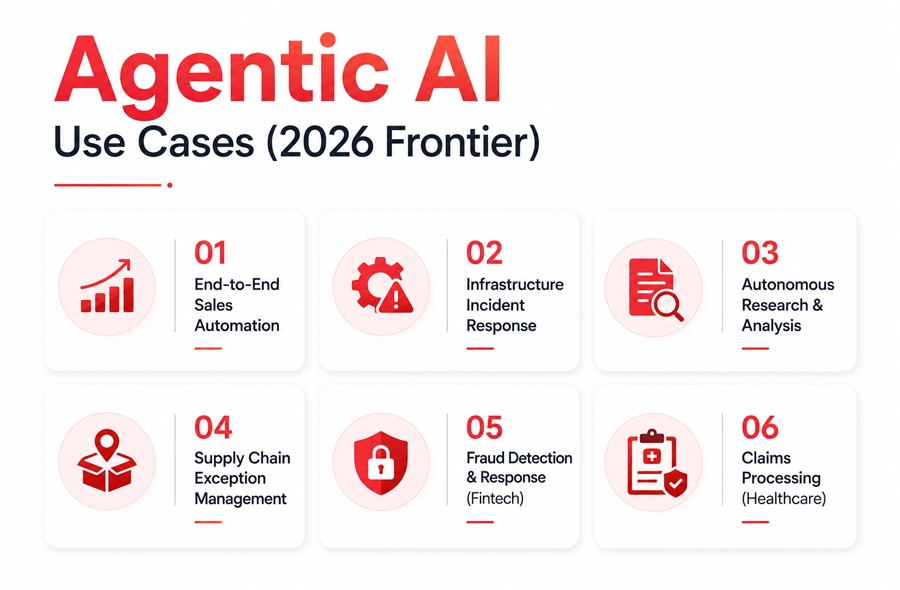
End-to-End Sales Automation: From lead qualification and personalized outreach through proposal generation and contract drafting multiple specialized agents hand off context seamlessly without human re-entry between stages.
Infrastructure Incident Response: An agentic system detects anomalies, investigates root cause, formulates a remediation plan, executes it, validates restoration, and drafts the post-incident report autonomously, within CTO-defined governance guardrails.
Autonomous Research & Analysis: Multi-agent systems coordinate web research agents, data analysis agents, and writing agents to produce investment briefs, competitive intelligence reports, or regulatory summaries from a single high-level instruction.
Supply Chain Exception Management: Agentic systems monitor supplier networks in real time, detect disruptions, assess downstream impact, evaluate alternatives, and initiate purchase order revisions an increasingly common pattern for compressing exception resolution time from days to hours.
Fraud Detection & Response (Fintech): An agentic system correlates signals across transaction monitoring, device fingerprinting, and account history, decides whether to hold, escalate, or clear a transaction, and routes confirmed fraud cases to investigators with a full evidence trail coordination that a single bounded agent can't do alone.
Claims Processing (Healthcare): Agents handle intake, eligibility verification, and coding in parallel, an orchestrator reconciles discrepancies and flags exceptions for human adjudication, and the system maintains the audit trail payers and regulators require end-to-end, with a human in the loop at the decision points that matter.
Common Mistakes CTOs Make and How to Avoid Them
Mistake 1: Agentwashing Calling Everything an "Agent"
The most common mistake is the one Gartner named: treating AI assistants, chatbots, or copilots as AI agents because a vendor said so. A copilot that suggests a response for a human to approve is not an agent. An agent acts. If your system requires human approval before every action, it is an assistant and that is perfectly fine, but govern it accordingly.
Before deploying any system labeled as an "agent," ask: does it take actions autonomously, or does it require human approval at every step? If the latter, govern it as an assistant, not an agent.
Mistake 2: Building Agentic Systems Without an Orchestration Layer
Some teams build collections of individual AI agents and assume that wiring them together via API calls constitutes an agentic system. Without a purpose-built orchestration layer responsible for goal decomposition, context management, task routing, and error recovery what you have is a fragile pipeline, not an autonomous system.
Treat orchestration as core infrastructure, not an afterthought. Evaluate frameworks like LangGraph, CrewAI, or Semantic Kernel before writing agent code. The orchestration layer is where governance, observability, and adaptability live.
Mistake 3: Applying Copilot Governance to Agentic Systems
As AI shifts from copilots to autonomous agents, the risk profile changes fundamentally from hallucination (bad output) to unbounded action (bad outcomes). Yet many organizations apply the same review process they use for a writing assistant to a system that can execute API calls, modify records, and send emails. The 2025 AI Agent Index a joint study from Cambridge, MIT, Stanford, and other institutions reviewed 30 prominent deployed agents and found that 25 disclosed no internal safety results at all. Deloitte's 2026 enterprise survey tells a similar story from the governance side: just 21% of organizations report a mature governance model for agentic AI, even as adoption accelerates.
Define explicit autonomy tiers. Agents that read data need different controls than agents that write to systems. Agents touching financial or compliance systems need full audit trails. Design governance before you design the agent.
Mistake 4: Skipping Data Readiness
A July 2025 Harvard Business Review survey found that only 15% of companies believe their data and systems are fully ready for agentic AI. The MIT/NANDA study of 300+ AI deployments found that approximately 95% of generative AI pilots failed to produce measurable impact and the root cause was almost never the AI model. It was flawed enterprise integration and poor data quality.
Audit your data readiness before scoping your agentic AI project. Agents are only as good as the data they can access and act on. Clean, structured, accessible, governed data is the prerequisite not a nice-to-have.
Mistake 5: Underestimating the Production Engineering Requirement
A working agentic AI demo is not a production agentic AI system. Industry benchmarks for a fully autonomous production multi-agent platform with memory, tool-use, orchestration, human-in-the-loop guardrails, and compliance controls commonly range from the low hundreds of thousands to well over a million dollars to build, with meaningful monthly operating costs at moderate scale. Actual figures vary widely by scope, integration complexity, and existing data readiness which is exactly why a scoping conversation should come before a budget line.
Plan for the full production engineering investment before committing to the roadmap. Scope the operating cost, the governance framework, and the observability stack alongside the agent architecture not after the first prototype ships.
Whether you're investing in AI/ML Development, Generative AI Development, or a complete Agentic AI Development initiative, architecture, governance, and production readiness should be planned together rather than treated as separate phases.
Best Practices for CTOs Deploying AI Agents and Agentic AI in 2026
Start with the workflow, not the technology. Map the end-to-end process before deciding whether you need an agent or an agentic system. Let workflow complexity drive the architecture choice.
Mature Product Engineering Services typically begin with business workflow discovery before selecting AI models, orchestration frameworks, or infrastructure.
Define autonomy tiers upfront. Decide which actions agents can take without human approval, which require approval, and which should never be automated. Document these as policy not code comments.
Instrument everything. Agent observability is non-negotiable in production. Implement logging at the action level, not just the output level. You need to know what each agent did, when, and why.
Build memory architecture with intention. Short-term context and long-term memory are different systems with different storage, retrieval, and privacy requirements. Design both explicitly.
Govern data access with least-privilege principles. Agents should only have access to the data they need for their specific task. Overpermissioned agents are one of the most common sources of enterprise AI incidents.
Pilot in narrow, reversible workflows first. The safest place to start is an internal workflow where mistakes are visible, correctable, and low-stakes. Use that pilot to validate your governance model.
Budget for integration, not just the model. The AI model is rarely the constraint. Integration with existing ERPs, CRMs, data warehouses, and identity platforms is where complexity and cost concentrate.
Plan for agent sprawl governance now. Organizations that do not establish centralized visibility into which agents exist, what they access, and what they cost will face governance crises as adoption scales.
The Aspire SoftServ Perspective
Every week, we speak with CTOs and VP Engineering who have invested in AI agent tooling and found themselves at a ceiling. Their individual agents work. The business problem they actually need to solve does not fit within a single agent's scope. They need orchestration, memory, and adaptive planning and they discover that mid-project.
The reverse also happens: teams attempt to build full agentic systems for problems that are actually well-served by a single well-designed AI agent. They over-engineer, over-spend, and deliver late.
At Aspire SoftServ, we approach every Agentic AI Development engagement with a workflow-first discovery process. Before recommending an architecture, we map the end-to-end business process, assess data and integration readiness, evaluate risk, and define governance requirements. The technology choice follows from that analysis not the other way around.
Our Agentic AI Development practice covers the full build lifecycle: from architecture design and agent orchestration, through data pipeline integration, observability instrumentation, and production deployment with governance built in from day one, not retrofitted after launch.
Frequently Asked Questions
Q: What is the difference between an AI agent and Agentic AI?
A: An AI agent is a discrete system designed to execute a specific task within defined boundaries triggered by a user or system event. Agentic AI is a broader architectural paradigm where multiple agents are orchestrated by a planning layer to autonomously pursue complex, multi-step business goals. In simple terms: an AI agent executes tasks; Agentic AI pursues outcomes.
Q: Is ChatGPT an AI agent or Agentic AI?
A: In its standard form, ChatGPT is neither. It is an AI assistant it generates responses to prompts but requires human action to implement any output. When combined with tool use, plugins, or orchestration layers, it begins to exhibit agent-like characteristics. Full agentic AI behavior requires persistent memory, multi-step planning, and multi-agent coordination that standard ChatGPT does not provide natively.
Q: Can AI agents and Agentic AI work together?
A: Yes and they typically do. In an agentic architecture, individual AI agents are the specialists that execute specific tasks. The agentic orchestration layer above them determines which agents to activate, in what sequence, and coordinates their outputs. AI agents and Agentic AI are complementary: agents are the workers; agentic AI is the general contractor managing the project.
Q: When should I use an AI agent instead of building an Agentic AI system?
A: Use an AI agent when your use case is narrowly scoped, involves a single system or domain, has a predictable execution path, and requires low infrastructure overhead. Use an agentic approach when the workflow spans multiple systems, requires adaptive decision-making, demands persistent context across steps, or involves coordinating multiple specialized capabilities toward a shared business outcome.
Q: What are the governance differences between AI agents and Agentic AI?
A: AI agents operate within defined boundaries and typically present lower governance risk. Agentic AI systems with their autonomous planning and multi-step execution capability require significantly more robust governance: explicit autonomy tiers, full audit trails, least-privilege data access controls, and runtime policy enforcement. Applying copilot-level governance to agentic systems is one of the most common causes of enterprise AI incidents.
Q: What is "agentwashing" and how do I identify it?
A: Agentwashing is Gartner's term for the practice of relabeling AI assistants, chatbots, or copilots as "agents" without the underlying autonomy to justify the designation. The test is simple: does the system take actions autonomously without human approval at each step? If a human must review and approve every output before anything happens, the system is an assistant not an agent. Genuine agents act; assistants suggest.
Q: What frameworks are used to build Agentic AI systems?
A: The leading open-source frameworks in 2026 include LangGraph (graph-based multi-agent workflows), CrewAI (role-based agent teams with event-driven coordination), Microsoft Semantic Kernel (enterprise .NET and Python environments), and AutoGen (in transition to Microsoft Agent Framework). Both MCP (Model Context Protocol, originated by Anthropic) and A2A (Agent-to-Agent, originated by Google) are now Linux Foundation standards governing how agents connect to tools and to each other.
Q: What is the typical cost of building an Agentic AI system?
A: Cost varies significantly by scope from well-scoped single-workflow AI agents that are fast and inexpensive to deploy, up to fully autonomous production multi-agent platforms with memory, tool-use, orchestration, human-in-the-loop guardrails, and compliance controls, which represent a much larger build and ongoing operating investment. Because the range is wide, the right first step is scoping your specific workflow rather than benchmarking against an industry-wide number.
Conclusion
The debate around Agentic AI vs AI Agents is not simply about terminology. It is fundamentally about architecture, governance, business capability, and choosing the right engineering approach for the problem you're trying to solve.
AI agents are powerful tools for well-scoped, repetitive tasks. They are deployable today, deliver measurable ROI in contained workflows, and represent the most accessible entry point into autonomous AI for most organizations. Agentic AI is the next frontier systems that do not just respond to instructions, but pursue goals. They plan, coordinate, adapt, and deliver outcomes end-to-end.
The organizations winning in 2026 are not necessarily the ones that moved fastest. They are the ones that understood the distinction, chose the right architecture for the right problem, and built governance into their systems from the start. For CTOs and VP Engineering, the mandate is clear: get precise about what you are building and why. The architecture decision you make today will shape your AI capability for the next three years.
Determine the right AI architecture for your enterprise.