

 Updated on 22 May 2026

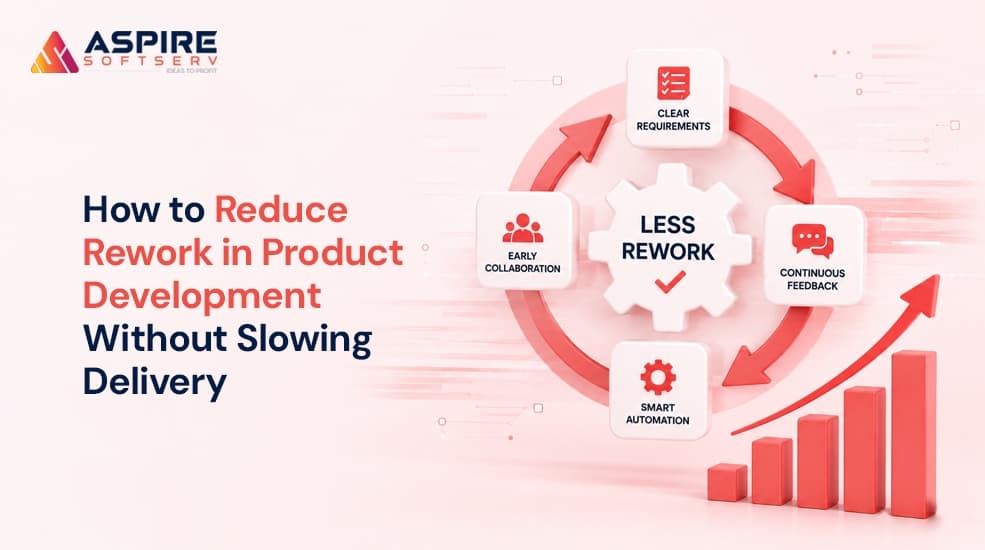
If your team is spending 20–30% of sprint capacity fixing defects and revisiting completed work, this guide explains exactly how to reduce rework without slowing delivery and what structural changes make the biggest difference.
Most teams don't have a speed problem. They have a rework problem. In most scaling organizations, 20% or more of delivery capacity is silently consumed by fixing, rewriting, and re-testing work that was already considered done. For CTOs and product heads, this is one of the most expensive and least visible drains on engineering output and it compounds every quarter without a clear line item to point to.
The teams that solve this aren't slowing down to be more careful. They're redesigning how work flows from discovery to deployment. Organizations investing in structured product engineering services that address the full delivery system from requirements to release consistently reduce rework without sacrificing throughput. The goal is not to eliminate iteration. It is to eliminate the avoidable kind.
This guide is written for CTOs and engineering leaders scaling teams of 20 to 200+ engineers, product heads dealing with missed deadlines and unpredictable releases, and technical teams where 15% or more of sprint capacity goes to bug fixing, defect correction, or work that gets reopened after sign-off.
What Is Rework in Software Development?
Rework in software development refers to any effort spent fixing, rewriting, or correcting work that was previously considered complete. This includes bug fixes after sign-off, requirement changes that invalidate implemented logic, integration corrections caused by mismatched API expectations, and design revisions triggered by unclear handoff artifacts.
In most engineering teams, rework typically consumes 15–30% of total development capacity making it one of the largest single sources of waste in the software development lifecycle. Unlike planned refactoring or deliberate iteration, rework is unplanned, disruptive, and almost always more expensive than the original work it corrects. It is not a sign of a team moving too fast. It is a sign of a delivery system not designed to absorb change efficiently.
Why Rework Is at the Center of Product Development Challenges
Rework is one of the biggest hidden costs in product development challenges facing scaling organizations. A requirement mistake caught during discovery might take twenty minutes to resolve. The same mistake discovered after implementation can trigger UI changes, API rewrites, test suite updates, deployment rollbacks, and customer support overhead a multi-day, multi-team event costing 5–10x more than early detection would have.
If 20% of your sprint is going to rework, you are effectively running a hidden second backlog one that never gets prioritized, never gets estimated, and never appears in the roadmap, but always shows up in the delay.
Key Insight: Most rework is introduced before development begins not during coding. In most technical teams, rework originates from three structural sources: requirements written as intent rather than executable acceptance criteria, architecture designed for immediate delivery rather than future change, and quality gates positioned too late in the cycle. Each of these is a process and system failure, not a talent problem.
How to Identify If Rework Is a System Problem
Before investing in solutions, leaders need clarity on whether rework is situational or structural. You likely have a systemic rework issue if more than 15% of sprint capacity is spent on bug fixes or correction work, features frequently reopen after completion, releases feel unpredictable or risky, engineers instinctively avoid touching certain parts of the codebase, or delivery timelines consistently slip despite effort remaining constant.
If two or three of these are true simultaneously, the issue is not execution it is your delivery system design. No amount of working harder will resolve a structural problem that keeps reintroducing the same failure patterns sprint after sprint.
The Hidden Cost: Technical Debt Impact on Delivery
Technical debt impact is almost always underestimated because it accumulates gradually and distributes itself across the system. By the time it becomes visible in delivery slowdowns and regression spikes, it has already been shaping team capacity for months. Rework cost spreads across multiple teams and functions not just engineering.
Code-level debt in the form of duplication and poor modularization slows feature work and increases defect risk. Architecture debt tightly coupled services and inconsistent domain boundaries turns simple changes into multi-team coordination efforts. Delivery debt from manual deployments and brittle pipelines increases release anxiety and rollback frequency. Test debt from missing coverage and flaky end-to-end tests allows defects to escape to production where they are far more expensive to fix.
The compounding effect is what makes technical debt impact so damaging long-term. A leadership team might approve a feature assuming it is a one-sprint change, only to discover the underlying subsystem is so fragile that even minor enhancements require extensive regression testing and refactoring. Roadmap planning becomes unreliable, quarterly commitments slip, and the organization starts overestimating what it can deliver a pattern that erodes stakeholder trust faster than almost anything else. This is typically where Product Strategy & Consulting plays a critical role: helping leadership see debt not as a technical concern, but as a business risk with measurable delivery consequences.
Struggling to identify where rework is coming from in your delivery system?
We run a 30-minute Rework Risk Assessment that identifies where your delivery system is leaking capacity, which parts of your architecture are generating the most rework, and quick wins to reduce rework within the next two to three sprints.

How Rework Increases Software Development Cost Over Time
Rework increases total product cost by 20–40% because its impact spreads across engineering, QA, operations, product, and support simultaneously. Most of these costs never appear cleanly on a budget line, which is exactly why they persist. The fastest way to reduce software development cost is not to code faster it is to prevent work that will need to be done again.
| Cost Layer | What Happens | Business Effect |
|---|---|---|
| Engineering time | Re-implementing logic, refactoring modules, patching defects | Lower delivery capacity |
| QA time | Re-testing fixed workflows and adjacent flows | Slower release cadence |
| Operations time | Incident handling, rollbacks, hotfix deployment | Increased operational risk |
| Product time | Roadmap slippage, requirement rework, reprioritization | Lower planning predictability |
| Support time | Customer escalations, manual remediation | Higher service cost |
Teams that shorten feedback loops, prevent defects earlier, and build product increments that are safer to release consistently deliver more value per sprint than teams optimizing for raw velocity. Reducing software development cost is not a budgeting exercise it is a systems design decision.
Common Product Development Challenges That Lead to Rework
These are not isolated mistakes they are patterns that repeat across delivery systems and are visible in the backlog, architecture, and test strategy before they become customer-facing incidents.
Ambiguous requirements remain the single most common source of avoidable rework. User stories describe a goal but not the rules, edge cases, or data conditions engineering actually needs. Ambiguity forces engineers to guess, and guesswork becomes rework when product expectations and implementation reality diverge after delivery.
Real-world example: A pricing rule missing edge cases for bundled product discounts caused an API rewrite, cascading UI changes, and two weeks of unplanned rework across three teams all from a single missing acceptance criterion.
Weak design-to-engineering handoff creates a second wave of rework. When UX artifacts don't define error states, responsive behavior, and empty states, engineering fills the gaps with assumptions that later require redesign or code changes especially when product owners review output after implementation rather than during it.
Poor dependency management is particularly damaging in distributed systems. One unstable dependency an internal API, shared library, or external service can trigger a cascade of rework across multiple services. Without clear contracts, this becomes recurring rather than a one-time event. Cloud and DevOps Engineering practices that enforce environment parity and dependency versioning are often the fastest fix here.
Incomplete test strategy shapes software quality issues downstream in ways that are difficult to reverse quickly. Teams relying heavily on manual testing or only validating the happy path will see defects survive until production or UAT, increasing correction work and creating the kind of release anxiety that undermines any attempt to improve the agile development process. Weak software project management compounds this further poor estimation, uncontrolled scope, and unclear ownership create backlog churn that makes releases unpredictable and directly erodes engineering productivity across the organization.
Before vs. After Reducing Rework
| Before | After |
|---|---|
| 20–30% of capacity lost to rework | Less than 10% rework with stable delivery systems |
| Unpredictable release timelines | Consistent, reliable delivery cycles |
| Reactive hotfixes and repeated defects | Proactive quality through shift-left testing |
| Architecture that resists every new feature | Modular systems that absorb change cleanly |
| Teams afraid to touch legacy areas | Confident engineers with fast, trustworthy pipelines |
A SaaS team reduced rework from 28% to 12% in ten weeks by introducing API contracts across service boundaries, automating CI testing at the component level, and reducing release batch size by 40%. These were not large-scale transformations they were targeted system changes that addressed the structural sources of rework directly.
Most teams see measurable reduction within 6–12 weeks. The path typically looks like this: in weeks two to three, rework sources become visible through metrics and pipeline instrumentation. By weeks four to six, defect escape rate begins to drop as shift-left practices take hold. By weeks six to twelve, the percentage of sprint capacity spent on rework falls measurably and delivery predictability improves.
These practices require upfront investment in architecture and automation, which may slow initial delivery by 5–10%, but the return on that investment compounds significantly over subsequent quarters.
How to Reduce Rework Without Slowing Delivery
The fastest way to reduce rework is to shift quality upstream using contracts, automation, and smaller releases. The best teams achieve this not by adding process overhead but by redesigning their delivery system so rework is less likely and less expensive when it does occur.
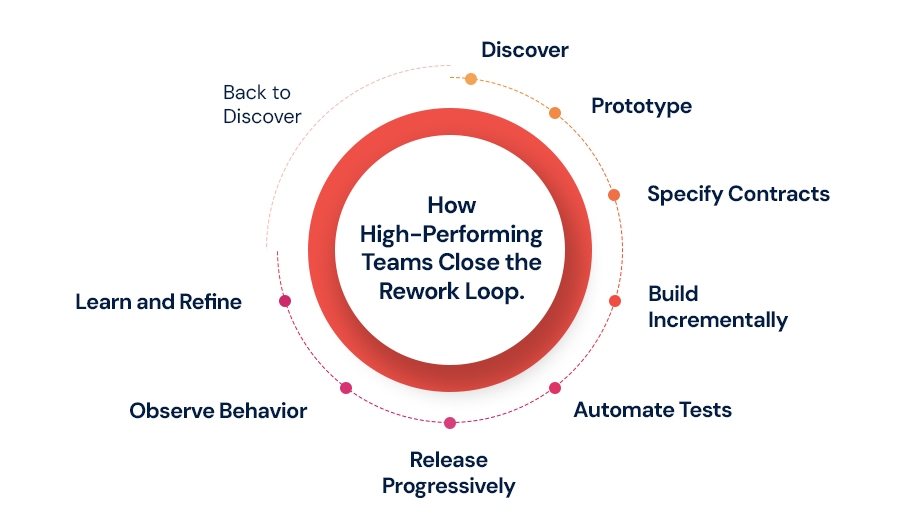
1. Turn requirements into executable contracts.
Requirement ambiguity is eliminated before a line of code is written when teams define acceptance criteria, business rules, error states, and API expectations upfront. Contract-first specifications OpenAPI schemas, event contracts, domain boundary definitions ensure every team knows expected input and output behavior before implementation begins. This single discipline eliminates a significant percentage of integration rework across the software development lifecycle.
2. Build a shift-left quality system.
Defects caught in CI cost a fraction of what they cost in production. Shift-left testing means unit tests, component tests, contract tests, static analysis, and security checks all run inside the pipeline not at the end of the sprint. This is where strong QA engineering practices directly reduce the volume of rework reaching downstream teams.
3. Use smaller, safer releases.
Large batch releases make it difficult to isolate failure sources. Smaller increments, trunk-based development, and progressive delivery reduce blast radius and simplify rollback. Feature flags decouple deployment from exposure a foundational DevOps practice for teams balancing speed and stability.
4. Reduce integration risk with contract testing.
In microservices and modular systems, contract testing validates that services still honor their API expectations even when implementations change. This catches integration breakage before end-to-end failures appear and reduces dependence on slow, brittle full-suite tests a core capability within mature Software Product Development delivery models.
5. Make architecture resilient to change.
Clear domain boundaries, event-driven decoupling, interface segregation, and modular services that can be updated independently minimize cross-team coordination and lower the probability that a simple feature request becomes a multi-team refactor. Product Design and Prototyping that validates architectural assumptions early prevents the most expensive form of rework: redesigning systems already in production.
6. Automate feedback in CI/CD.
A mature pipeline does more than compile code. Linting, static code analysis, test suites, security scanning, dependency checks, and deployment validation should all run automatically on every merge a core output of strong Cloud and DevOps Engineering investment that allows teams to move with confidence rather than caution.
In short: Rework is a delivery system design problem. These six practices address it at the source rather than treating symptoms after the fact
How Product Engineering Services Reduce Rework
Reducing rework requires coordinated changes across the delivery system not isolated fixes in a single team or layer. This is why rework cannot be solved in isolation. It requires an integrated approach across the full product engineering discipline.
Product Strategy & Consulting improves requirement clarity and prioritization, reducing the upstream ambiguity that causes the majority of downstream rework. Product Design and Prototyping validates assumptions before development begins, preventing the design gaps that force code changes after implementation. Software Product Development builds modular, change-resilient systems that absorb new requirements without triggering cascading rework. Cloud and DevOps Engineering enables safe, frequent releases with automated feedback loops that catch defects early. Strong QA engineering practices ensure defects are caught at the lowest-cost stage of the pipeline. And ongoing product sustenance and support reduces recurring defects and production issues that consume engineering capacity without generating new value.
When these capabilities operate as a connected system rather than separate functions, rework drops significantly because the conditions that create it are addressed at every stage of delivery.
Practical Controls That Prevent Rework
| Control | What It Prevents | Why It Matters |
|---|---|---|
| Acceptance criteria with edge cases | Requirement ambiguity | Reduces wrong implementation |
| API contracts | Integration drift | Prevents service mismatch |
| Test pyramid | Regression gaps | Improves test speed and coverage |
| Feature flags | Risky rollouts | Limits blast radius |
| Canary releases | Production surprises | Catches issues early in live traffic |
| Observability | Slow debugging | Improves incident diagnosis and MTTR |
| Code review standards | Low-quality merges | Improves long-term maintainability |
These controls are direct levers on the volume of rework a team generates, the software development problems a growing organization accumulates in production, and the total cost of delivery over time. They are the difference between a team that ships with confidence and one that ships with anxiety.
Metrics Leaders Should Track
Decision-makers should not manage rework by instinct or anecdote. Tracking the right operational metrics exposes flow efficiency and quality trends in measurable terms that drive real prioritization decisions.
The most important metrics to monitor are deployment frequency and lead time for changes, which together show how fast and safely code moves from commit to production. Change failure rate and mean time to restore reveal how stable releases actually are once they ship. Defect escape rate and story reopen rate expose how much quality is slipping through at each stage. Most directly useful is the percentage of sprint capacity spent on rework versus feature work the clearest indicator of whether the delivery system is generating value or consuming it.
DORA-style metrics are especially valuable because they capture both speed and stability exactly the balance required when reducing rework without sacrificing delivery throughput in the product development process.
Final Takeaways
Rework is not a sign that teams are moving too fast. It is a sign that the delivery system is not designed to absorb change efficiently. The key conclusions that every engineering leader should carry forward from this guide:
Rework is a system design problem, not an execution issue effort alone will not fix it
Most rework starts upstream, during discovery, requirements definition, and design handoff not during coding
Preventing rework is 5–10x cheaper than fixing it after release the math strongly favors upstream investment
Strong architecture, DevOps practices, shift-left testing, and contract-based development eliminate rework at the source
Teams that reduce rework improve delivery speed, software development cost, and release predictability simultaneously
The metrics that matter most are change failure rate, defect escape rate, and the percentage of sprint capacity spent on correction work
For teams where internal capacity is already stretched or technical debt impact has accumulated faster than it can be repaid, working with experienced product engineering services helps leadership establish the right delivery model, quantify the real cost of the current system, and prioritize the changes with the highest return. The goal is a delivery system where avoidable rework is the exception, not the default.