

Introduction
Industrial software underpins critical operations across manufacturing, supply chain, utilities, energy, and more, playing an essential role in ensuring uptime, productivity, and compliance. However, a rapidly changing competitive landscape driven by globalization, digital transformation, and the demands of Industry 4.0—has exposed the limitations of traditional, monolithic applications. Today's business imperatives require scalable, resilient, and highly responsive digital platforms that quickly adapt to consumer needs and market shifts.
Product engineering services have emerged as the strategic enabler for industrial modernization, combining cloud-native architectures and microservices to deliver unprecedented agility, modularity, and cost savings. This comprehensive guide explores every critical aspect—architectural patterns, process flows, technology stacks, benefits, real-world case studies, implementation tactics, and pitfalls to avoid—enabling IT leaders, architects, and operations professionals to chart a confident course toward digital transformation in industrial environments.
The Strategic Case for Industrial Software Modernization
Why Industry Leaders Must Act Now ?
Organizations across manufacturing, logistics, and utilities face critical challenges that demand immediate attention through modern product engineering solutions:
- Aging legacy systems with rising maintenance costs consuming 70-80% of IT budgets.
- Inability to scale on demand during market fluctuations or production surges.
- Slow cycle times for feature additions (6-12 month release cycles).
- Poor visibility into real-time operations limiting data-driven decisions.
- Fragmented systems and data silos hampering analytics and automation.
Business Value Through Modern Engineering Solutions
Specialized product engineering consulting unlocks transformational value:
- Scalability : Dynamically adjust to production peaks without infrastructure overhaul.
- Fault Resilience : Isolated failures don't trigger plant-wide outages.
- Faster Innovation : Deploy new features in weeks instead of months.
- Enhanced Security : Automated compliance and rapid patching capabilities.
- Cost Efficiency : 30-50% operational cost reduction through optimization.
Defining Cloud-Native Product Engineering for Industrial Applications
Cloud-native systems leverage cloud platforms to deliver highly scalable, resilient, and portable applications. Modern digital product engineering implements these systems with key features :
- Microservices Architecture : Business capabilities become independent, loosely coupled services.
- Containerization : Services packaged with dependencies for consistency across environments.
- API-First Interfaces : Enable seamless integration with IoT devices and partner systems.
- Service Mesh & Orchestration : Kubernetes manages deployments and inter-service communication.
- DevOps & Automation : CI/CD pipelines accelerate development and reduce errors.
- Infrastructure as Code : Declarative provisioning ensures repeatability and auditability.
Key Characteristics of Microservices in Industrial Software
- Independent Deployment : Service-by-service updates avoid "big bang" release risks.
- Loose Coupling : Minimal dependencies enable rapid innovation without system-wide impact.
- Polyglot Programming : Optimal technology selection per service (Python for ML, Go for streaming).
- Tailored Scaling : High-demand services scale independently from low-volume processes.
- Failure Containment : Robust patterns prevent error cascading across systems.
- Domain-Driven Design : Services map to business processes for simplified operations.
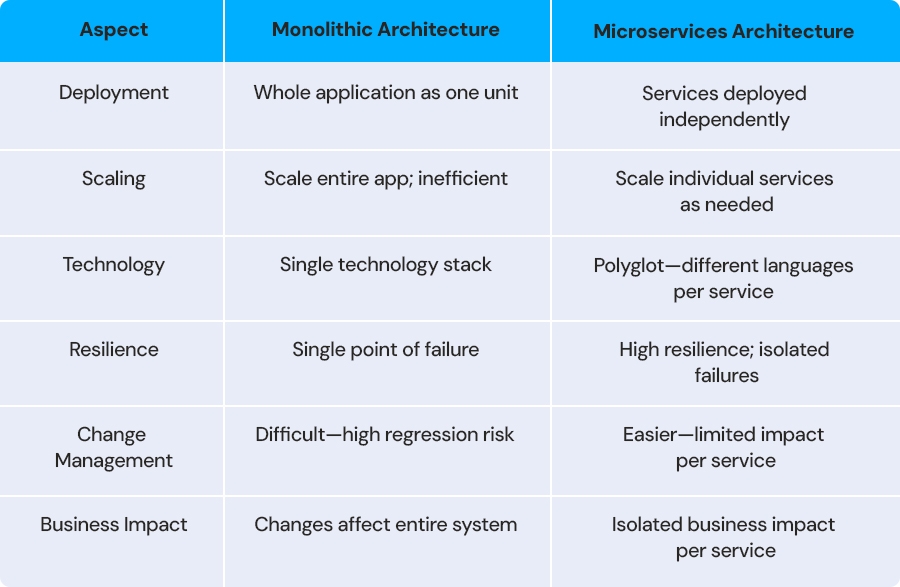
Architecture Comparison: Strategic Decision Framework
The Complete Product Engineering Modernization Process
Strategic Overview for Executives
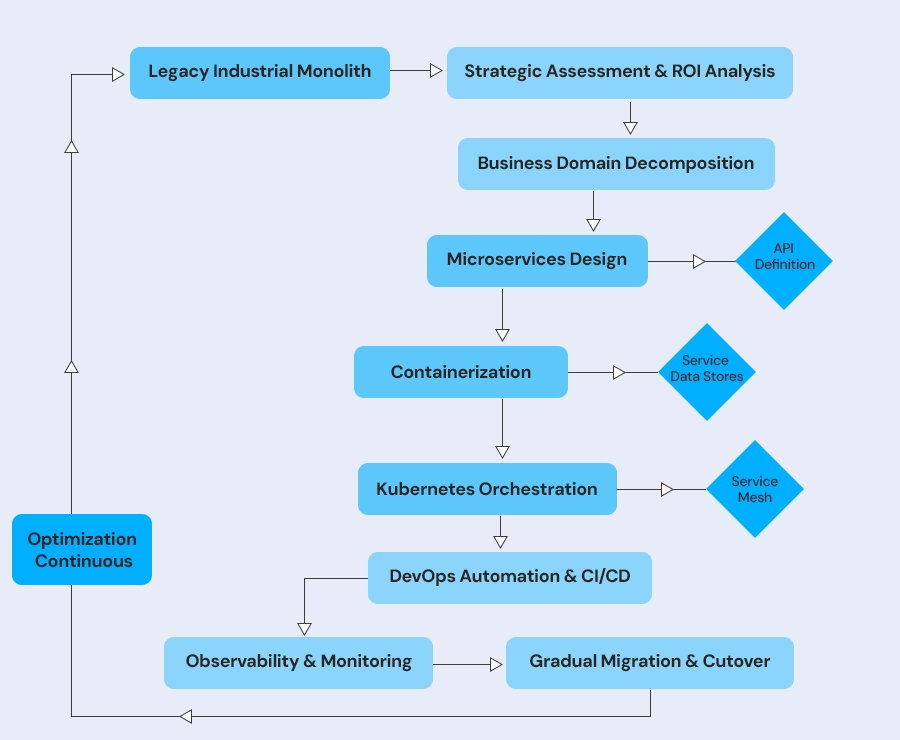
Successful modernization through product engineering services follows proven methodology spanning 12-24 months:
1. Strategic Assessment and Business Alignment
- Comprehensive legacy system audit and dependency mapping.
- Business domain prioritization based on strategic value.
- Business domain prioritization based on strategic value.
- ROI modeling for transformation initiatives.
2. Domain Decomposition and Service Design
- Apply Domain-Driven Design for clear service boundaries.
- Identify core domains: asset management, production scheduling, quality control.
- Define APIs and communication patterns (REST, gRPC, event-driven).
- Establish data ownership and service contracts.
3. Implementation and Migration
- Containerize microservices with standardized images.
- Deploy using Kubernetes orchestration platform.
- Implement service mesh for secure communication.
- Build comprehensive CI/CD automation pipelines.
- Deploy centralized logging and monitoring systems.
- Execute gradual migration using strangler pattern.
Product Engineering Process Flow
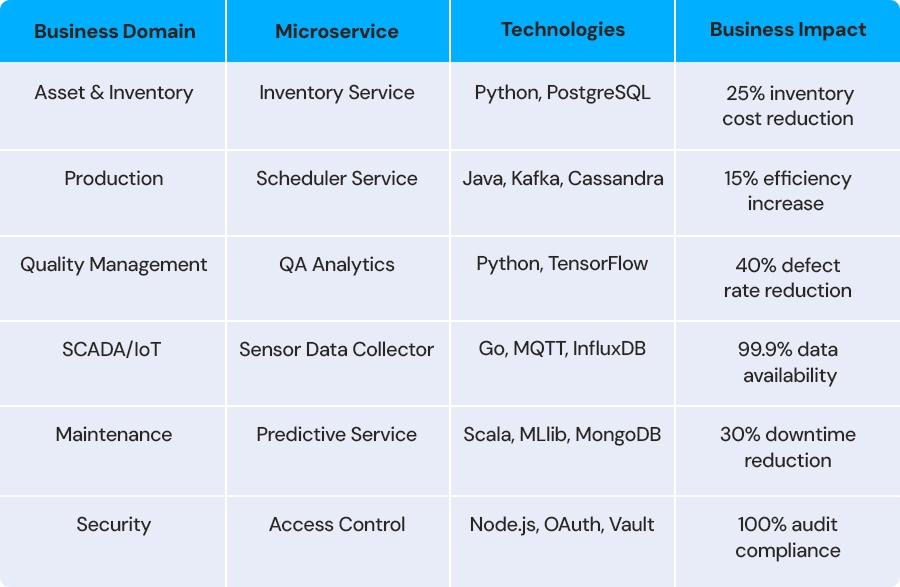
Industrial Microservice Domains: Implementation Guide
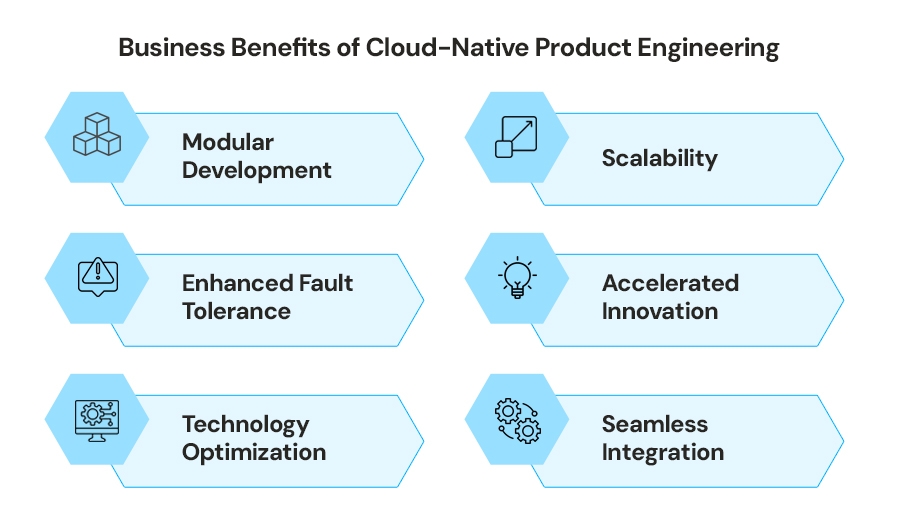
Business Benefits of Cloud-Native Product Engineering
Executive Value Proposition
Digital product engineering services deliver measurable outcomes impacting bottom-line performance :
Strategic Risk Mitigation: Avoiding Common Pitfalls
- Complex Operational Overhead : Invest in DevOps foundations and platform engineering teams.
- Data Consistency Challenges : Implement event sourcing and eventual consistency models.
- Cultural Transformation : Provide leadership commitment and comprehensive training programs.
- Over-Engineering : Assess business requirements before committing to microservices architecture.
- Vendor Lock-in : Choose open standards and maintain multi-cloud capabilities.
Real-World Success Stories
PayPal — Real-Time Analytics Transformation
- Challenge : Analytics reports took 12+ hours, preventing real-time decisions.
- Solution : Migrated to streaming ETL pipelines using Kafka and cloud platforms.
- Results : Report generation reduced to seconds, enabling instant global decision-making.
Shippeo — Supply Chain Visibility Revolution
- Challenge : Legacy systems couldn't deliver real-time logistics intelligence.
- Solution : Event-driven cloud-native architecture with IoT sensor integration.
- Results : 20% delivery accuracy improvement through predictive insights.
Implementation Best Practices
- Start With Business Outcomes : Align product engineering solutions with measurable impact.
- Embrace Domain-Driven Design : Let business boundaries define service boundaries.
- Automate Everything : From testing to compliance, automation enables scale.
- Build for Observability : Invest early in monitoring and distributed tracing.
- Implement Security-First : Automate compliance and encrypt all data.
- Plan Gradual Migration : Use strangler pattern to minimize business disruption.
Smart Manufacturing Transformation Example
A global manufacturer modernized SCADA systems through digital product engineering, replacing monolithic modules with containerized services :
- Sensor Data Collection Service : Real-time IoT processing.
- Production Scheduling Service : Automated workflow optimization.
- Predictive Maintenance Service : AI-driven equipment monitoring.
- Quality Control Service : Automated defect detection.
Results : Real-time anomaly detection, dynamic scalability during surges, secure remote updates, and 40% infrastructure cost reduction.
Getting Started: Modernization Roadmap
Phase 1 : Foundation (Months 1-3)
- Build transformation team with IT, operations, and business stakeholders.
- Assess applications by modernization readiness and business value.
- Establish CI/CD, Infrastructure as Code, and monitoring foundations.
- Select 1-2 high-impact domains for pilot implementation.
Phase 2: Implementation (Months 4-12)
- Develop first microservices following domain-driven principles.
- Deploy Kubernetes orchestration and service mesh infrastructure.
- Establish continuous integration and deployment pipelines.
- Implement comprehensive monitoring and alerting systems.
Phase 3: Scaling (Months 13-24)
- Migrate additional business domains to microservices architecture.
- Optimize performance based on operational data.
- Implement advanced security and compliance automation.
- Complete legacy system decommissioning and knowledge transfer.
Conclusion: Leading Industrial Transformation
Modernizing software infrastructure through product engineering services is a strategic imperative for competitive advantage. Organizations realize transformational benefits by adopting flexible, modular platforms that scale and evolve with business demands.
Success requires strong architectural foundations, sound engineering practices, and automation focus. Expert product engineering consulting provides proven methodologies to navigate complexity while minimizing risk and maximizing ROI.
Ready to Lead Industrial Modernization?
AspireSoftServ's Product Engineering Services help industrial enterprises modernize legacy systems, adopt cloud-native architectures, and build resilient digital platforms that drive operational excellence and competitive advantage. Our proven methodologies and deep industrial expertise enable successful transformation with minimized risk and maximized business value.
Transform your industrial operations today. Explore our comprehensive Product Engineering Services to discover how we can accelerate your cloud-native transformation and position your organization for Industry 4.0 success.
Contact our industrial modernization experts for a comprehensive assessment, strategic workshops, or a custom transformation roadmap tailored to your business requirements.
Frequently Asked Questions
Q: Is cloud-native always more cost-efficient for industrial workloads?
A: Cost efficiency depends on scale and usage patterns. Product engineering consulting reveals 30-50% savings for high-throughput, variable demand scenarios through resource optimization.
Q: How does microservices affect compliance in regulated industries?
A: Properly implemented microservices enhance compliance through automation, granular controls, and compliance-as-code practices.
Q: What's the recommended legacy system management approach?
A: Product engineering services employ strangler fig pattern—building new services around legacy systems, gradually routing functionality after validation.
Q: How long does industrial modernization take?
A: Most implementations span 12-24 months for complete transformation, with initial value delivery within 3-6 months.
Accelerate Your Cloud-Native Transformation