


 Updated on 19 February 2026

Most healthcare platforms fail when they scale because they're built as software development projects, not engineered products. The difference is critical: software development services deliver features on a timeline. Product engineering services design systems that evolve, scale, and survive real-world complexity. When your platform grows from 100 users to 100,000, it's the engineering decisions made at the beginning that determine whether you scale smoothly or collapse under pressure.
Healthcare amplifies this challenge. A typical retail app might have unpredictable traffic and user behaviors. Healthcare platforms must handle fragmented legacy systems, stringent regulatory compliance, life-critical uptime requirements, and workflows that vary wildly between hospitals. Custom software development that ignores these realities from day one will fail regardless of how elegant the code appears.
This isn't theoretical. Research shows that 80% of AI healthcare initiatives never make it beyond the pilot phase. The platforms that do survive share one common trait: they were engineered as products from the start, not retrofitted after problems emerged.
The Hidden Cost of Building Healthcare Platforms Like Software Projects
When a custom healthcare software development company approaches platform development as a traditional software project, they optimize for the wrong outcomes. The focus becomes: deliver features by the deadline, meet the sprint commitments, and get the pilot deployed. What gets deprioritized? The architectural decisions that determine whether that pilot can serve 10 patients or 10,000.
Consider a real scenario: a hospital network launches an AI-powered diagnostic platform. During the three-month pilot with 200 patients, everything works beautifully. Accuracy hits 95%. Clinicians love the interface. Leadership approves a national rollout. Six months later, the platform serves 50,000 patients across 12 hospitals and the wheels come off.
Accuracy drops to 70% because the AI model was trained on data from one hospital's specific demographics and equipment. Response times balloon from 2 seconds to 45 seconds as database queries scan millions of unindexed records. The compliance team discovers that audit logs don't meet HIPAA retention requirements. Clinicians start using workarounds because the system can't handle their hospital's unique workflows.
This isn't a software bug. It's an engineering failure. The platform wasn't designed to scale, to evolve, or to handle the operational reality of healthcare delivery. This is where software product engineering diverges from traditional development: it anticipates these failures before a single line of code is written.
Why Traditional Development Approaches Break in Healthcare
Traditional software development treats infrastructure, compliance, and integration as implementation details to address during development. Product engineering treats them as first-order design constraints that shape every decision.
Here's what this looks like in practice:
Traditional Approach:
Build the core features first
Add HIPAA compliance during security review
Integrate with EHR systems when a hospital requests it
Optimize performance when users complain about slowness
Scale infrastructure when traffic increases
Product Engineering Approach:
Design data architecture for HIPAA compliance from day one
Build integration frameworks that accommodate any EHR standard (HL7, FHIR, CDA)
Architect for performance under peak load before writing application code
Implement observability and monitoring as core platform capabilities
Design for horizontal scaling as a baseline assumption
The traditional approach creates technical debt with every sprint. The engineering approach prevents it from accumulating.
| Decision Point | Software Development Approach | Product Engineering Approach | Long-Term Impact |
|---|---|---|---|
| Database Design | Normalize for current features | Design for query patterns at 100× scale | Avoids complete re-architecture |
| Compliance | Implement during security audit | Embed in data model and access controls | Prevents costly remediation |
| API Strategy | Build endpoints as features need them | Design API contract for 5-year evolution | Maintains backward compatibility |
| Testing Strategy | Test features before release | Test failure modes and edge cases | Reduces production incidents by 60% |
| Deployment | Manual releases when ready | Automated CI/CD with rollback capability | Enables weekly updates vs quarterly |
Why Engineering Decisions Matter More Than Tools
There's a common misconception in healthcare tech: if we just use the right cloud platform, implement DevOps practices, and add AI capabilities, our platform will succeed. This is backwards.
Tools don't scale products. Engineering decisions do.
SaaS development companies often sell cloud migration as a solution to scalability problems. But moving a poorly architected platform from on-premises servers to AWS doesn't fix fundamental design flaws it just makes those flaws more expensive to operate. Cloud engineering services provide value only when the underlying architecture is designed to leverage cloud capabilities.
Let me give you a concrete example. A healthcare analytics platform was experiencing severe performance degradation. Their solution: migrate from on-premises infrastructure to a cloud computing services model. They expected the elastic scaling and distributed computing power to solve their problems.
It didn't. Why? Because their application architecture relied on monolithic batch processing jobs that locked database tables for hours. Moving to the cloud meant they could run these jobs on bigger servers, but the fundamental architectural constraint remained. Queries still waited in queue. Users still experienced timeouts.
The engineering solution wasn't cloud migration it was re-architecting the data pipeline to use event-driven processing, implementing read replicas for analytics queries, and designing the schema to support concurrent access patterns. Once those engineering decisions were made, cloud infrastructure amplified their effectiveness.
This is the core principle of product engineering: architecture precedes tools.
The Three Engineering Trade-offs That Determine Platform Success
Every healthcare platform faces the same three engineering trade-offs. How you resolve them determines whether your product survives first contact with production load.
Trade-off #1: Flexibility vs Consistency
Do you design a platform that adapts to every hospital's unique workflow, or do you standardize processes and push hospitals to conform? Neither extreme works.
Too much flexibility leads to configuration explosion your platform becomes a custom implementation for every customer, destroying your ability to maintain and update it. Too much rigidity leads to user rejection and workarounds that bypass your security controls.
Product engineering solves this through Product Strategy & Consulting identifying which variations reflect genuine clinical differences versus organizational preferences. You build flexibility where medical practice varies (treatment protocols, clinical decision trees) and enforce standardization where consistency matters (data formats, security controls, audit trails).
Trade-off #2: Performance vs Cost
Healthcare platforms face unpredictable load patterns. A pandemic drives 50x traffic overnight. A hospital merger doubles your user base in a quarter. Do you over-provision infrastructure to handle theoretical peak load, or do you optimize for average usage and accept degradation during spikes?
Product engineering uses Cloud and DevOps Engineering to make this trade-off dynamic rather than static. Auto-scaling infrastructure adjusts capacity in real-time. Caching strategies handle routine queries without hitting databases. Queue-based architectures buffer peak loads without dropping requests. You pay for the resources you use while maintaining performance during surges.
Trade-off #3: Speed vs Reliability
Can you ship new features weekly while maintaining 99.99% uptime for life-critical systems? Traditional thinking says no you slow down deployment velocity to reduce risk. Product engineering says you need better engineering practices, not slower release cycles.
This is where DevOps engineering services transform healthcare platforms. Automated testing catches 90% of defects before they reach production. Feature flags allow gradual rollouts that limit blast radius. Canary deployments detect problems with 1% of traffic before impacting all users. Automated rollback recovers from failures in seconds rather than hours.
How Product Engineering Prevents the Pilot-to-Production Gap
The pilot-to-production gap is healthcare tech's most expensive problem. Your platform works beautifully with 100 beta users at one hospital. Then you scale to 10,000 users across five hospitals and everything breaks differently at each location.
This gap doesn't appear because of bad coding or insufficient testing. It appears because pilot environments hide the complexity that emerges at scale.
What Pilots Hide
Data Volume Complexity: Testing with 10,000 patient records reveals nothing about query performance with 10 million records. The database architecture that works fine in development becomes the bottleneck in production.
Workflow Diversity: Every hospital has unique processes shaped by local regulations, insurance requirements, staffing models, and clinical cultures. Your pilot site's workflow is one data point. Your tenth customer has workflows you never anticipated.
Integration Reality: Test environments use clean, standardized data. Production environments have decades of legacy data with inconsistent formats, missing fields, duplicate records, and encoding errors that crash your parsers.
Concurrent Access Patterns: Pilots have sequential usage one user completing their workflow before the next begins. Production has hundreds of simultaneous users creating race conditions, lock contention, and deadlocks that never appeared in testing.
How Engineering Prevents These Failures
Product Design and Prototyping doesn't just design for the happy path. It designs for the edge cases, failure modes, and exceptional conditions that define production reality.
This means:
Modeling data architecture for the 10-year data retention requirement, not the 3-month pilot
Designing APIs with versioning from day one so you can evolve without breaking existing integrations
Building observability into every component so you can diagnose production issues without adding logging later
Implementing circuit breakers and bulkheads that prevent cascading failures across system components
Creating data validation layers that gracefully handle malformed inputs instead of crashing
Enterprise software development that ignores these patterns creates platforms that work until they matter then fail catastrophically.
| Pattern | Why Pilots Succeed | Why Production Fails | Engineering Solution |
|---|---|---|---|
| Data Quality | Clean test data, manual entry | Decades of legacy data, automated imports | Schema validation + graceful degradation |
| User Load | Sequential testing, controlled timing | Concurrent access, unpredictable spikes | Load testing at 10× expected peak + auto-scaling |
| Integration Depth | Mock APIs, simplified workflows | Complex EHR integrations, variant data formats | Adapter pattern + configurable transformations |
| Error Handling | Known failure modes, reproducible bugs | Unknown edge cases, rare race conditions | Chaos engineering + comprehensive logging |
| Compliance Scope | Single jurisdiction, simplified requirements | Multi-state regulations, evolving standards | Compliance framework + automated policy enforcement |
The Product Engineering Process That Builds for Reality
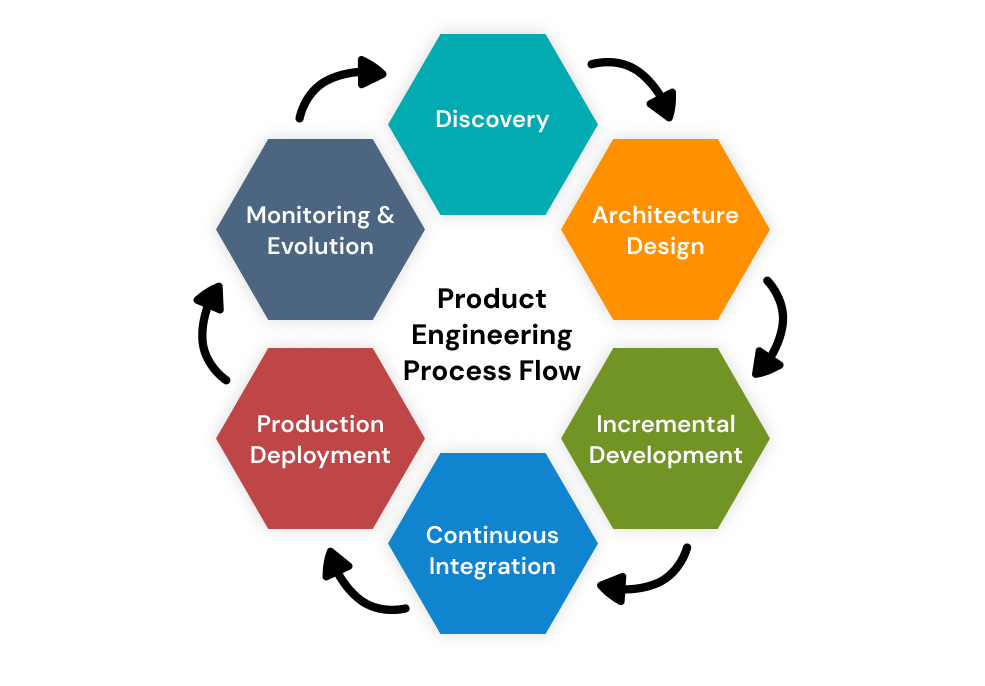
Product engineering services don't just build differently they build in a different order. Instead of features-first, they prioritize architecture-first. Instead of pilot-fast, they design production-ready.
Here's how the process actually works:
Discovery: Understanding What You're Really Building
Most healthcare platforms start with a feature list: "We need patient scheduling, clinical documentation, billing integration, and analytics dashboards." Product engineering starts with constraints: "What regulations must we comply with? What systems must we integrate with? What performance is required? What happens when this component fails?"
Product Strategy & Consulting maps the entire system landscape before designing the first component. This means:
Identifying every data source your platform will consume (EHRs, labs, imaging, claims, pharmacy)
Understanding the regulatory environment across all target markets (HIPAA, GDPR, FDA device classification, state licensing)
Mapping failure criticality (which components can degrade vs which must maintain 100% uptime)
Defining success metrics that matter (patient outcomes, clinician efficiency, operational cost reduction)
This discovery phase reveals the engineering decisions that will define your product:
Should you build a monolith or microservices?
Depends on your team size, deployment complexity, and whether different components have different scaling characteristics.
Should you own your ML infrastructure or use managed services?
Depends on your data volume, model complexity, and whether you have specialized ML engineering talent.
Should you support on-premises deployment or cloud-only?
Depends on your target market's infrastructure maturity and regulatory constraints.
These aren't technical preferences they're business constraints that engineering must resolve correctly.
Architecture: Designing Systems That Evolve
Once you understand constraints, you design the architecture that satisfies them. This is where Software Product Development diverges most sharply from traditional coding.
Traditional development asks: "How do we build feature X?" Product engineering asks: "How do we build a platform that can incorporate feature X today and features Y and Z next year without re-architecting?
Key architectural decisions:
Data Architecture:
How do you model patient data to support current features while allowing future additions?
Where do you draw boundaries between operational data (fast writes, recent queries) and analytical data (complex aggregations, historical trends)?
How do you partition data to support multi-tenancy, geographic distribution, and data sovereignty requirements?
Integration Architecture:
Do you build point-to-point integrations or implement an integration hub?
How do you handle data transformations between incompatible formats?
What happens when an external system is unavailable queue, retry, or fail?
Security Architecture:
How do you implement zero-trust networking without making every request a bottleneck?
Where do you enforce authorization at the API gateway, service layer, or data layer?
How do you audit access to PHI while maintaining query performance?
Getting these decisions right means your platform can add hospitals, integrate new systems, and comply with new regulations without fundamental re-architecture.
Implementation: Building With Production in Mind
With architecture defined, implementation becomes systematic rather than exploratory. Teams aren't figuring out how to make things work they're executing a design that already solved the hard problems.
Custom web application development services that follow this approach deliver features faster, not slower, because they avoid the constant rework that comes from discovering architectural problems during implementation.
The implementation process integrates Cloud and DevOps Engineering from sprint one:
Every feature includes observability (logging, metrics, tracing) as part of the definition of done
Security controls are implemented as you build features, not added during hardening sprints
Performance testing validates each component under load before it reaches integration testing
Infrastructure as code deploys environments identically across development, staging, and production
This approach prevents the classic healthcare platform failure mode: features that work in development but fail in production due to differences in infrastructure, configuration, or data.
Validation: Testing What Actually Matters
Healthcare software development services often focus testing on functional correctness: does the feature do what the specification says? Product engineering tests operational resilience: does the feature maintain performance and availability under production conditions?
This means:
Load testing that simulates realistic concurrent user patterns, not just sequential automation
Chaos testing that randomly kills services to verify graceful degradation
Security testing that attempts actual attack patterns, not just checks for known vulnerabilities
Integration testing against real EHR systems with messy, real-world data
Compliance testing that validates audit trails, access controls, and data retention policies
The goal isn't to find every possible bug before launch. The goal is to verify that when unexpected issues occur (and they will), your platform degrades gracefully rather than failing catastrophically.
Real Outcomes: What Changes When You Engineer Products Instead of Building Software
The difference between software development and product engineering shows up in metrics that matter to business outcomes, not just technical operations.
Time to Market
Counter-intuitively, product engineering often delivers faster than traditional development. Why? Because you don't spend months re-architecting when your pilot platform can't scale. You don't halt feature development to implement security controls you should have built from the start. You don't delay launches because compliance audits reveal gaps in your data handling.
A saas product development team we worked with reduced their time to production deployment from 14 months to 8 months by front-loading architectural decisions. They spent more time in planning and design (3 months vs 1 month) but eliminated two complete re-architecture cycles that had consumed 4 months each in previous products.
Technical Debt Accumulation
Traditional development accumulates technical debt linearly with feature growth. Product engineering maintains constant technical debt by paying it incrementally as part of each feature.
This shows up in maintenance burden. Platforms built as software projects spend 60-70% of engineering capacity on maintenance, bug fixes, and firefighting. Platforms built through product engineering spend 20-30% on maintenance because they prevent problems through design rather than fixing them through patches.
Regulatory Compliance Effort
HIPAA compliance isn't a one-time checklist. It's an ongoing operational requirement that must be validated every time you add features, integrate new systems, or update infrastructure.
Platforms that bolt compliance on later spend 15-20% of each sprint on compliance verification. Platforms that engineer compliance into data models, access controls, and audit mechanisms spend 3-5% of each sprint on compliance because most verification is automated.
Customer Onboarding Complexity
When your platform is engineered to accommodate workflow variation within architectural constraints, customer onboarding is configuration rather than customization. Instead of code changes for each customer, you enable or disable features, map their data fields, and configure their approval workflows.
One enterprise software development platform reduced average customer onboarding time from 6 months to 6 weeks by moving from custom integrations to configurable adapters. Their engineering investment in a flexible integration framework paid off after the third customer.
Platform Reliability and Uptime
Healthcare platforms have zero tolerance for downtime during critical workflows. An outage during patient admission, medication dispensing, or emergency department operations isn't just inconvenient it impacts patient safety.
Platforms engineered for reliability achieve 99.95%+ uptime without heroic efforts because they design for failure:
Redundant components with automatic failover
Circuit breakers that prevent cascading failures
Graceful degradation that maintains core functionality when secondary services fail
Automated rollback that reverts bad deployments in seconds
Comprehensive monitoring that detects anomalies before they impact users
Platforms built as software projects struggle to achieve 99.5% uptime despite enormous operational effort because they're constantly reacting to unexpected failures rather than handling expected failure modes.
When Engineering Decisions Made Today Determine Tomorrow's Capabilities
The most important outcome of product engineering isn't what it enables today it's what it enables tomorrow. Healthcare technology evolves rapidly. Regulations change. Clinical practices advance. Patient expectations increase. Integration requirements multiply.
Platforms built through product engineering adapt to these changes because adaptation was designed in from the beginning. Platforms built as software projects resist change because every addition threatens the fragile assumptions that hold the system together.
Consider how different platforms respond to a common challenge: integrating a new AI diagnostic model.
Software-Built Platform:
The AI team builds a model that achieves 92% accuracy in research. When it's time to deploy, they discover:
The production database schema doesn't include the features the model needs
The inference latency (800ms) exceeds the application timeout (500ms)
The model output format doesn't match the UI component expecting results
There's no infrastructure to monitor model drift in production
The compliance team needs three months to validate the AI decision audit trail
Deployment takes 7 months of re-engineering.
Engineering-Built Platform:
The AI team builds the same model. When it's time to deploy:
The data architecture already includes comprehensive feature storage
The service mesh handles long-running inference requests asynchronously
The API contract anticipated AI integrations with flexible result schemas
Model monitoring was built as a platform capability, not a feature
The audit framework logs all AI decisions by design
Deployment takes 3 weeks of configuration and testing.
The difference isn't the AI model or the development team's talent. The difference is whether the platform was engineered to evolve or coded to work.
This is why product engineering services focus on long-term product thinking rather than short-term feature delivery. The engineering decisions you make today how you model data, design APIs, implement security, structure deployments determine your platform's ability to adapt two years from now.
Moving Forward: Engineering Your Healthcare Platform for Success
If you're building a healthcare platform, you face a choice: engineer it as a product from the start, or build it as software and re-engineer it later when reality forces your hand.
The evidence is clear. Healthcare platforms that succeed at scale share common characteristics:
They designed for production complexity from day one
They embedded compliance, performance, and reliability into their architecture
They built systems that evolve rather than systems that work once
They invested in engineering decisions before writing production code
Product engineering services provide the framework, practices, and expertise to make these outcomes achievable. Whether you're starting a new platform, scaling an existing one, or improving a product that's accumulated too much technical debt, product engineering transforms how you build.
The healthcare industry can't afford platforms that work until they matter. Patients, clinicians, and health systems need technology that performs reliably under production conditions, integrates with complex ecosystems, complies with evolving regulations, and adapts to advancing medical knowledge.
Building platforms that meet these requirements isn't about using the right tools or following the latest methodologies. It's about making engineering decisions that prioritize long-term platform evolution over short-term feature delivery.
That's the discipline product engineering services brings to healthcare technology and it's the difference between platforms that fail at scale and platforms that define the future of healthcare delivery.