


 Updated on 24 March 2026


The Compliance Imperative in FinTech
In the fast-paced world of FinTech, where users expect instant access to services, balancing robust regulatory compliance with seamless onboarding is a make-or-break challenge. The KYC compliance process (Know Your Customer) and AML compliance solutions (Anti-Money Laundering) are non-negotiable yet traditional manual checks can drag customer onboarding fintech timelines from minutes to days, costing platforms real revenue in the form of abandoned signups.
Global frameworks like FATF recommendations, the EU's AMLD6, and the U.S. Bank Secrecy Act enforce these standards rigorously, with non-compliance penalties reaching millions of dollars. For decision-makers CEOs, CTOs, and Heads of Product the real business risk is not just fines. It's the 20–40% abandonment rate caused by slow onboarding, as highlighted in recent Forrester research.
The solution is to embed KYC AML compliance fintech into the platform's DNA from day one not bolt it on as an afterthought. This requires strong Product Strategy & Consulting to map regulatory requirements against real user journeys before a single line of code is written.
What decision-makers need to understand about core compliance challenges:
Geographic variance: India's Aadhaar e-KYC differs from U.S. SSN checks or EU eIDAS. One-size-fits-all fails globally.
Data privacy: GDPR and CCPA demand minimal data retention and clear consent violations are costly.
Scalability: Handling 1M+ daily onboardings without latency spikes requires architectural forethought, not reactive fixes.
Regulatory velocity: Regulations like PSD3 in Europe evolve constantly. Your platform must update rules without redeploying core systems.
| Compliance Framework | Core Requirements | FinTech Impact |
|---|---|---|
| KYC compliance process | ID verification, biometric checks, PEP screening | Delays if manual; automate for <60s completion |
| AML compliance solutions | Transaction monitoring, risk scoring | Real-time alerts prevent false positives |
| FATF Travel Rule | Crypto transaction data sharing | API integrations with VASPs |
| GDPR / CCPA | Consent management, data minimization | Tokenized storage over raw PII |
Technical Architecture for Frictionless Compliance
A resilient FinTech platform uses microservices, event-driven architectures, and cloud-native stacks to decouple compliance from core product flows. This is where digital product engineering services make a measurable difference by prioritizing API-first designs that treat compliance as a feature, not a dependency.
Think of it in four layers:
Frontend Layer: React/Next.js for responsive UIs with WebAuthn biometrics users barely notice they're being verified.
Orchestration Layer: Kubernetes-orchestrated microservices manage the digital onboarding process fintech at scale, routing users through verification steps based on risk tier.
Compliance Engine: Dedicated modules for automated KYC verification and the AML monitoring system isolated from core banking logic so updates don't require system-wide deployments.
Data Layer: Encrypted vaults (e.g., HashiCorp Vault) with zero-trust access ensure no unencrypted PII ever touches uncontrolled systems.
From a business outcome perspective: this architecture means your engineering team can update a sanctions screening rule or swap a verification vendor without downtime. Cloud and DevOps Engineering practices CI/CD pipelines, auto-scaling, and infrastructure-as-code ensure 99.99% uptime even during peak onboarding surges.
For example, AWS Lambda handles bursty KYC workloads cost-efficiently (you pay only when verifications run), while Apache Kafka streams transaction events to AML monitoring system queues in real time allowing alerts to fire in milliseconds, not minutes.
Integrating Automated KYC Verification
Automated KYC verification is the cornerstone of an efficient KYC onboarding process. Platforms that get this right see onboarding complete in under 2 minutes a business-critical advantage when competitors take days.
Modern automated KYC verification pipelines combine:
OCR (Optical Character Recognition): Extracts name, DOB, and ID numbers from document images instantly no manual data entry.
Liveness Detection: FaceTec and similar SDKs match the user's selfie to their ID photo and confirm the user is present (not a photo or deepfake).
Third-Party Risk Scoring: APIs from providers like Jumio or Onfido return a risk score within seconds, letting your system approve, reject, or flag for human review.
PEP/Sanctions Screening: Tools like World-Check cross-reference applicants against global watchlists in real time.
The business result: a full KYC compliance process that takes under 90 seconds, reduces abandonment rates from 30–50% to below 10%, and costs $2–$5 per user instead of $15–$25 for manual review.
Automated KYC Verification Flow
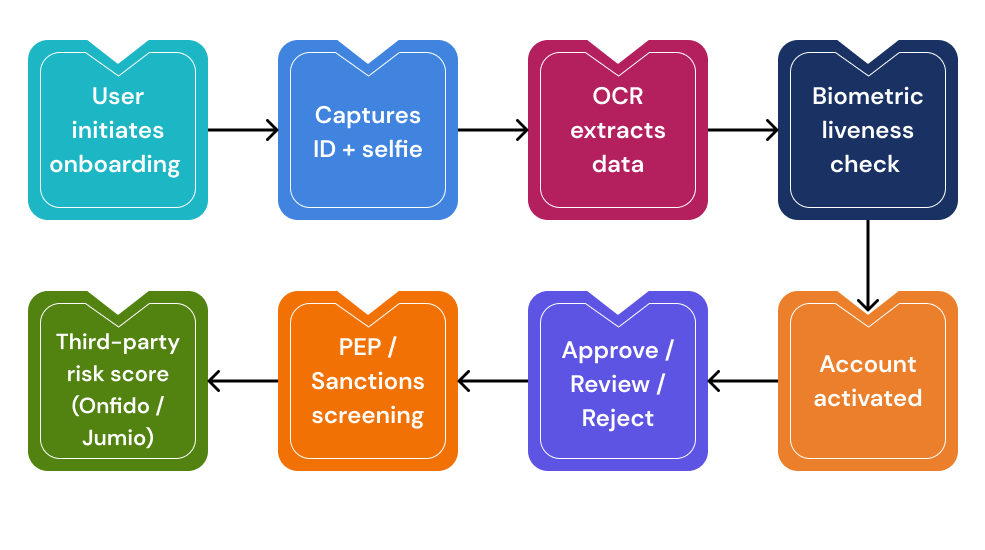
Platforms like Revolut have used this exact model combining Onfido with custom ML to hit 3-minute onboarding at 40 million users. The lesson for product leaders: the pipeline above is not aspirational; it's already production-proven.

Building a Robust AML Monitoring System
A modern AML monitoring system must process millions of transactions in real time without creating false positive noise that overwhelms compliance teams. The wrong balance here costs real money on both sides: missed fraud means liability; excessive alerts mean analyst burnout and delayed legitimate transactions.
The most effective AML compliance solutions evolve through three stages. Rule-based engines come first velocity checks, thresholds, geographic flags. These establish a baseline quickly. Then ML models (XGBoost, Isolation Forest) layer on top to detect behavioral anomalies that rules would miss. Finally, graph analytics (Neo4j) map transaction networks to catch coordinated activity like smurfing or mule account chains.
This iterative approach is what strong Product Design and Prototyping enables: prototype with rules, validate with real transaction data, then layer ML without rebuilding the foundation.
| AML Rule Type | Detection Logic | Business Outcome | Tech Stack Example |
|---|---|---|---|
| Velocity | Transactions > threshold in timeframe | Flags high-frequency fraud fast | Kafka Streams + Redis caching |
| Structuring | Split large sums below reporting threshold | Prevents smurfing patterns | Graph DB (Neo4j) |
| Geographic | Transactions from high-risk jurisdictions | Reduces cross-border fraud exposure | IP geolocation + WHOIS APIs |
| Behavioral | Deviation from user's historical baseline | Catches account takeover early | Isolation Forest ML model |
For product leaders: the business case is clear. Chime, using Alloy's AML compliance solutions, cut manual compliance reviews by 70%. That's a direct cost reduction that compounds as the platform grows. Software Product Development teams integrate these via serverless functions, triggering SAR (Suspicious Activity Report) filings automatically eliminating hours of manual analyst work per case.
Streamlining Customer Onboarding in FinTech
Customer onboarding fintech works best when compliance is invisible to the user. The modern approach often called 'compliance-as-a-service' uses progressive profiling: collect only what's needed to activate the account, then deepen the data profile over time as the relationship matures.
A phased digital onboarding process fintech flow that leading platforms use looks like this:
Four-Phase Onboarding Flow
Pre-Onboarding (0–30 seconds): Email, phone, and soft SSN/ID check. No friction, no document uploads yet. Builds trust before asking for more.
ID Verification (30–90 seconds): Automated KYC verification via mobile SDK ID capture, selfie liveness, OCR extraction. The user experiences this as a camera moment, not a compliance checkpoint.
Risk Assessment (Instant, background): AML compliance solutions scoring runs silently. The user sees a progress indicator. Your system is checking sanctions lists and behavioral signals.
Account Activation (JIT Provisioning): Just-in-time account creation fires only when risk thresholds are met. E-signature consent via DocuSign APIs completes the loop.
For crypto platforms, the same flow adds wallet address screening at step 3. For neo-banks targeting APAC markets, step 1 may include mobile number verification via local telco APIs. The architecture is modular by design that's how product engineering services build for global expansion from day one.
Global Compliance: Navigating Multi-Jurisdictional Challenges
Global compliance in fintech platforms means your system must know where a user is, what regulations apply in that jurisdiction, and which verification provider is licensed to operate there all before returning a result. This is not a configuration problem. It's an architecture problem.
The solution is a modular "regtech" layer with country-specific plugins that swap verification providers based on jurisdiction. For a platform operating across the EU and U.S., for example, that means eIDAS biometrics for Europe, SSN+ITIN for the U.S., and MiCA-specific wallet screening for crypto. Multi-region S3 buckets handle data residency. GitOps pipelines push regulation updates without downtime.
| Region | Key Regulations | Compliance Challenge | Tech Adaptation |
|---|---|---|---|
| EU | AMLD6, GDPR | Data residency + consent complexity | eIDAS biometrics, GDPR-compliant vaults |
| US | BSA, FinCEN, OFAC | Real-time OFAC screening requirements | SSN / ITIN + OFAC screening APIs |
| India | PMLA, RBI guidelines | Aadhaar linkage + rural connectivity | Aadhaar e-KYC + offline OTP fallback |
| APAC | MAS (Singapore), HKMA | Fragmented multi-country standards | PEP screening via Refinitiv + Trulioo |
Three practical mitigations for the biggest multi-jurisdictional headaches:
Data Residency: Multi-region cloud storage with strict access controls per jurisdiction. No EU user data in U.S. regions.
Regulation Changes: GitOps-managed rule updates a new FATF guidance can be deployed in hours, not a sprint cycle.
False Positives: Human-in-the-loop review queues handle the ~5% of edge cases ML can't resolve confidently. Analysts review, not rubber-stamp.
Leveraging AI and Emerging Tech for Next-Gen Compliance
AI doesn't just speed up KYC AML compliance fintech it fundamentally changes what's detectable. Rule-based systems catch known fraud patterns. ML models catch unknown ones. Graph Neural Networks map relationship webs across tens of millions of accounts to surface mule networks that no rule would ever flag.
For product leaders evaluating AI investment in compliance, the ROI case is strong:
NLP parses unstructured documents (utility bills, bank statements) for address verification eliminating manual extraction.
GANs simulate synthetic fraud scenarios for training your models improve without waiting for real fraud to occur.
Device fingerprinting via IoT signals enhances the AML monitoring system accuracy by linking behavioral patterns to specific devices catching account takeover early.
Product engineering services deploy these via MLOps platforms like Kubeflow, enabling continuous model retraining without operational disruption. Platforms that invest in this approach report 40% cost reduction in compliance operations not theory, but benchmarked outcomes from production deployments.
One critical forward-looking note: the EU AI Act will require explainable decision models for high-stakes use cases including credit and identity decisions. Platforms building compliance AI today should ensure their models can justify decisions in human-readable terms. Product Strategy & Consulting that doesn't account for this will leave platforms exposed to a new category of regulatory risk by 2026.
Implementation Best Practices and Case Studies
Platforms that successfully combine speed and compliance in fintech platforms share a set of engineering disciplines that separate production-grade systems from prototype thinking:
Zero-Trust Security: mTLS for all inter-service APIs. No internal service trusts another by default.
Observability: Prometheus + Grafana dashboards track compliance SLAs in real time not just uptime, but verification success rates, false positive rates, and average review queue times.
Chaos Engineering: Deliberately inject failure into compliance services to verify the platform degrades gracefully rather than blocking all onboardings.
Immutable Audit Trails: Hyperledger-based logs ensure every compliance decision is tamper-evident critical for regulatory examination.
Real-World Benchmarks
| Metric | Traditional Approach | Modern Compliant Platform |
|---|---|---|
| Onboarding Time | 3–5 business days | < 5 minutes |
| Drop-off Rate | 30–50% | < 10% |
| Compliance Cost / User | $15–$25 | $2–$5 |
| False Positive Rate | ~15% | < 2% |
| SAR Filing | Manual, days-long process | Automated, near real-time |
Revolut scaled to 40 million users with automated KYC verification, achieving 3-minute onboardings via Onfido plus custom ML models trained on their own fraud data.
Chime deployed AML compliance solutions through Alloy's platform, cutting manual compliance reviews by 70% translating directly to lower cost-per-acquisition and faster time-to-revenue on every new customer.
Cost Optimization Through Product Engineering Services
Engaging dedicated product engineering services delivers measurable ROI through reusable compliance modules verification adapters, AML rule libraries, consent management components that reduce build time by 50% compared to greenfield development.
Digital product engineering services combine low-code UI tools for compliance form flows with serverless backends for verification calls the right tool for each layer, not over-engineering everything. The result: faster time-to-market without accumulating technical debt.
When evaluating product engineering services providers, benchmark on compliance-specific SLAs: verification uptime >99.9%, false positive rate <2%, average onboarding completion time <5 minutes. These are measurable, contractable outcomes not vague commitments.
Future-Proofing Your FinTech Platform
Regulations will keep evolving faster, not slower. Platforms built on modular compliance in fintech platforms architecture adapt in days. Platforms built with compliance bolted on adapt in quarters, if they adapt at all.
Near-term priorities every CTO and Head of Product should plan for now:
EU AI Act (2025–2026): Explainability requirements for automated compliance decisions. Build interpretable models from the start.
Quantum-Safe Cryptography: Long-timeline risk, but cryptographic migrations take years. Start evaluating now.
MiCA for Crypto: EU's Markets in Crypto-Assets regulation demands new wallet screening and reporting. If you're in crypto, this is already in scope.
PSD3: Open banking expansion in Europe. New consent models and API access requirements are coming.
Cloud and DevOps Engineering built on infrastructure-as-code makes regulation response a configuration change, not a replatforming project. That agility is a competitive moat one that compounds over time as your competitors scramble to catch up.
Conclusion: Compliance Is Your Product Feature, Not Your Liability
Designing FinTech platforms for 2025 and beyond means treating the KYC compliance process, AML monitoring system, and global regulatory requirements not as burdens to minimize, but as foundational product features that build user trust and protect the business.
With the right combination of Product Strategy & Consulting, Product Design and Prototyping, Software Product Development, and purpose-built product engineering services, you achieve what seems paradoxical: compliance that is faster, cheaper, and more reliable than doing it manually while simultaneously being more secure and audit-ready than anything a manual process could produce.
The platforms winning in FinTech today didn't accept the false tradeoff between speed and compliance. They engineered their way out of it.
Ready to Modernize Your Compliance Architecture?
AspireSoftserv specializes in building compliance-first FinTech platforms that onboard users in minutes, not days while meeting KYC, AML, and global regulatory requirements across 195+ countries.
Build Your FinTech Platform the Right Way