


 Updated on 1 April 2026

Who This Is For And Why It Matters Now
If you are a CTO, Product Head, or Founder building a FinTech platform with regional or global expansion on your roadmap, the architectural decisions you make today will directly determine your cost, compliance readiness, and speed to market tomorrow.
Many FinTech platforms fail not because of weak demand, but because their systems cannot handle multi-country complexity. A platform that works brilliantly for 10,000 users in one market starts cracking under the weight of regulatory fragmentation, latency demands, and data sovereignty laws when it crosses borders.
This blog draws on real-world implementation patterns from platforms handling hundreds of millions of API calls daily to regional FinTechs scaling UPI-to-global payment ramps to give you a decision-ready guide on multi-tenant architecture FinTech teams can actually use.
What Is Multi-Tenant Architecture in SaaS?
Multi-tenant architecture SaaS is a software design model where a single instance of an application serves multiple customers called tenants simultaneously. Each tenant's data is logically isolated and secure, but the underlying infrastructure, codebase, and operational overhead are shared.
For FinTech platforms, this means one deployment can serve a neobank in Singapore, a lending marketplace in Germany, and a payment gateway in Brazil each operating under its own compliance rules, data residency requirements, and business logic without requiring a separate codebase or infrastructure stack per market.
This is the foundational design principle behind SaaS architecture design for global financial products. It is not just an engineering choice it is a strategic business decision with direct impact on how fast you grow and how much that growth costs.
Early Warning Signs Your Architecture Will Not Scale Globally
Before diving into how to build it right, diagnose where you stand today.
Signs your current architecture will struggle at scale:
Every new country or region requires a separate deployment cycle
Infrastructure costs grow linearly with every new client or tenant onboarded
Compliance changes in one region require code-level changes across the codebase
Performance drops measurably as your user base grows beyond a certain threshold
Your engineering team spends more time on operational overhead than product development
Key Insight: Platforms that delay adopting multi-tenant architecture SaaS often face 2–3x higher infrastructure costs during expansion not because of growth, but because of architectural debt catching up.
A real pattern seen repeatedly: a lending platform expanding from one country to three saw infrastructure costs increase by 2.5x within six months not because traffic tripled, but because single-tenant setup required three separate deployment environments, three compliance stacks, and three maintenance cycles running in parallel.
If two or more of the warning signs above apply to your platform, your architecture is likely holding back your growth not just slowing it down.
Multi-Tenant vs Single-Tenant SaaS: Choose Your Foundation Wisely
The multi-tenant vs single-tenant SaaS debate is not purely technical it is a business strategy decision with long-term cost, speed, and compliance implications.
In single-tenant SaaS, each customer receives a dedicated software instance, database, and often dedicated infrastructure. This offers deep customization but drives up costs and maintenance overhead substantially. For a FinTech platform onboarding 50 enterprise banking clients, this means provisioning and managing 50 separate environments.
Multi-tenant SaaS architecture, by contrast, pools resources across all clients through a single shared codebase and infrastructure while keeping tenant data logically isolated. The result: dramatically lower total cost of ownership and far greater operational efficiency.
| Aspect | Single-Tenant SaaS | Multi-Tenant SaaS |
|---|---|---|
| Scalability | Limited; vertical scaling per tenant | Horizontal scaling across shared resources |
| Cost Efficiency | High per tenant due to custom infrastructure | Low; driven by economies of scale |
| Maintenance | Separate updates per tenant environment | Single update deployed across all tenants |
| Customization | High — tenant-specific code and configuration | Moderate handled via config and metadata |
| Security Isolation | Strong through physical separation | Strong through logical access controls and encryption |
| FinTech Fit | Legacy institutions with unique regulatory setups | Global neobanks and platforms needing rapid expansion |
Key Insight: Single-tenant expansion takes 6 months per region on average. Multi-tenant expansion takes 6 weeks. That gap is a competitive moat or a competitive liability, depending on which side of it you are on.
For FinTech platform scalability, multi-tenant wins clearly reducing total cost of ownership by up to 60% while enabling capabilities like real-time global payments, tenant-specific compliance, and rapid feature rollouts.
When multi-tenant architecture makes sense:
You are scaling to multiple countries or serving multiple business clients
You need cost-efficient infrastructure that does not grow linearly with tenants
Your product serves clients with broadly similar workflows and compliance needs
Speed of market entry is a competitive priority
When it may not be the right fit:
Each client requires heavily customized logic at the code level
Regulatory mandates require physical data isolation (rare, but applicable in certain institutional financial contexts)
Your client base is small and the overhead of multi-tenancy outweighs the benefit
Core Principles of Multi-Tenant Database Design
Your database design will decide whether your multi-tenant system scales or fails everything else in the architecture depends on getting this layer right.
Three primary models govern multi-tenant database design:
1. Shared Database, Shared Schema
All tenants share one database and one schema, with row-level security enforcing isolation. This is the simplest model to build and operate, but carries the highest risk of data leakage if access controls are misconfigured. Suitable for early-stage platforms with lower compliance requirements.
2. Shared Database, Separate Schemas
One database, but each tenant gets a dedicated schema. This balances operational simplicity with meaningful isolation. It is often the ideal starting point for SaaS multi-tenant architecture in FinTech, offering clean separation of tenant data without the overhead of managing multiple databases.
3. Separate Databases per Tenant or Tenant Pool
Full database-level isolation per tenant or group of tenants. The most secure model and the most operationally intensive. This approach suits high-compliance scenarios particularly GDPR-governed European markets, regulated lending platforms, or institutional financial products.
For most FinTech SaaS platform development contexts, a hybrid approach delivers the best outcome: pool smaller or newer tenants into shared database environments, then migrate high-volume or high-compliance tenants into isolated database instances as they grow.
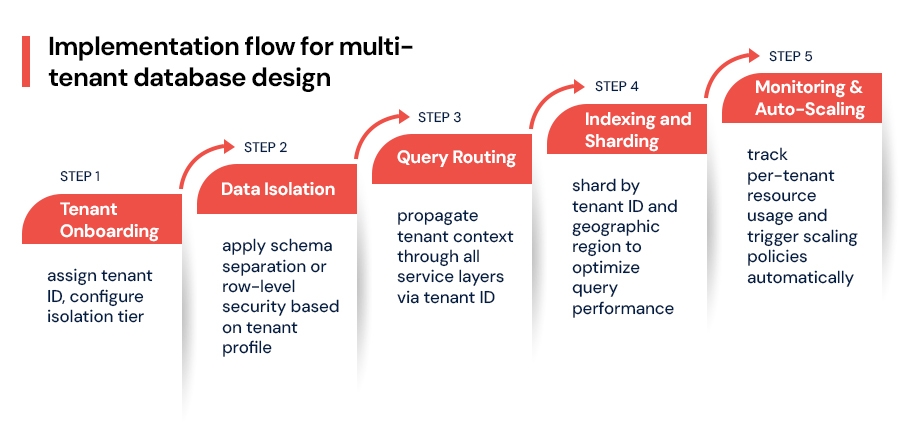
On security: encrypt all tenant data at rest and in transit using AES-256. Enforce least-privilege access via role-based access controls. Maintain comprehensive audit logs to satisfy multi-country SaaS compliance requirements across jurisdictions including GDPR, PSD2, and MAS.
Building Scalable SaaS Architecture for FinTech
Scalable SaaS architecture for FinTech must do more than handle average load it must absorb sudden, unpredictable spikes. Think payment surges during major sale events, or simultaneous cross-border settlement windows. Multi-tenant architecture addresses this through microservices, event-driven design, and cloud-native orchestration.
Key architectural layers:
API Gateway Layer Routes all incoming requests using tenant ID for context resolution. Tenant-aware routing handles authentication, rate limiting, and request distribution at this layer. This is the entry point for all tenant traffic and must be highly available.
Application Layer Stateless microservices deployed on container orchestration platforms, with tenant context propagated through request headers or tokens. Statelessness is critical it allows horizontal scaling of individual services without session management complexity.
Data Layer Implements the database design model chosen above, augmented with caching using tenant-namespaced keys to reduce read pressure on the primary database for frequently accessed tenant data.
Observability Layer Per-tenant metrics, error rates, and latency tracking. Without tenant-specific observability, diagnosing performance degradation or compliance incidents in a multi-tenant environment becomes extremely difficult.
For cloud SaaS architecture, multi-region deployments are essential. Active-active regional setups, backed by globally distributed databases, keep read-write latency under 100ms for cross-border FinTech platforms.
Key Insight: That 100ms threshold is not arbitrary. Internal data from payment platform implementations consistently shows that response times above 100ms correlate with measurable drops in transaction completion rates making latency a direct revenue variable, not just an engineering metric.
Benefits of multi-tenant architecture for global FinTech expansion:
| Benefit | Impact on Global Expansion | Example Metric |
|---|---|---|
| Cost Savings | 50–70% lower infrastructure costs | $0.10 per user per month vs $1+ in single-tenant setups |
| Rapid Scaling | Auto-scale to 1M+ users without re-architecture | 10x growth delivered within 6 months |
| Compliance Agility | Region-specific controls configurable per tenant | 90% faster market entry in new jurisdictions |
| Feature Rollouts | Instant updates deployed across all tenants simultaneously | Zero-downtime deployments |
| Innovation Speed | Shared R&D investment in capabilities like AI fraud detection | 40% faster time to MVP |
Tackling Global SaaS Expansion Challenges
Expanding a FinTech SaaS platform globally introduces a specific category of complexity that purely domestic products never encounter. Global SaaS expansion challenges are not just technical they are regulatory, operational, and structural.
1. Multi-Country SaaS Compliance
Different markets operate under fundamentally different regulatory frameworks. PSD2 in the EU mandates open banking interfaces and strong customer authentication. MAS in Singapore imposes its own data residency and risk management requirements. SEC rules govern US-facing financial products differently from all of these.
Multi-tenant architecture enables compliance agility through tenant-level metadata. Each tenant's configuration can enforce region-specific controls automatically for example, ensuring that EU tenant data is stored and processed exclusively within EU-region infrastructure without requiring engineering intervention per compliance update.
2. Latency and Performance at Global Scale
Cross-border FinTech platforms face a hard technical constraint: payment confirmations and financial data queries must return results within 100ms or less to meet user expectations and SLA requirements. Achieving this globally requires active-active multi-region deployments not just passive failover, but simultaneous read-write capability across geographic clusters.
3. Data Sovereignty
Data sovereignty laws require that certain categories of data be stored and processed within specific national or regional borders. In a multi-tenant database design built for global operations, this is handled through geographic sharding: APAC tenants routed to Singapore-based infrastructure, EMEA tenants to Frankfurt. This satisfies regulatory requirements without fragmenting the application codebase.
Global rollout process flow:
Assess target market regulatory and infrastructure requirements
Configure tenant-level compliance and UI settings for the region
Deploy regional infrastructure with appropriate data residency controls
Onboard tenants with region-specific isolation validated
Validate with controlled rollout before full go-live
Real-World Validation: How Leading Platforms Execute This
Stripe operates a multi-tenant SaaS architecture that supports transactions in 135+ currencies and handles over 500 million API calls daily. Per-tenant isolation within shared infrastructure allows Stripe to maintain consistent performance and compliance at that scale without per-customer infrastructure provisioning.
Plaid, which powers bank account connectivity for thousands of FinTech applications, relies on a SaaS platform architecture that supports financial data aggregation across borders. Its investment in structured software product development practices enabled rapid market coverage expansion in compressed timeframes.
Razorpay represents a strong regional case study in fintech SaaS platform development. Starting in India and expanding globally, Razorpay built on cloud-native, multi-tenant foundations that allowed it to handle multi-country SaaS compliance requirements without rebuilding its core platform per market.
Revolut executed the same architectural pattern to scale across 30+ countries using configurable tenant-level compliance and multi-region data residency to meet local regulatory requirements without country-specific engineering teams.
These are not outliers. They are proof points of a repeatable architectural pattern that any FinTech software architecture team can implement with the right foundation.
Is Multi-Tenant Architecture Right for Your Platform? A Self-Diagnostic
Answer these questions to assess your current readiness:
You likely need multi-tenant architecture now if:
You are onboarding more than 10 business clients or regional deployments
Infrastructure costs are growing faster than revenue
Time-to-market for each new region exceeds three months
Compliance configuration requires engineering involvement for each change
Your team is spending more time maintaining environments than building product
You may have time to defer if:
You are pre-product-market fit and serving fewer than five clients
All clients operate under identical regulatory conditions
Your architecture is already cloud-native and can be refactored incrementally
The single-tenant vs multi-tenant decision is not permanent, but migrating from single to multi-tenant at scale is expensive and disruptive. Building multi-tenant capability into your foundation even if not fully utilized immediately is almost always the lower-risk path.
How to Map Architecture Challenges to the Right Engineering Solutions
Rather than treating product engineering services as a catch-all, the most effective approach maps specific business problems to specific service capabilities:
This problem-to-solution mapping is how platforms make the transition efficiently not by rebuilding everything, but by identifying the highest-leverage architectural changes and sequencing them correctly.
Firms with deep experience in digital product engineering services have helped FinTech platforms cut deployment time by 50% and reduce first-market entry timelines from six months to six weeks.
| Business Challenge | Engineering Solution |
|---|---|
| Scaling across multiple regions without cost explosion | Cloud and DevOps Engineering — multi-region deployment, infrastructure automation |
| Managing compliance across different regulatory jurisdictions | Product Strategy and Consulting — compliance-aware architecture roadmap |
| Slow time-to-market for new features or markets | Software Product Development — modular, configurable multi-tenant core |
| Poor tenant onboarding experience slowing adoption | Product Design and Prototyping — self-service onboarding and configuration interfaces |
| Rising infrastructure costs with growing client base | Architecture audit — identify single-tenant overhead and migration pathway |
Future-Proofing Your Architecture
The next evolution of scalable SaaS architecture in FinTech involves three converging trends:
AI-driven tenant optimization is moving from experimental to production-grade. Predictive sharding where the system anticipates which tenants will generate high load and pre-provisions resources accordingly reduces both latency and cost in large-scale SaaS multi-tenant architecture deployments.
Edge computing is closing the gap for real-time financial use cases. As trading platforms, payment processors, and fraud detection systems demand sub-10ms response times, pushing compute closer to end users through edge deployments becomes a structural requirement rather than an optimization.
Regulatory technology integration is becoming embedded in architecture rather than bolted on. The next generation of fintech software architecture will treat compliance as a first-class system concern automatically adjusting data flows, audit trails, and access controls based on tenant jurisdiction in real time.
The multi-tenant vs single-tenant SaaS debate is also evolving toward nuanced hybrid models where core platform logic is multi-tenant, but certain high-sensitivity data objects are physically isolated within the same architectural frame.
Conclusion: Build Once, Scale Everywhere
Multi-tenant architecture is not a buzzword it is the structural foundation that allows FinTech SaaS platform development teams to expand from one market to many without rebuilding for every new region.
The platforms winning globally Stripe, Revolut, Razorpay made this architectural bet early. They invested in SaaS architecture design, data isolation, regional compliance configuration, and cloud-native scalability before they needed it at scale. That foresight is now a durable competitive advantage.
If your platform is approaching an inflection point a growing client base, new markets on the horizon, or infrastructure costs becoming a boardroom conversation now is the right time to assess your architecture honestly.
The cost of getting it right now is a fraction of the cost of migrating under pressure later.
Frequently Asked Questions
What is multi-tenant architecture in FinTech SaaS?
Multi-tenant architecture SaaS in FinTech is a design model where a single application instance serves multiple financial clients banks, lending platforms, payment gateways with each tenant's data fully isolated. It enables cost-efficient scaling, faster market entry, and configurable compliance without maintaining separate infrastructure per client.
Is multi-tenant architecture secure enough for financial data?
Yes, when implemented correctly. Security in SaaS multi-tenant architecture is achieved through logical isolation using row-level security, schema separation, or dedicated databases depending on compliance requirements. Combined with AES-256 encryption at rest and in transit, role-based access controls, and audit logging, multi-tenant FinTech platforms can meet GDPR, PSD2, MAS, and SOC 2 requirements.
When should a FinTech platform move from single-tenant to multi-tenant?
The clearest trigger points are: when each new market entry requires a separate deployment, when infrastructure costs grow faster than revenue, or when compliance changes require engineering involvement across multiple environments. Earlier is almost always better migration at scale is significantly more expensive and disruptive than building multi-tenant capability into the foundation.
How does multi-tenant architecture support multi-country SaaS compliance?
Through tenant-level metadata and configurable compliance controls. Each tenant's configuration can enforce region-specific data residency, access rules, and audit requirements automatically. Multi-country SaaS compliance across frameworks like PSD2, GDPR, and MAS can be managed through policy-as-code approaches without country-specific code changes.
What is the cost difference between single-tenant and multi-tenant SaaS?
Multi-tenant infrastructure typically costs 50–70% less per tenant than single-tenant setups. In concrete terms, single-tenant deployments often cost $1 or more per user per month in infrastructure, while multi-tenant shared infrastructure brings this down to $0.10 or below at scale. The savings compound significantly as the number of tenants grows.
How long does it take to expand to a new market with multi-tenant architecture?
With a properly implemented cloud SaaS architecture, new market entry primarily involves configuring tenant-level compliance and deploying regional infrastructure not rebuilding the product. This reduces time-to-market from the typical 4–6 months required in single-tenant setups to 4–6 weeks in mature multi-tenant implementations.
Turn your architecture into growth advantage