


 Updated on 18 March 2026

When Technology Created the Problem It Was Supposed to Solve
Electronic Health Records promised to modernize healthcare. Instead, they quietly shifted physicians into a role no one intended data entry operators. Today, doctors spend more time facing screens than patients, and the consequences are showing up everywhere: longer wait times, lower care quality, and a physician burnout documentation crisis that healthcare systems can no longer ignore.
The irony is hard to miss. The same digital transformation that was supposed to free clinicians from paperwork has buried them deeper in it. But the solution to a technology problem is, ultimately, a better technology built with the right engineering architecture, not just more software.
This article explores how clinical documentation automation medical scribe technology is reshaping physician workflows, what engineering decisions make or break these platforms, and when healthcare organizations should move from awareness to action.
The Real Cost of Documentation Overload
The documentation burden is not a minor inconvenience. It is a structural failure embedded into how modern clinical workflows were designed. In the United States, HIPAA compliance requirements, CPT and ICD coding standards, and Medicare documentation rules have created an environment where every patient interaction generates a trail of mandatory records each demanding precision, each eating into the physician's day.
Physician documentation pressures don't just affect productivity. They affect patient outcomes. When a doctor is mentally managing what to type next instead of listening to a patient, the quality of that consultation degrades in ways that are difficult to measure but impossible to deny.
| Metric | Before Automation | After Automation |
|---|---|---|
| Documentation time per patient | 16 minutes | 5 minutes |
| Patients seen per day | 18 | 25 |
| Physician satisfaction | Low | Improved |
| Administrative workload | High | Moderate |
| Documentation error rate | Higher (manual) | Reduced (AI-assisted) |
The numbers make the case clearly. But understanding why the problem is this deep requires looking at what went wrong in how EHR systems were originally built.
Why EHR Systems Became a Documentation Trap
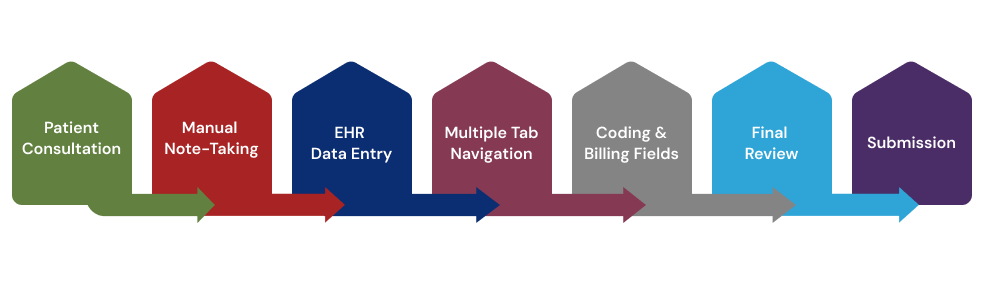
EHR documentation systems were largely designed around billing and compliance workflows, not clinical usability. This engineering decision made decades ago is still costing physicians hours every single day.
The result: multiple tabs to navigate, mandatory structured fields that don't reflect how doctors actually think, and no intelligent layer to reduce redundancy. The physician became the data pipeline.
How AI Medical Scribe Technology Actually Works
An AI medical scribe does not simply record speech. It understands clinical language, identifies relevant patient data within a conversation, and generates structured documentation that meets both compliance and care standards in real time.
The process follows a clear engineering logic:
The system captures the doctor-patient conversation through an audio interface
A speech recognition engine converts the audio into raw text
Natural language processing (NLP) identifies clinical entities symptoms, diagnoses, medications, follow-up instructions
A medical documentation AI model structures this data into EHR-compatible notes
The physician reviews and approves with minimal editing required
What makes this powerful is not the AI model alone. It is the engineering architecture surrounding it the data pipelines, latency management, and integration logic that determines whether the system works in a real clinical environment or only in a controlled demo.
The Engineering Architecture That Makes or Breaks Automation
This is where most healthcare platform conversations stall. Organizations understand the value of medical documentation automation in theory but underestimate what it takes to implement it well. The difference between a working system and a failed one almost always comes down to engineering decisions made early in the product development cycle.
| Technology Layer | Function | Engineering Consideration |
|---|---|---|
| Speech Recognition Engine | Converts clinical conversations to text | Must handle medical vocabulary, accents, background noise |
| NLP Pipeline | Extracts clinical entities and intent | Requires domain-specific training data |
| EHR Integration Layer | Connects automation output to existing records | API compatibility with legacy systems |
| Cloud Infrastructure | Enables real-time processing at scale | HIPAA-compliant cloud architecture required |
| ML Lifecycle Management | Improves accuracy over time | Needs DevOps-driven monitoring and retraining |
The engineering complexity here spans Product Strategy & Consulting determining which automation approach fits the platform's existing architecture through Software Product Development building the NLP models and integration layers all the way to Cloud and DevOps Engineering ensuring the system performs reliably under real-world clinical conditions.
A healthcare organization that tries to layer an AI tool on top of an unreformed EHR infrastructure will likely see limited results. The architecture must be ready before the AI can perform.
A Real-World Scenario: What Implementation Actually Looks Like
Consider a mid-sized US hospital network that wants to reduce the physician burnout documentation problem among its primary care physicians. The initial instinct is to purchase an off-the-shelf AI transcription tool. But after a Product Strategy & Consulting review, the engineering team identifies three critical gaps:
First, the hospital's EHR system uses a proprietary data format that no commercial transcription tool supports natively requiring a custom integration layer. Second, the clinical terminology used across departments is inconsistent, meaning a generic NLP model will generate inaccurate structured notes. Third, the existing cloud setup does not meet HIPAA audit trail requirements.
None of these problems are obvious until someone with Software Product Development experience sits down with the clinical and IT teams to map the actual workflow. This is the gap between buying a product and engineering a solution.
After a structured Product Design and Prototyping phase where the team tests different transcription approaches with a small group of physicians the organization identifies which system architecture reduces documentation time without disrupting the consultation experience. Only then does full deployment begin.
This kind of structured engineering process from strategy through prototyping to deployment is what separates successful healthcare automation projects from expensive failures.
Healthcare Workflow Automation Beyond Documentation
Healthcare workflow automation extends the value of documentation automation across the full patient care cycle. Once the documentation layer is intelligent and automated, adjacent processes can also be streamlined.
Practical automation extensions include:
Automated medical notes flowing directly into billing systems, reducing claims processing time
Patient intake data pre-populating EHR fields before the physician enters the room
Follow-up instructions generated from consultation notes and automatically sent to patients
Lab result summaries flagged and structured for physician review without manual sorting
Each of these improvements requires engineering integration work. The medical transcription software layer is the entry point, but the downstream value only materializes when the system connects to the broader clinical infrastructure. This is precisely where Cloud and DevOps Engineering capabilities become critical ensuring that data flows reliably between systems, that APIs remain stable, and that the platform can scale as patient volume increases.
When Should Healthcare Platforms Implement Documentation Automation?
This is the question decision-makers actually need answered. Not whether automation is valuable the evidence is clear but when their organization is ready to implement it effectively.
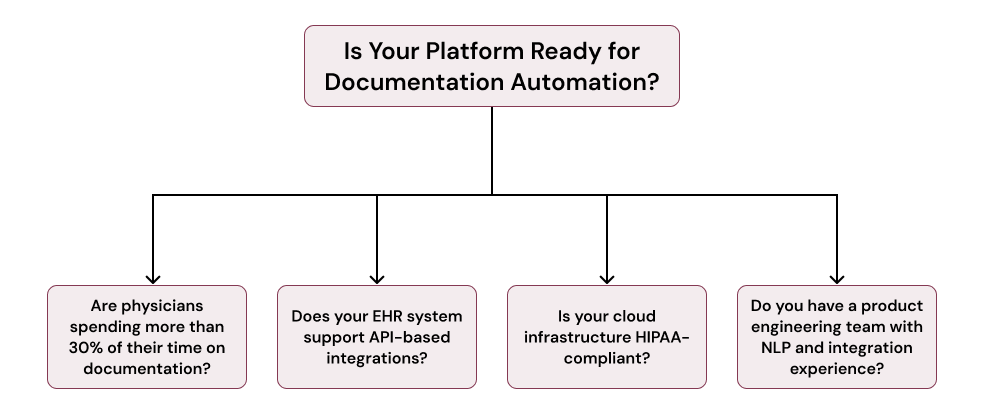
If 3 or more are YES: You are ready to begin implementation planning. If 2 or fewer are YES: Start with a Product Strategy & Consulting engagement to identify gaps before building.
The honest answer for most healthcare organizations is that the technology is ready before the infrastructure is. Rushing to deploy clinical documentation automation medical scribe tools without addressing the underlying architecture gaps leads to poor adoption, inaccurate notes, and physician frustration the opposite of the intended outcome.
The Physician Adoption Problem and How Engineering Solves It
Medical documentation automation fails most often not because the AI is inaccurate, but because physicians don't trust or adopt it. This is an engineering and Product Design and Prototyping problem as much as a change management one.
Systems that require physicians to significantly alter their consultation behavior create friction. Systems designed around how doctors actually work where the AI operates invisibly in the background see much higher adoption rates.
Key design decisions that drive adoption:
The physician should never feel monitored consent and transparency features matter
Review and approval interfaces must be fast if editing the AI note takes longer than writing it manually, adoption collapses
The system must demonstrate accuracy quickly physicians need to trust the output within their first few consultations
These are not afterthoughts. They are core Product Design and Prototyping decisions that must be made before engineering begins at scale.
The Path Forward: From Documentation Burden to Clinical Intelligence
The evolution of automated medical notes does not stop at reducing documentation time. The same infrastructure that captures and structures clinical conversations becomes the foundation for clinical decision support, predictive patient insights, and population health analytics.
Healthcare organizations that invest in building the right engineering architecture today are not just solving a documentation problem. They are creating the data infrastructure that will power the next generation of clinical intelligence tools.
This is the long-term framing that CTOs, Heads of Engineering, and Healthcare Product Leaders need to carry into these investment decisions. The immediate ROI is measurable fewer hours on documentation, more patients seen, lower physician attrition. But the strategic value is larger: a healthcare platform built on real-time, structured clinical data is a fundamentally more capable platform.
Clinical documentation automation medical scribe technology is the entry point. The destination is a healthcare system where physicians focus entirely on patients while intelligent platforms handle everything else.
If your healthcare platform is evaluating documentation automation, the first step is rarely the AI model it is the engineering architecture review. Explore how our product engineering services team helps healthcare organizations build automation-ready clinical platforms.
Planning AI documentation automation for your healthcare platform?