


 Updated on 29 July 2026

Introduction
Many enterprise software companies assume adopting a next-generation model like GPT-6 is simply an API integration project. In our engagements, we've repeatedly seen AI initiatives stall long before the model is ever deployed not because the model underperforms, but because the product underneath it wasn't engineered for AI. Legacy architecture, disconnected data systems, and fragile DevOps pipelines slow implementation, inflate costs, and delay ROI. Boards ask about AI strategy, competitors ship AI features faster, and engineering teams are left retrofitting infrastructure that was never designed for this kind of workload. This is precisely where product engineering services make the difference between an AI pilot that stalls and one that reaches production. This article walks through what CEOs, CTOs, and VP Engineering leaders should prepare for as frontier models like GPT-6 arrive, and why the real work starts with engineering, not the model.
Why This Is a Product Engineering Problem First
Enterprise AI adoption succeeds or fails based on the same fundamentals that determine any software initiative: solid architecture, disciplined data governance, and an engineering team that knows how to operationalize a capability rather than just demo one. GPT-6-class models are expected to bring stronger reasoning and more reliable retrieval-backed responses, but none of that helps if a product can't feed the model clean, connected, real-time data.
Industry research on AI project outcomes including widely cited figures from firms like Gartner on enterprise AI pilot failure rates points to the same root causes we see directly in client engagements: pilots stall when usage controls and observability aren't planned early, particularly on legacy systems across healthcare, HCM, and SaaS platforms. In our own work, the most common failure points are predictable:
Company data is scattered across disconnected systems with no unified retrieval layer, so the model can't see the full picture
APIs were designed for internal use, not AI consumption, and can't safely expose structured context
Response times degrade once real usage hits, because infrastructure wasn't built for AI-scale traffic
Cloud costs increase rapidly without caching, batching, or usage controls in place
If any of this sounds familiar, that's the signal to invest in AI-ready architecture before committing budget to a GPT-6 rollout.
Product Engineering, Not the Model, Is the Real Foundation
It's worth being direct about positioning: this isn't an article about what a future GPT-6 can do. It's about what your product needs to be able to do first. Product engineering services sit at the center of AI readiness cloud infrastructure, DevOps automation, and AI integration are all downstream of a solid product engineering foundation, not the other way around. Teams that start with the model and work backward toward architecture consistently spend more, ship slower, and end up rebuilding what should have been designed correctly the first time.
Product Architecture Changes Needed for AI Readiness
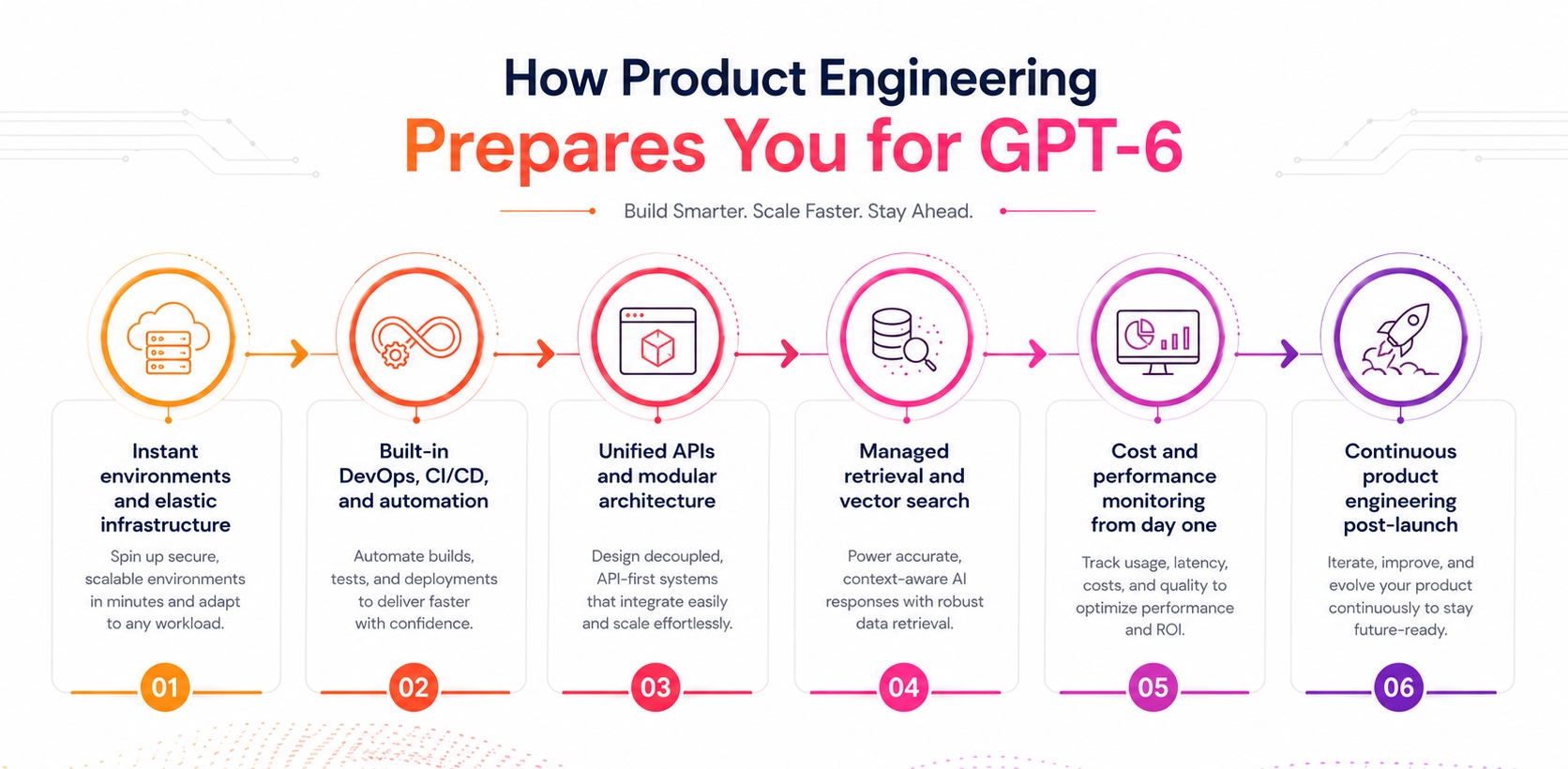
Before any AI integration work begins, engineering teams need to evaluate four layers of the stack:
| Architecture Layer | What It Handles | Why It Matters |
|---|---|---|
| Inference Hosting | Model serving, autoscaling, cost reporting | Controls latency and unit economics |
| Retrieval & Knowledge | Vector databases, data connectors, knowledge refresh cadence | Grounds responses in real-time enterprise data and reduces hallucinations |
| Application & Orchestration | Prompt versioning, workflow orchestration, safety layers | Keeps AI behavior predictable, consistent, and auditable |
| Security & Compliance | Data residency, PII detection, identity and access control | Protects sensitive enterprise and customer data while ensuring regulatory compliance |
This is the exact work our Software Product Development and Cloud and DevOps Engineering teams handle rearchitecting APIs, standing up retrieval pipelines, and hardening infrastructure so it scales without cost surprises. Planning at this stage naturally connects back to Product Strategy & Consulting, since architecture decisions should follow business priorities, not the other way around.
How Enterprise Teams Typically Get There
Most organizations follow a predictable path from idea to production, and skipping steps is a common reason AI projects stall:
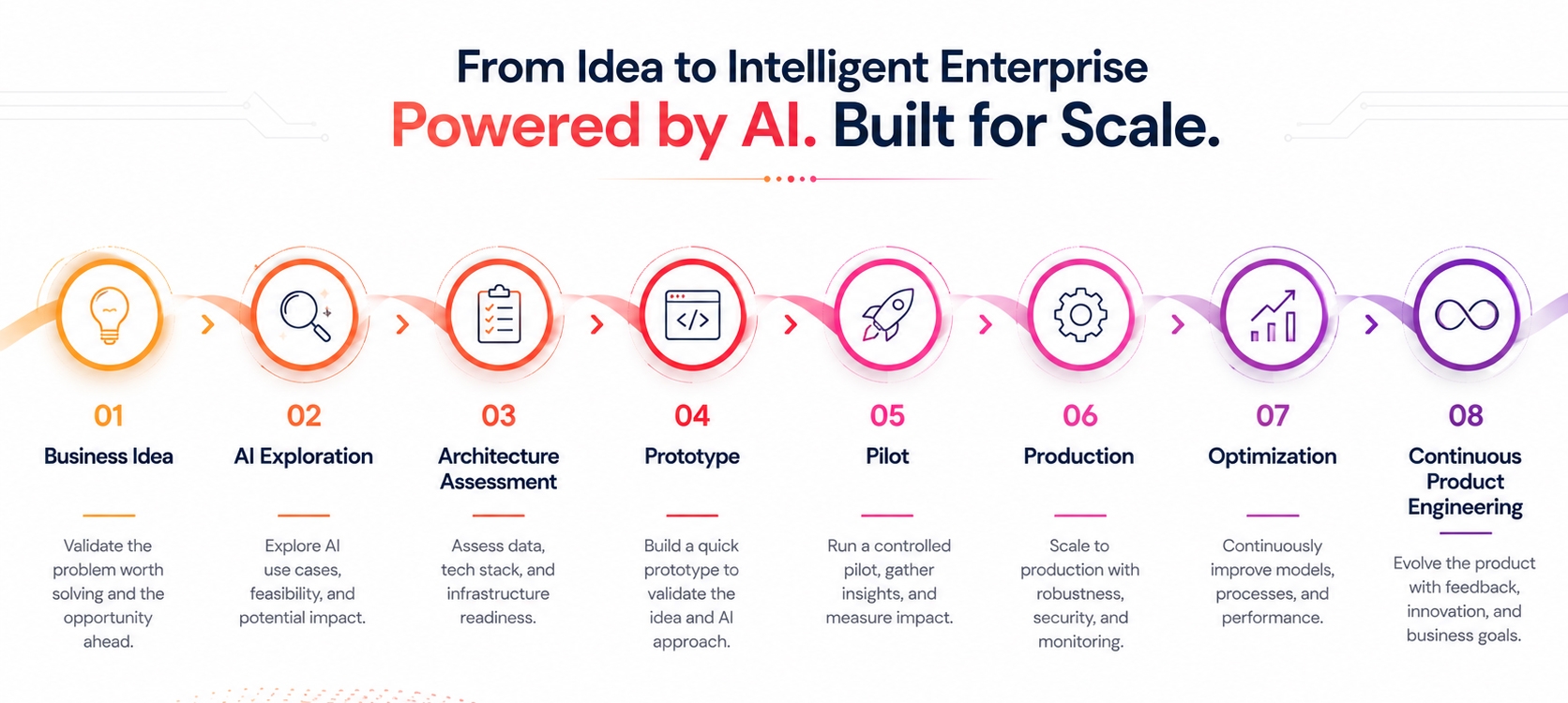
Each stage builds on the last. In one enterprise engagement we supported, skipping the architecture assessment step led to a significant cost overrun once the AI feature reached production traffic a pattern we've since seen recur whenever teams jump straight to model integration. None of this holds up without ongoing product engineering services to maintain, monitor, and tune the feature post-launch AI products aren't a one-time build; they need continuous refinement as usage and data evolve.
Where GPT-6-Class Models Fit and Where They Don't
Not every workflow is a good candidate for a frontier reasoning model, and being upfront about this is part of good engineering advice, not a weakness. These models tend to perform well for knowledge search, copilots, summarization, and multi-turn support workflows where grounded retrieval and human review are part of the design. They're a poor fit for deterministic calculations, real-time trading logic, safety-critical workflows, and regulated approval systems where explainability and determinism matter more than reasoning flexibility. Recognizing this distinction early prevents wasted engineering cycles on the wrong use case.
Industry Snapshot: Healthcare
Preparing an EMR or patient engagement platform for AI features like these requires structured patient data, secure API layers, and compliant AI workflows, per our Healthcare Software Development work. Patient records, scheduling systems, and billing data typically live in separate systems which means an AI-powered hospital appointment assistant can't answer questions accurately until those systems are connected through a unified retrieval layer.
Industry Snapshot: HCM
Preparing an AI recruitment platform follows a similar pattern, drawing on our HCM Software Development experience. An AI recruitment copilot needs resume parsing, applicant tracking system integration, vector search, and explainable recommendations grounded in real candidate data not generic model output. Without that foundation, the copilot either hallucinates candidate details or simply can't access the information recruiters need.
Industry Snapshot: Fintech
Fintech platforms face a similar readiness gap with a sharper compliance edge. A fraud-detection copilot or KYC/AML document review assistant needs transaction data, identity records, and regulatory rule sets connected through auditable, access-controlled pipelines not just a model plugged into raw customer data. Regulated disclosure generation adds another layer: outputs need traceable sourcing and human sign-off before anything reaches a customer or examiner. This is where AI-ready architecture and compliance-first engineering have to be designed together from day one, not retrofitted after a pilot.
Common Objections We Hear
Teams evaluating enterprise AI adoption often raise objections that sound reasonable on the surface:
"We're too small for this" in our experience, readiness depends more on data hygiene than company size
"We already use GPT-4, why change now" the architecture work carries forward and compounds in value with each model upgrade
"We don't have AI engineers in-house" this is exactly the gap product engineering services fill, without the cost of building a full internal AI team
"Our architecture isn't ready" that's a starting point for an assessment, not a reason to wait
Key takeaway: Most AI projects succeed or fail based on data quality and system architecture, not the model itself. AI-ready architecture is the real prerequisite for enterprise AI success, and it's engineering work not a procurement decision.
Risks Worth Planning For
No AI rollout is risk-free, and acknowledging that builds trust with technical buyers. Hallucination risk is best managed through retrieval-grounded responses, confidence thresholds, and human review on high-stakes outputs. Data leakage risk requires strict access controls, redaction, and tokenization built into the application layer from the start. Over-reliance on the model is mitigated by keeping manual workflows and failover modes available, and compliance drift needs periodic audits as both the model's behavior and your regulatory environment evolve.
Getting Started
The most useful next step for a product leader evaluating GPT-6 for enterprise product teams isn't a bigger AI budget it's a structured readiness check. Book a Product Architecture Assessment, and our team will help identify:
API readiness gaps
Cloud scalability issues
AI data pipeline bottlenecks
Security and compliance risks
A practical AI integration roadmap for when GPT-6-class models arrive
Conclusion
Enterprise AI isn't becoming a competitive advantage anymore it's becoming an expectation. The organizations that prepare their products ahead of the next model generation will spend less time fixing architecture and more time delivering customer value. Product engineering services are what turn AI ambition into production-ready software, and the sooner that foundation is in place, the faster the next model upgrade becomes an opportunity instead of a scramble.
Build an AI-Ready Product That Scales