


 Updated on 30 July 2026

This guide is written for CTOs, CEOs, Founders, VPs of Engineering, and Product Owners preparing for AI4 2026, held August 4–6 at The Venetian in Las Vegas one of the largest enterprise AI conference 2026 gatherings in the US. Many teams walk into AI conferences chasing tools and demos, but walk out with more questions than answers because they never clarified their architecture, data readiness, or product strategy beforehand. This article fixes that gap with a practical prep framework for the AI4 conference agenda 2026.
What Is AI4, and Why Is It Different?
AI4 is one of the largest gatherings in the US for enterprise AI decision-makers, bringing together technology leaders, AI vendors, researchers, and enterprise teams across healthcare, finance, manufacturing, and other regulated industries. Unlike academic AI events focused on research breakthroughs, AI4 centers on real-world deployment, governance, and measurable business outcomes which is exactly why it matters to product and engineering leaders, not just data science teams.
In our experience across enterprise engagements, most AI pilots that stall do so because of weak architecture, unclear data ownership, or a lack of engineering discipline behind the model not because the underlying model underperformed. That gap is the real reason preparation matters more than attendance.
Who Should Attend AI4 2026?
This conference is especially valuable for:
CTOs modernizing enterprise applications and evaluating AI-ready architecture
CEOs and Founders assessing where enterprise AI adoption fits their growth plan
Product Owners building AI-enabled features into existing products
Engineering leaders responsible for cloud modernization and DevOps automation
Teams trying to move stalled pilots into production
Why AI4 Matters for Enterprise Leaders
Enterprise AI adoption is no longer optional it's a boardroom priority. AI4 gives leaders a concentrated window to benchmark real deployments, meet vendors, and pressure-test assumptions before committing budget.
Real-time benchmarking of what's actually working in production, not just in demos
Vendor and partner triage against your specific operating model
Cross-industry insight from healthcare, Human Capital Management, and core ERP deployments
Talent and org-design signals for building internal AI capability
Core Themes to Prepare For
Enterprise AI strategy and Governance Come ready to discuss KPIs tied to revenue and cost outcomes, not vanity metrics. Ask peers how they structure model ownership, retraining triggers, and bias auditing. A useful lens: is your governance centralized, federated, or hybrid and does that match your risk tolerance?
AI-ready architecture and Scaling This is where most projects quietly fail. Before selecting a model or vendor, Product Engineering Services teams should validate whether existing infrastructure can actually support enterprise-scale AI data pipelines, feature stores, and observability included. A feature store, in plain terms, is a shared library of ready-to-use data signals that stops every team from rebuilding the same inputs from scratch. If your architecture can't support that today, an architecture assessment before AI implementation is far cheaper than a redesign after a failed rollout.
AI product development and Engineering Discipline Successful AI product engineering isn't just about the model it's product strategy, cloud architecture, DevOps automation, and continuous monitoring working together. Define acceptance criteria the way you would for any product: business SLAs, confidence thresholds, and workflows that make model uncertainty visible to the people using it.
Generative AI for enterprises Bring questions on prompt guardrails, fine-tuning versus retrieval-augmented generation, and IP or data-leakage risk. Real use cases worth raising: contract analytics for legal teams, virtual agents tied into HCM for onboarding, and generative tools that speed up R&D and design ideation.
AI in Healthcare and HCM These are high-stakes, example-rich domains. A hospital piloting AI-assisted scheduling should validate patient wait-time improvements in one department before expanding further. In HR, AI-driven document verification can meaningfully reduce onboarding time in some cases from several days to under 48 hours. These are the kinds of concrete, ICP-relevant stories worth asking vendors and peers about at AI4.
Scaling AI Across Large Organizations Discuss whether a Center of Excellence or embedded model teams (or a hybrid) fits your scale, and where the gaps sit between domain experts, data engineers, and production SREs.
The Product Engineering Framework Behind Every Successful AI Initiative
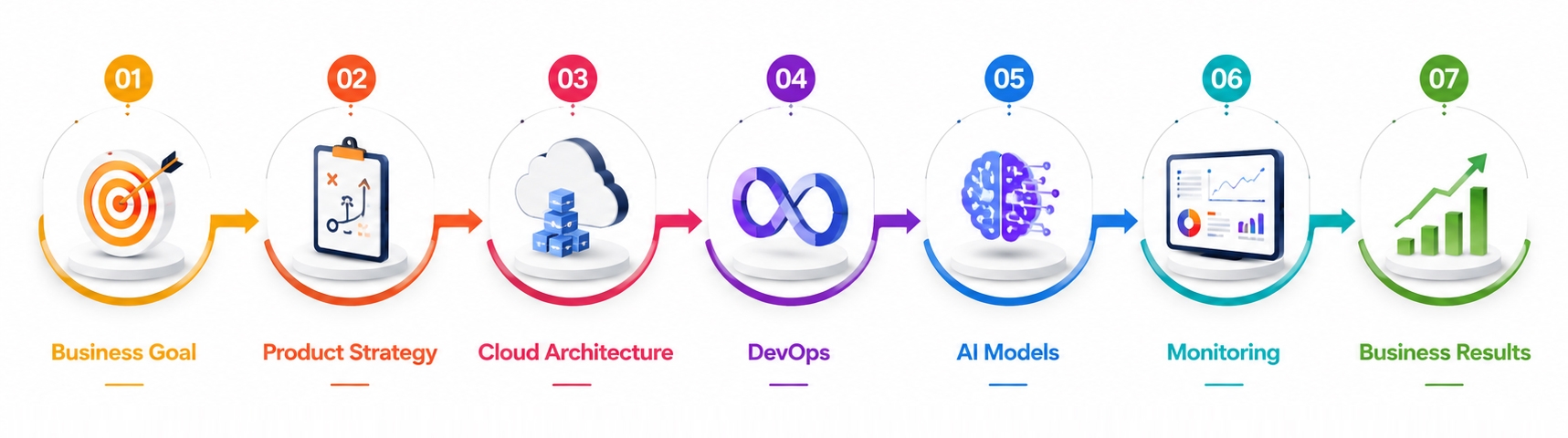
Cloud and AI are tools. Product engineering is the craft that connects them to a business outcome. Skipping any layer in this chain is usually why AI initiatives stall after the pilot stage.
Technical and Business Prep Checklist
Before you land in Las Vegas, prepare:
A one-to-two-page architecture snapshot: data flows, feature stores, model endpoints, infra costs
A one-page brief per use case: business outcome, success metric, data availability, constraints
A security and compliance matrix covering data classification and audit requirements
A tooling inventory showing CI/CD maturity and current bottlenecks
Table 1: AI Product Lifecycle and Ownership
| Phase | Primary Owner |
|---|---|
| Discovery | Product strategy, domain experts |
| Data Readiness | Data engineering, governance |
| Modeling | ML engineers, data scientists |
| Deployment | Platform, DevOps, ModelOps |
| Post-Deployment | Observability, compliance, business analytics |
Evaluating Vendors and Partners
Ask AI consulting services and platform vendors scenario-driven questions rather than accepting a demo at face value:
How do you detect feature and schema drift before it breaks production?
What does your rollback process actually look like?
What's the real total cost of ownership at production scale, including human-in-the-loop review?
How many AI systems have you taken from pilot to production and how long did it take?
Table 2: Vendor Evaluation Checklist
| Capability | What to Ask |
|---|---|
| MLOps Platform | Feature store support, drift detection, auto-scaling |
| Generative AI Studio | Fine-tuning controls, RAG integration |
| Security & Privacy | Data masking, differential privacy, certifications |
| Integration | Prebuilt ERP/CRM connectors, event-stream support |
Many organizations also bring in independent product engineering services partners to evaluate vendor claims before signing multi-year contracts a step worth considering if internal bandwidth is limited.
Before AI4 vs. After AI4
| Before AI4 | After AI4 |
|---|---|
| Vendor brochures | Technical evaluation framework |
| AI ideas | Prioritized roadmap |
| Architecture assumptions | Validated decisions |
| Isolated pilots | 90-day execution plan |
A Simple AI Readiness Framework
Before greenlighting a new AI initiative, score your organization from 0–5 across five dimensions: data quality, infrastructure maturity, security posture, engineering capacity, and product clarity. A low score on any one dimension is usually the real reason pilots stall not the model itself.
Common Pitfalls to Probe With Peers
Missing data contracts that quietly break pipelines
Unclear ownership between model performance and data quality
Manual retraining processes that can't keep pace with drift
The fix in each case is the same: treat AI like a product, with clear ownership, SLAs, and runbooks not a one-off experiment.
Turning AI4 Insights Into a 90-Day Plan
Weeks 1–2: Internal debrief; shortlist top vendor or partner follow-ups
Weeks 3–4: Architecture sprint addressing your top two technical gaps
Month 2: Run a pilot with clear business metrics for 4–6 weeks
Month 3: Evaluate against acceptance criteria and plan phased rollout
Key Takeaways
Enterprise AI strategy succeeds or fails based on architecture and governance, not model choice alone
AI-ready architecture should be validated before vendor selection, not after
Real examples from AI in healthcare and HCM make abstract AI trends concrete for decision-makers
Strong AI product engineering treats AI as a disciplined product function, not a side experiment
A clear 90-day plan converts conference conversations into measurable outcomes
Frequently Asked Questions
What is AI4 2026?
AI4 2026 is one of the largest US conferences for enterprise AI leaders, bringing together enterprise decision-makers, AI vendors, and researchers to discuss real-world AI deployment, governance, and business outcomes.
Where is AI4 2026 being held?
AI4 2026 takes place August 4–6, 2026 at The Venetian in Las Vegas, Nevada, drawing enterprise leaders across healthcare, finance, HCM, and technology sectors.
Who should attend AI4?
CTOs, CEOs, Founders, Product Owners, and engineering leaders responsible for AI strategy, architecture, or product modernization should attend.
What topics will AI4 cover?
Expect sessions on enterprise AI strategy, generative AI governance, MLOps, AI in regulated industries, and scaling AI across large organizations.
How should companies prepare before attending?
Bring an architecture snapshot, prioritized use cases, a vendor evaluation checklist, and clear success metrics for any pilot already in flight.
How can Product Engineering help after AI4?
A Product Engineering Services partner can translate conference insights into a validated architecture, a phased rollout plan, and production-ready AI features rather than another unfinished pilot.
Conclusion
AI4 2026 isn't about finding the newest AI model it's about making better engineering decisions. Organizations that combine product strategy, cloud architecture, DevOps, and AI into a disciplined product engineering approach will be far more likely to turn conference insights into measurable business outcomes. Cloud and AI are tools; product engineering is the craft that turns them into results.
Build a Strong Foundation for Enterprise AI