

 Updated on 5 May 2026

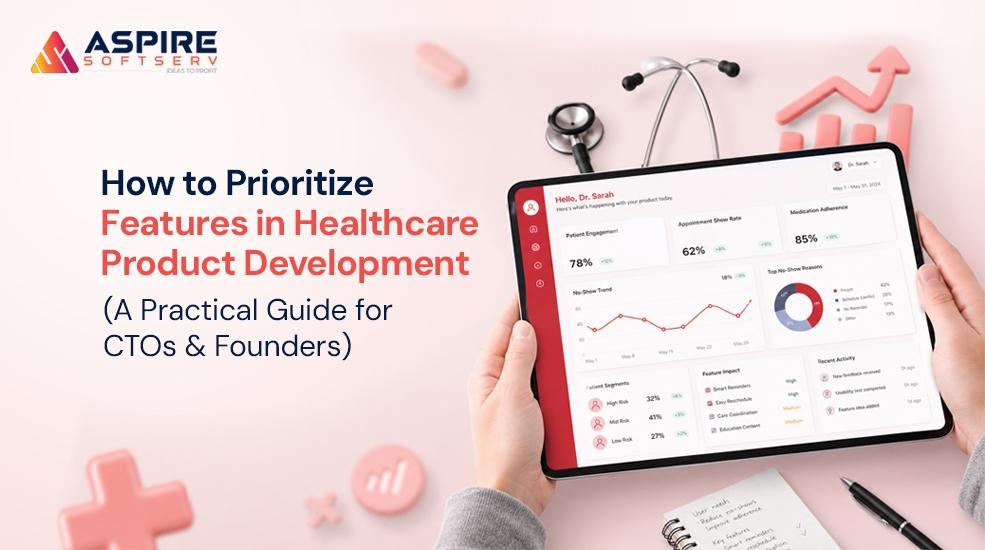
Building a healthcare product means making hard choices every single sprint. Do you invest in a smoother patient onboarding flow, or do you fix the claims reconciliation bottleneck draining your ops team? This isn't a theoretical dilemma it's the decision that separates products that scale from those that stall. This guide is for founders and CTOs building healthcare platforms where both patient adoption and operational efficiency directly impact revenue and scalability.
This is exactly where structured product engineering services become critical not just to build features, but to help teams prioritize the right features at the right stage of growth.
Most teams pick a side too early. They either chase patient delight until the margins collapse, or they over-engineer backend workflows until clinicians stop using the product altogether. The real skill in healthcare product development is knowing when to prioritize what and building a system that makes those decisions repeatable and cost-efficient.
What Is Healthcare Feature Prioritization?
Healthcare feature prioritization is a structured process used by product teams to decide which features to build first based on their impact on patient outcomes, operational efficiency, and business goals. It accounts for regulatory constraints, interoperability requirements, and the finite capacity of engineering teams working in one of the most compliance-heavy industries in software.
Without this system, teams end up in the same meeting every sprint debating the same trade-offs and making decisions based on whoever argues loudest rather than what the data says.
The Real Cost of Getting Prioritization Wrong
Here's a pattern that repeats itself across healthcare startups: a team builds a beautifully designed patient app with symptom tracking, personalized dashboards, and a virtual triage chatbot. The UX is excellent. But six months post-launch, the billing module throws errors on 12% of claims, the scheduling tool can't handle concurrent bookings, and the ops team is manually reconciling data every morning.
The result? High churn despite strong satisfaction scores. The healthcare platform development challenges weren't technical they were prioritization failures.
The inverse also happens. Teams build airtight backend infrastructure automated workflows, AI-driven scheduling, predictive inventory but the patient-facing interface is clunky. Clinicians adopt it. Patients don't. And in a market where patient experience in healthcare directly influences retention and reimbursement models, that's a costly miss.
Both Priorities Matter But Not Equally at the Same Time
Short answer: You should not balance both equally prioritize based on your current bottleneck.
| Focus Area | Goal | Example Features | Business Impact |
|---|---|---|---|
| Patient Experience in Healthcare | Adoption and retention | Telehealth, reminders, dashboards | Higher NPS, lower churn |
| Healthcare Operational Efficiency | Cost and scalability | Scheduling, billing, automation | Lower costs, higher throughput |
Patient experience in healthcare is about reducing friction at every touchpoint appointment booking, health record access, medication reminders, telehealth visits. HIMSS research shows that top-rated patient portals correlate with 20–30% higher patient retention.
Healthcare operational efficiency focuses on what happens behind the interface staff scheduling, claims processing, bed management, inventory forecasting. In hospitals where margins sit between 2–5%, improving hospital workflow using software can reduce readmission rates by 15% and reclaim hours clinicians lose to manual data entry every day.
Key insight:
Patient features drive adoption and retention
Ops features drive profitability and clinical scalability
The right balance depends entirely on your current constraint, not your preference
The 70–30 / 40–60 Prioritization Model
This is the clearest decision shortcut for healthcare product strategy. Use it to set your roadmap allocation before every planning cycle:
| Product Stage | Patient Focus | Ops Focus | Primary Signal |
|---|---|---|---|
| Early-stage / Pre-launch | 70% | 30% | Adoption is the constraint |
| Growth / Post-PMF | 40% | 60% | Cost and throughput are the constraint |
| High churn despite engagement | Fix ops first | Then patient | Ops debt is killing retention |
If your roadmap allocation hasn't changed in 12 months, that's a signal your product has grown but your healthcare product roadmap strategy hasn't kept up.
A Framework That Actually Works: RICE + Kano Combined
Most teams default to gut feel or whoever has the loudest voice in the room. A more reliable approach is combining RICE scoring with the Kano model wo frameworks that together give you both a quantitative rank and a qualitative signal for healthcare product feature prioritization.
RICE scoring (Reach × Impact × Confidence ÷ Effort) forces your team to estimate real numbers:
RICE Scoring Table Sample Healthcare Features
| Feature | Reach | Impact (1–10) | Confidence | Effort | RICE Score |
|---|---|---|---|---|---|
| Symptom tracker app | 50K patients/mo | 9 | 90% | 3 months | 135 |
| AI bed allocation | 200 staff | 8 | 80% | 4 months | 80 |
| Automated billing reconciliation | 5K claims/mo | 9 | 95% | 5 months | 85.5 |
| Telehealth video integration | 10K visits/mo | 7 | 85% | 2 months | 74.5 |
The symptom tracker wins on patient reach. Billing automation wins on ops ROI. Both deserve roadmap space but in different quarters depending on your current growth phase.
The Kano model adds the qualitative layer RICE alone misses:
Basic needs Must-haves like secure login and HIPAA-compliant data storage. Non-negotiable regardless of RICE score.
Performance features Scale proportionally with satisfaction: faster scheduling, accurate diagnostics, cleaner reporting.
Delighters Features users didn't expect but adopt quickly: AI-powered medication insights, proactive risk alerts, personalized health nudges.
When you combine both frameworks, the healthcare software feature prioritization framework stops being a political exercise and starts functioning like an engineering decision.
The Prioritization Process: How to Run It in Practice
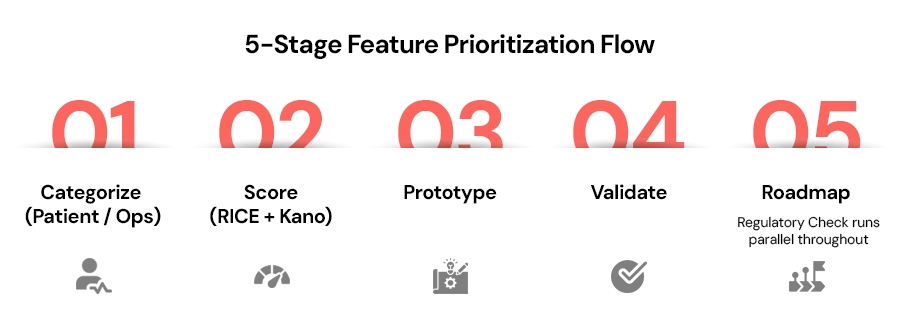
Stage 1 — Gather inputs across three channels. Collect patient NPS surveys, clinician workflow feedback, and ops metrics—average handling time, error rates, manual touchpoints. A patient might love the app while the billing team is drowning. You need both signals before you score anything.
Stage 2 — Categorize features by primary beneficiary. Is this feature primarily solving a patient problem or an operational one? Features that serve both are your highest-priority candidates—they move both metrics without splitting resources.
Stage 3 — Score using RICE, then apply Kano classification. Features that score high on RICE and fall in the "basic need" Kano category go first, without debate. Features that are delighters but low-reach go to Q3 or Q4.
Stage 4 — Prototype before you build. This is where Product Design and Prototyping pays for itself especially when validating complex healthcare workflows early, before compliance and engineering constraints make changes expensive. A prototype tested with 10 real users can invalidate a 3-month build assumption in 3 days.
Stage 5 — Validate post-launch and feed back into the next cycle. Set clear metrics upfront: NPS above 8 for patient features, throughput improvement of 15% or more for operational features. No target, no learning and no basis for the next prioritization round.
When to Lead With Patient Experience
Prioritize features for healthcare apps that improve patient experience when:
Your NPS is below 7
Churn is happening within the first 30 days of onboarding
Activation rates patients completing key actions are under 40%
You are in a consumer-facing market where word of mouth drives growth
Features that consistently perform well at this stage include personalized health dashboards, wearable integrations, medication reminders, and one-click telehealth access. These build the habit loops that create retention and retention is what makes every downstream investment in ops worth making.
When to Shift to Operational Efficiency
If your product is already adopted but cost per transaction is rising, staff are experiencing alert fatigue, or clinical outcomes aren't improving despite high engagement your ops layer is the bottleneck.
Healthcare system performance optimization at this stage means:
AI-driven scheduling to reduce no-shows by up to 18%
Predictive inventory management via IoT sensors
Claims automation with OCR-based reconciliation that eliminates manual error correction
Real-time staff dashboards with customizable alert thresholds to prevent the alert fatigue that makes ops tools get ignored
This is also where Cloud and DevOps Engineering decisions become directly tied to product strategy particularly for scaling multi-tenant healthcare platforms handling concurrent clinical workloads. Microservices architecture and container-based deployments are not just infrastructure choices; they are what allows your product to handle peak clinical loads without degrading the patient experience that drove adoption in the first place.
The Hybrid Roadmap: Balancing Both Without Losing Either
The most effective healthcare product roadmap strategy is a structured allocation that shifts over time as your product matures not a pendulum that swings reactively based on whoever raised a concern last week.
Sample Roadmap Allocation by Quarter
| Quarter | Patient Experience Focus | Operational Efficiency Focus | Key Metrics |
|---|---|---|---|
| Q1 | Mobile onboarding, symptom tracker | Claims automation baseline | NPS >7, Error rate <5% |
| Q2 | Wearable sync, telehealth video | AI scheduling, staff dashboards | Adherence +20%, No-shows -15% |
| Q3 | Chatbot, health insights | Inventory ML, predictive alerts | Cost per encounter -12% |
| Q4 | Personalization engine | Interoperability (FHIR/HL7) | Retention +25%, Throughput +15% |
This structure reflects the core principle in balancing patient experience and operational efficiency in healthcare: patient features open the door, operational features keep the business viable enough to walk through it repeatedly.
The Challenges That Break Healthcare Product Roadmaps
Healthcare platform development challenges surface in three specific situations that teams rarely plan for in their initial roadmap:
Regulatory interference. FDA 510(k) requirements can delay an AI-diagnostic feature by 6–18 months. If that's sitting in Q2 without accounting for regulatory review cycles, your entire roadmap cascades downstream. Always run a compliance checkpoint before scoring features that touch clinical decision-making.
Interoperability debt. Features built without FHIR or HL7 compliance create integration debt that compounds with every new data source you add. Prioritize interoperability infrastructure early it is a basic need for healthcare application development at scale, not a future-state consideration you can defer without consequence.
Alert fatigue. Operational features like real-time dashboards and predictive alerts are only as valuable as the clinical response they generate. If you are improving hospital workflow using software but your alert volume overwhelms staff, adoption drops and your efficiency investment becomes a distraction tool. Build in customizable thresholds and snooze controls from the start.
These are not edge cases. They are why well-funded digital health product development teams miss their roadmap commitments despite strong engineering execution. Solving them requires cross-functional input from product, engineering, compliance, and clinical teams. This is where Product Strategy & Consulting support from experienced product engineering services partners makes a measurable difference particularly for teams scaling past their first 10,000 active users.
Final Takeaways
Don't choose patient experience or operational efficiency permanently the right answer changes with your product stage
Apply the 70–30 model early; shift to 40–60 as you scale and ops becomes the growth constraint
Use RICE scoring to compare features based on reach, impact, confidence, and effort and remove politics from the decision
Always prototype before committing engineering resources; validate regulatory assumptions before they become sprint blockers
Run a compliance check in parallel with every prioritization cycle not after the sprint has started
Shift your roadmap focus as constraints change: an adoption bottleneck and a cost bottleneck require fundamentally different solutions
If you cannot clearly identify your current constraint patient adoption or operational capacity you are prioritizing blindly. And in healthcare software development, prioritizing blindly is one of the most expensive mistakes a product team can make.
Improve Patient Experience Without Increasing Costs