

 Updated on 31 August 2026

The cost of Odoo ERP implementation in 2026 can range from a few thousand dollars for a basic setup to well over $100,000 for a complex, highly customized rollout. Understanding your Odoo ERP implementation cost early keeps the rest of the budgeting process realistic, since this figure sets the tone for every ERP implementation cost comparison you make against other platforms. The final amount depends on the number of users and applications, customization, data migration, integrations, business complexity, and the level of implementation support required, all of which shape your overall Odoo implementation budget.
It also helps to separate Odoo's software subscription from implementation services. Odoo lists its Standard plan at $24.90 per user per month when billed annually and its Custom plan at $49 per user per month when billed annually in its US pricing configurator. Implementation services are priced separately and can include business analysis, configuration, data import, customization, development, and training.
How Much Does Odoo ERP Implementation Cost?
There is no official fixed price for an Odoo implementation because every project has a different scope. When businesses ask how much it costs to implement Odoo ERP, the honest answer is that it depends on what you are implementing, not how many people will use it. For initial budgeting, a practical way to think about the market looks like this:
Basic implementation covers core applications, standard configuration, and limited customization. Planning range: $3,000 to $15,000.
Mid range implementation covers multiple applications, migration, integrations, and some customization. Planning range: $15,000 to $50,000.
Complex implementation covers extensive customization, multiple integrations, and multi company or multi country requirements. Planning range: $50,000 to $150,000 or more.
These ranges are not official Odoo price tiers. They are planning benchmarks. A basic project might involve Sales, CRM, and Invoicing with mostly standard workflows. A mid range project may add Inventory, Purchase, Accounting, migration from an existing ERP, and several integrations.
A complex rollout can involve manufacturing, multiple legal entities, country specific requirements, custom workflows, and several external systems. That is why two companies with the same number of users can receive very different Odoo implementation estimates.
Understanding these variables is central to any realistic Odoo ERP pricing conversation, and it is worth reviewing our Odoo implementation checklist ,before you request quotes so nothing gets missed during scoping, a pattern that holds across most ERP implementation cost benchmarks we see.
Odoo ERP Pricing: What Makes Up the Total Cost?
Odoo ERP pricing is a combination of software subscription and implementation work spread across several distinct cost categories. Understanding each layer helps you evaluate quotes accurately and avoid budgeting for software alone.
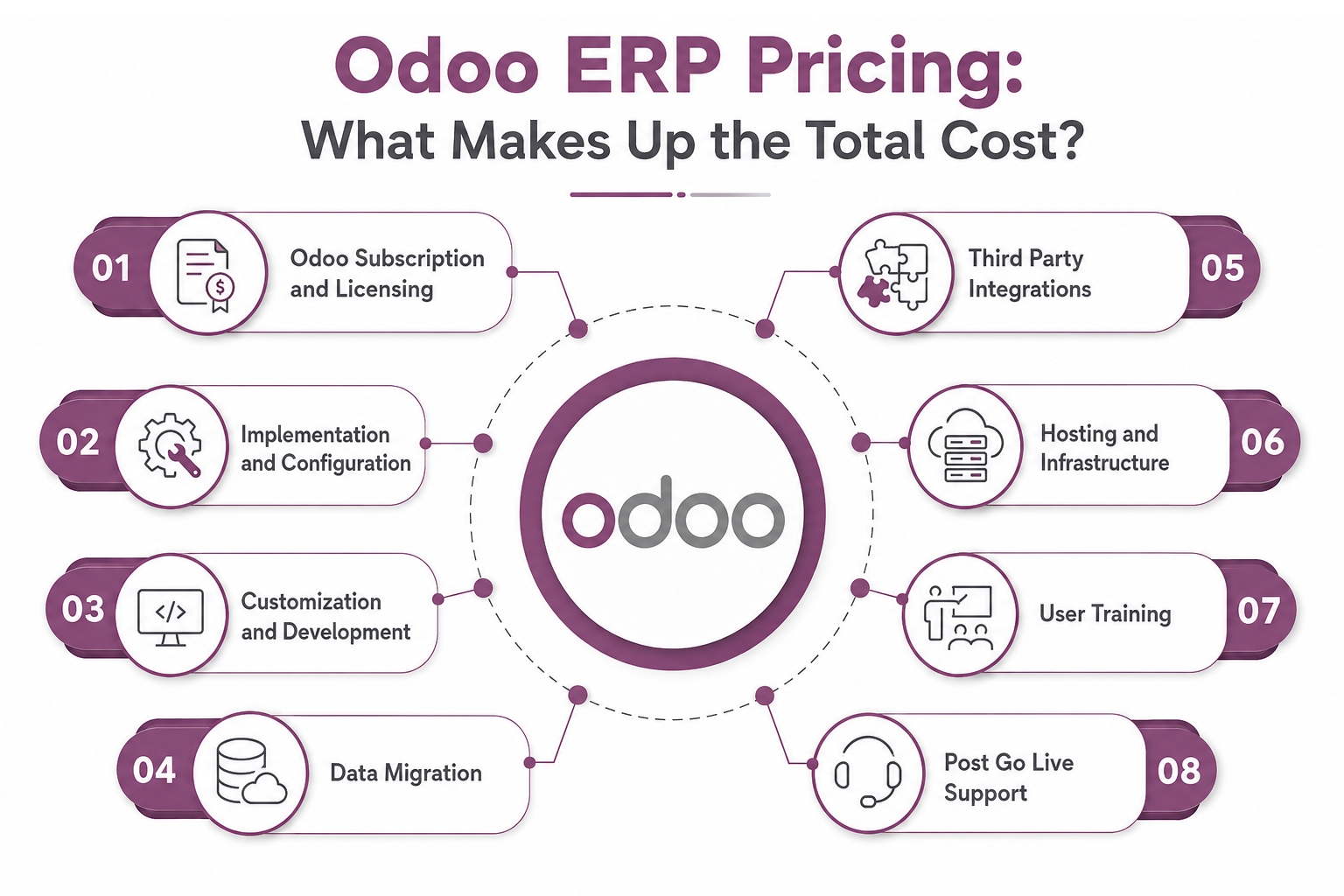
1. Odoo Subscription and Licensing
Odoo currently prices the Standard plan at $24.90 per user per month billed annually ($31.10 monthly) and the Custom plan at $49 per user per month annually ($61 monthly). Custom unlocks Odoo Studio, multi company databases, and external API access. This is a recurring cost that scales directly with your user count, independent of any implementation work. Odoo also still offers Odoo Community, the free, open source version, for businesses comfortable managing their own hosting and support. Odoo Enterprise is the paid tier that includes official support and the Standard and Custom plans above.
2. Implementation and Configuration
Implementation covers requirements analysis, process mapping, module setup, user roles, and workflow configuration. This is the work that turns Odoo's default settings into a system matching how your business actually operates. Projects with straightforward, standard workflows need comparatively less configuration time than those requiring detailed process mapping across multiple departments.
3. Customization and Development
When standard Odoo functionality cannot support a specific requirement, developers build custom modules, reports, approval workflows, or business logic instead. This is typically the largest single Odoo customization cost driver in any implementation, since custom code also requires ongoing testing, documentation, and maintenance through future Odoo version upgrades.
4. Data Migration
Moving records out of a legacy system involves extraction, deduplication, field mapping, import, and validation. It is never a simple file upload. Clean, well structured data from a single source keeps Odoo migration cost low and migrates quickly, while years of inconsistent records spread across multiple systems demand significantly more cleansing and validation work.
5. Third Party Integrations
Connecting Odoo to an ecommerce store, payment gateway, shipping carrier, or marketplace requires API development, authentication, data mapping, and error handling for every connection point. Odoo Integration cost typically rises with each additional connection, and every integration also carries ongoing maintenance since external platforms change their APIs independently of your Odoo environment.
6. Hosting and Infrastructure
Odoo Online bundles hosting directly into your subscription at no extra charge. Businesses choosing Odoo.sh or a self hosted, on premise deployment pay a separate hosting cost for server infrastructure, and that cost scales with transaction volume, storage needs, and the level of uptime and performance your operations require.
7. User Training
Odoo adoption depends heavily on how confidently your team can use it from day one. Training costs vary with team size and role complexity. A small sales team needs far less structured training than a multi department rollout spanning inventory, accounting, and manufacturing staff simultaneously.
8. Post Go Live Support
Support does not end at deployment. Budget for a period of post launch assistance covering bug fixes, minor configuration adjustments, and user questions as your team settles into daily use. Ongoing support plans beyond this initial window are typically priced separately from the core implementation cost.
These components form your true first year Odoo investment and your real total cost of ownership, not just the license fee. A quote that only covers software or basic configuration is incomplete. A realistic budget accounts for every layer above before you compare implementation proposals.
What Factors Can Increase or Reduce Your Odoo Implementation Cost?
Two businesses with identical headcounts can land on very different Odoo implementation costs. The gap comes down to variables tied to scale and complexity that shift the final pricing up or down significantly.
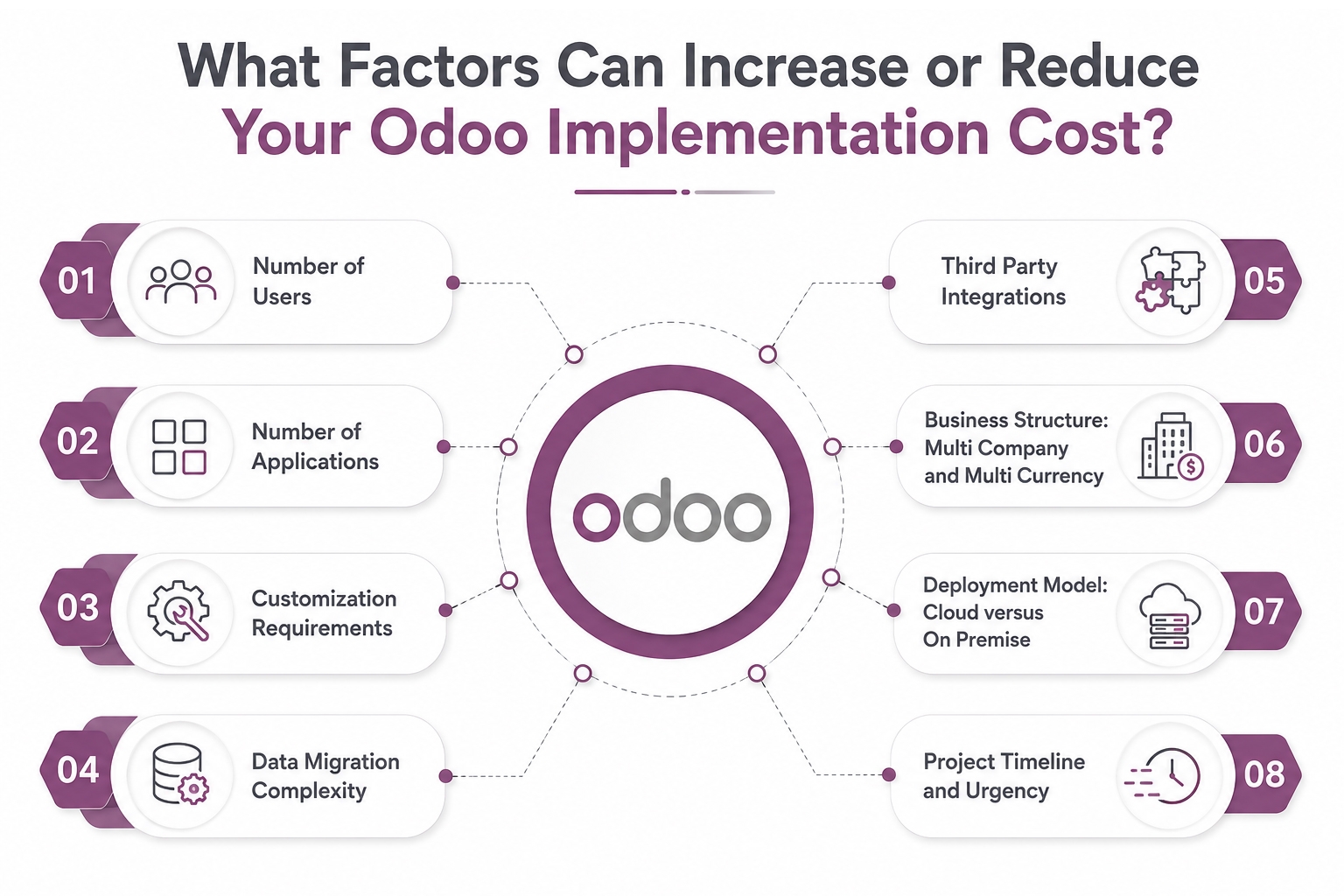
1. Number of Users
More users increase your subscription cost directly, but implementation effort does not scale in a straight line. A 20 user company with complex, department specific workflows can require more configuration and testing than a 50 user company running mostly standard Odoo functionality across simpler processes.
2. Number of Applications
Implementing Sales and CRM alone is a fundamentally different project from deploying Sales, Purchase, Inventory, Accounting, Manufacturing, and Quality together. Each additional application introduces new data relationships, permission structures, and testing scenarios that compound as more connected processes get added to the rollout.
3. Customization Requirements
This is usually the single largest Odoo customization cost variable. Businesses that can operate within Odoo's standard workflows spend far less than those attempting to rebuild complex legacy processes through custom modules, specialized reports, and unique approval logic that requires ongoing development and maintenance.
4. Data Migration Complexity
Both data volume and data quality directly influence Odoo migration cost. A migration involving one clean, well structured dataset moves quickly, while a project pulling years of historical transactions from multiple legacy systems with duplicate or incomplete records demands significantly more analysis, cleansing, and validation work. Many teams run into the same recurring problems here, which cover in our guide to common Odoo migration challenges and how to overcome them.
5. Third Party Integrations
A single connection typically keeps Odoo integration cost far lower than connecting Odoo simultaneously to an ecommerce store, payment gateway, shipping provider, and external warehouse system. The number of connections, their technical complexity, and how reliably they need to perform all directly affect the final project estimate.
6. Business Structure: Multi Company and Multi Currency
Multi company operations, multiple currencies, region specific accounting rules, and layered approval structures all add implementation effort. A single entity, single currency deployment sits comfortably at the lower end of the cost range, while a multi entity rollout with cross border compliance requirements moves well into higher territory.
7. Deployment Model: Cloud versus On Premise
Choosing Odoo Online keeps hosting bundled and implementation comparatively lean. Opting for Odoo.sh or a fully self hosted, on premise deployment adds infrastructure setup, security configuration, and ongoing server management work. All of that extends both the project timeline and the total cost.
8. Project Timeline and Urgency
Compressed timelines increase cost because more consultants and developers must work in parallel to hit an accelerated go live date. Projects with realistic, phased timelines generally cost less than rush implementations that require overtime, expedited testing, and additional resourcing to meet a tight deadline.
These variables rarely act alone. Most projects combine two or three simultaneously. Reviewing them against your own business before requesting quotes gives you a realistic starting range instead of a generic per user estimate. It also helps to avoid the mistakes we see most often, several of which are covered in our post on common mistakes to avoid when implementing Odoo.
What Does Odoo Implementation Actually Cost for Businesses Like Yours?
These are illustrative planning scenarios, not fixed quotes, but they show how the factors above translate into a real number.
Small service business: 10 users, Sales, CRM, and Accounting, no migration. Roughly $5,000 to $10,000. If this sounds like your situation, our guide on how to implement Odoo for a small business breaks down what that process looks like day to day.
Growing distributor: 30 users, Sales, Inventory, Purchase, and Accounting, one legacy migration, one integration. Roughly $20,000 to $40,000 with Odoo.sh hosting.
Multi location retailer: 50 users, ecommerce, POS, and Inventory, two integrations. Roughly $40,000 to $60,000 Odoo.sh hosting.
If your business resembles one of these profiles, you now have a realistic starting range before requesting a formal quote.
Why Choose Aspire SoftServ for Odoo ERP Implementation?
Choosing the right Odoo implementation partner matters as much as the software itself. The same platform can cost twice as much and deliver half as much value depending on who scopes it. Our Odoo Implementation Services price every engagement around your actual workflows, not a fixed package, so the number you receive reflects the work your business needs and keeps your total cost of ownership predictable.. Our approach draws on the same principles laid out in our best practices for Odoo ERP implementation.
Scope First Quoting: We map your applications, user roles, and processes before pricing anything, so your estimate is built on real requirements rather than a standard bundle. Every Odoo implementation starts with this scoping step.
Itemized Proposals: Every quote separates configuration, customization, migration, and integration costs individually, so you can see exactly where your budget goes and what would count as a change request later.
Customization Scoped Accurately: We estimate custom Odoo ERP development work based on actual complexity, not a flat markup, which keeps costs predictable rather than a source of mid project surprises.
Migration Costed Upfront: Data cleansing, mapping, and validation are priced as part of the original scope through our Odoo migration services, not billed separately once problems surface after go live.
Integration Costs Mapped Early: We identify every system Odoo needs to connect with during scoping, not during development, using Odoo integration those costs are part of your original number.
Support Built Into the Number: Post go live training and support are part of the engagement from day one, not an unplanned line item added after your system is already live.

Conclusion
The Odoo ERP implementation cost in 2026 depends much more on project scope than on the software subscription alone. A basic deployment may require only a few thousand dollars in implementation work, while mid sized and complex projects can move into the tens or hundreds of thousands.
The key variables are users, applications, customization, migration, integrations, and business complexity. The best way to calculate an Odoo ERP implementation budget is to define those requirements first and then request a scope based estimate.
Frequently Asked Questions
1. How much does Odoo ERP implementation cost in 2026?
There is no single fixed price. A basic implementation may start around $3,000, while mid range projects can fall around $15,000 to $50,000 and complex implementations can reach $50,000 to $150,000 or more. Actual pricing depends on customization, migration, integrations, users, and business complexity.
2. Is Odoo implementation cost separate from Odoo pricing?
Yes. Odoo separates its software subscription from implementation services. Implementation can include requirements analysis, configuration, data import, customization, development, and training.
3. What factors affect Odoo implementation costs?
The main factors are the number of users and applications, customization, data migration, third party integrations, and business complexity. Multi company structures, multiple currencies, and country specific requirements can also increase the scope.
4. What is included in an Odoo ERP implementation?
An implementation can include business requirements analysis, configuration, data migration, customization, development, integrations, training, testing, and deployment. The exact scope depends on the provider and project requirements.
5. How do I estimate my Odoo implementation cost?
Start by defining the users, required applications, current system, migration requirements, customization needs, and external integrations. This lets a partner provide a detailed, scope based quotation instead of a generic estimate, which is the foundation of accurate Odoo implementation costs planning.
Plan Your Odoo Implementation With Confidence!