

 Updated on 31 August 2026

Introduction
As businesses grow, managing operations through disconnected tools, spreadsheets, and manual processes can become increasingly difficult. Sales, finance, inventory, manufacturing, and customer operations may all have different challenges, making it harder to maintain visibility and keep teams aligned.
These are some of the ERP challenges businesses face as they scale. Odoo Experience 2026 gives businesses an opportunity to explore how modern ERP, automation, AI, and connected applications can help address these challenges.
The important question is not simply which ERP has the most features. It is which ERP solutions can solve the problems your business is actually facing?
Why ERP Challenges Increase as Businesses Grow
Business processes often become more complex as a company grows. What worked with a small team may no longer work when there are more customers, employees, transactions, products, or locations to manage.
Teams may start relying on multiple applications to handle different functions. This can lead to data silos, repetitive work, limited reporting, manual data entry, and communication gaps between departments.
Over time, these common ERP challenges for businesses can affect productivity, decision-making, customer experience, and the ability to scale. This is why businesses need to look at ERP not just as software, but as a way to improve how their operations work together.
Overcome Business ERP Challenges at OXP 2026
As businesses grow, ERP challenges can appear across different parts of daily operations. Disconnected systems, manual work, limited visibility, inventory issues, complex accounting, manufacturing, eCommerce, implementation, and emerging AI opportunities can all affect efficiency. At Odoo Experience 2026, businesses can explore these areas and understand how different ERP approaches can help address them.
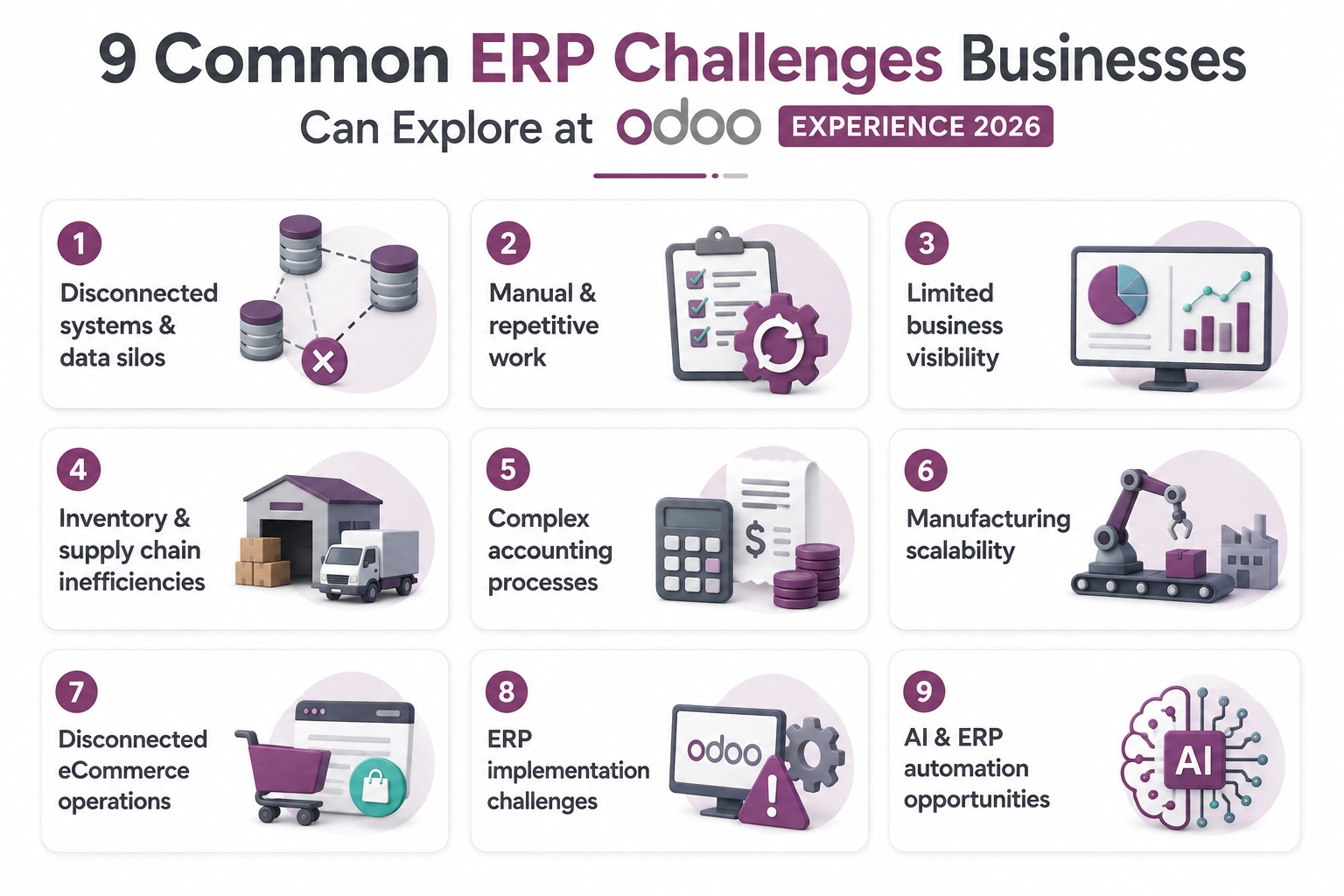
1. Disconnected Systems and Data Silos
When sales, accounting, inventory, customer management, and operations use separate systems, information can become scattered across the business. Employees may spend time checking different platforms or entering the same information more than once.
An integrated Odoo ERP approach can connect these business functions and create a more consistent flow of information. This can help teams work from shared data and reduce unnecessary movement between systems.
2. Much Manual & Repetitive Work
Manual data entry, approvals, follow-ups, document processing, and routine updates can take valuable time away from employees.
Businesses can explore ERP automation and AI-powered workflows to identify repetitive activities that can be handled more efficiently. The goal is not to automate everything, but to reduce work that does not require constant manual involvement.
3. Limited Business Visibility & Reporting
Having large amounts of business data does not always mean having clear visibility.
Management may struggle to get quick answers about sales performance, inventory, finances, customers, or operations. Connected ERP data, dashboards, and reporting can help bring this information together and make it easier to understand.
At OXP 2026, businesses can explore different approaches to improving business visibility, reporting, dashboards, and data-driven decision-making.
4. Inventory & supply chain inefficiencies
Inventory problems can affect several parts of a business. Inaccurate stock information, inefficient warehouse processes, poor replenishment planning, and disconnected purchasing can create delays and unnecessary costs.
Businesses managing complex supply chains can explore how Odoo connects Inventory, Purchase, Barcode, and warehouse operations. The focus should be on creating better coordination between what the business buys, stores, sells, and delivers.
5. Complex Accounting and Financial Processes
Finance teams often manage large volumes of transactions, invoices, payments, reconciliations, and reports. When financial processes depend heavily on manual work or disconnected systems, errors and delays can become difficult to avoid.
An integrated ERP can connect accounting with sales, purchasing, inventory, and other business operations. This can reduce duplicate data entry and give finance teams better visibility into the wider business.
6. Manufacturing Operations That Are Difficult to Scale
Manufacturing becomes more complex as production volumes, products, suppliers, and operational requirements increase.
Businesses may need better coordination between production, inventory, purchasing, quality, and other processes. Odoo MRP (Manufacturing Resource Planning) can provide a connected approach to managing these workflows, helping businesses evaluate how ERP can support more structured and scalable manufacturing operations.
7. eCommerce and Back-Office Operations Are Disconnected
For an eCommerce business, managing the website is only one part of the operation. Orders also need to connect with inventory, payments, shipping, accounting, and customer information.
When these functions operate separately, businesses can face delays and inconsistent information. An integrated ERP approach can help connect eCommerce and back-office operations, giving teams better control over the complete order-to-fulfillment process.
8. ERP Implementation Challenges
Choosing an ERP is only the beginning. Implementation can become challenging when businesses have unclear requirements, poor data quality, excessive customization, limited user adoption, or weak planning.
Before implementation, businesses should understand their existing processes and decide what needs to change. A successful ERP implementation should be built around business requirements rather than simply configuring software and expecting teams to adapt.
9. Using AI to Solve Everyday ERP Problems
AI is becoming an important part of modern ERP. Businesses can explore how AI automation, AI agents, and intelligent workflows can support everyday activities.
Potential applications include reducing repetitive tasks, finding information faster, supporting document processing, and helping teams work with business data more efficiently. The real value comes from applying AI where it solves a genuine operational problem.
How Should Businesses Approach These ERP Challenges?
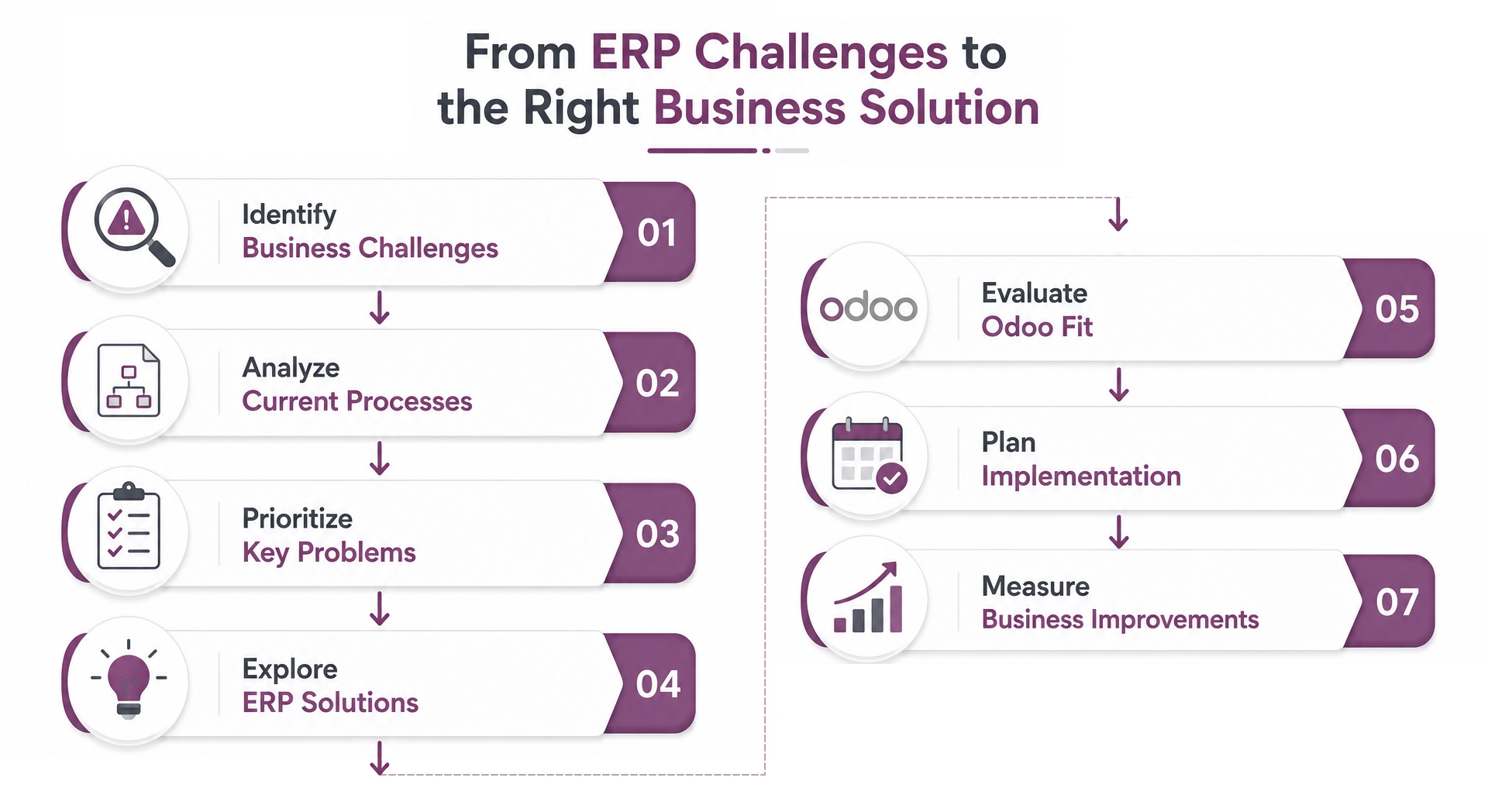
The first step is to understand the problem before choosing the solution.
Businesses should review their current processes, identify where teams lose time, find gaps in data and visibility, and understand which activities are difficult to scale. From there, they can prioritize the ERP challenges that have the biggest impact on operations.
This makes ERP evaluation more practical. Instead of asking “Which ERP has the most features?”, businesses can ask “Which ERP can solve our most important business challenges?”
What Should Businesses Look for at Odoo Experience 2026?
Businesses attending Odoo Experience 2026 should focus on the challenges most relevant to their operations rather than trying to explore every feature.
For example:
| Business Challenge | What to Explore |
|---|---|
| Disconnected systems | Integrated ERP workflows |
| Manual processes | Automation and AI |
| Poor visibility | Dashboards and reporting |
| Inventory issues | Inventory and Supply Chain |
| Financial complexity | Accounting and automation |
| Manufacturing growth | MRP and production workflows |
| eCommerce challenges | eCommerce and connected operations |
| Implementation concerns | ERP implementation methodology |
This approach can make the event more useful because businesses can connect what they learn with problems they are already trying to solve.
Is Your Business Ready for an ERP Transformation?
Before choosing an ERP or planning an implementation, businesses should first understand their current situation.
Look at your processes, data quality, integrations, manual tasks, reporting needs, existing systems, and team readiness. This can help you identify which problems need to be solved first and which ERP capabilities are actually relevant to your business.
A structured ERP readiness assessment can also help you identify gaps before making implementation decisions.
Conclusion: Turning ERP Challenges Into Business Improvements
ERP challenges are not the same for every business. Some struggle with disconnected systems and manual processes, while others need better visibility, automation, or a more scalable way to manage growing operations.
Odoo Experience 2026 gives businesses an opportunity to explore how ERP, automation, AI, and connected business applications can address these challenges. But the right solution starts with understanding your own processes, priorities, and gaps.
If you're evaluating your ERP options or considering Odoo ERP solutions for your business, the next step is to understand what your business actually needs and where Odoo can fit. Getting the right guidance early can help you choose the right approach, avoid unnecessary complexity, and build an ERP strategy around your business goals.
Frequently Asked Questions
1. What are the most common ERP challenges businesses face?
Common ERP challenges include disconnected systems, manual processes, limited data visibility, inventory inefficiencies, complex financial workflows, integration issues, and difficulties scaling operations.
2. How can Odoo help solve common ERP challenges?
Odoo brings different business functions together through connected applications. Businesses can use it to manage areas such as sales, accounting, inventory, manufacturing, eCommerce, CRM, and other operations within an integrated ERP solution.
3. Can Odoo help businesses reduce manual processes?
Yes. Odoo provides workflow automation capabilities, while its growing AI capabilities can support repetitive tasks and everyday business workflows. The right automation opportunities depend on the specific processes within each business.
4. Is Odoo suitable for businesses replacing an existing ERP?
Odoo can be considered by businesses looking to replace or consolidate existing systems. However, the decision should be based on business requirements, current processes, data, integrations, and future growth plans.
5. How can businesses prepare before choosing an ERP solution?
Businesses should review their current processes, data, integrations, customizations, reporting needs, and team readiness. Identifying these areas first makes it easier to determine which ERP solutions for businesses are actually needed.
Ready to Solve Your ERP Challenges?