


 Updated on 16 June 2026

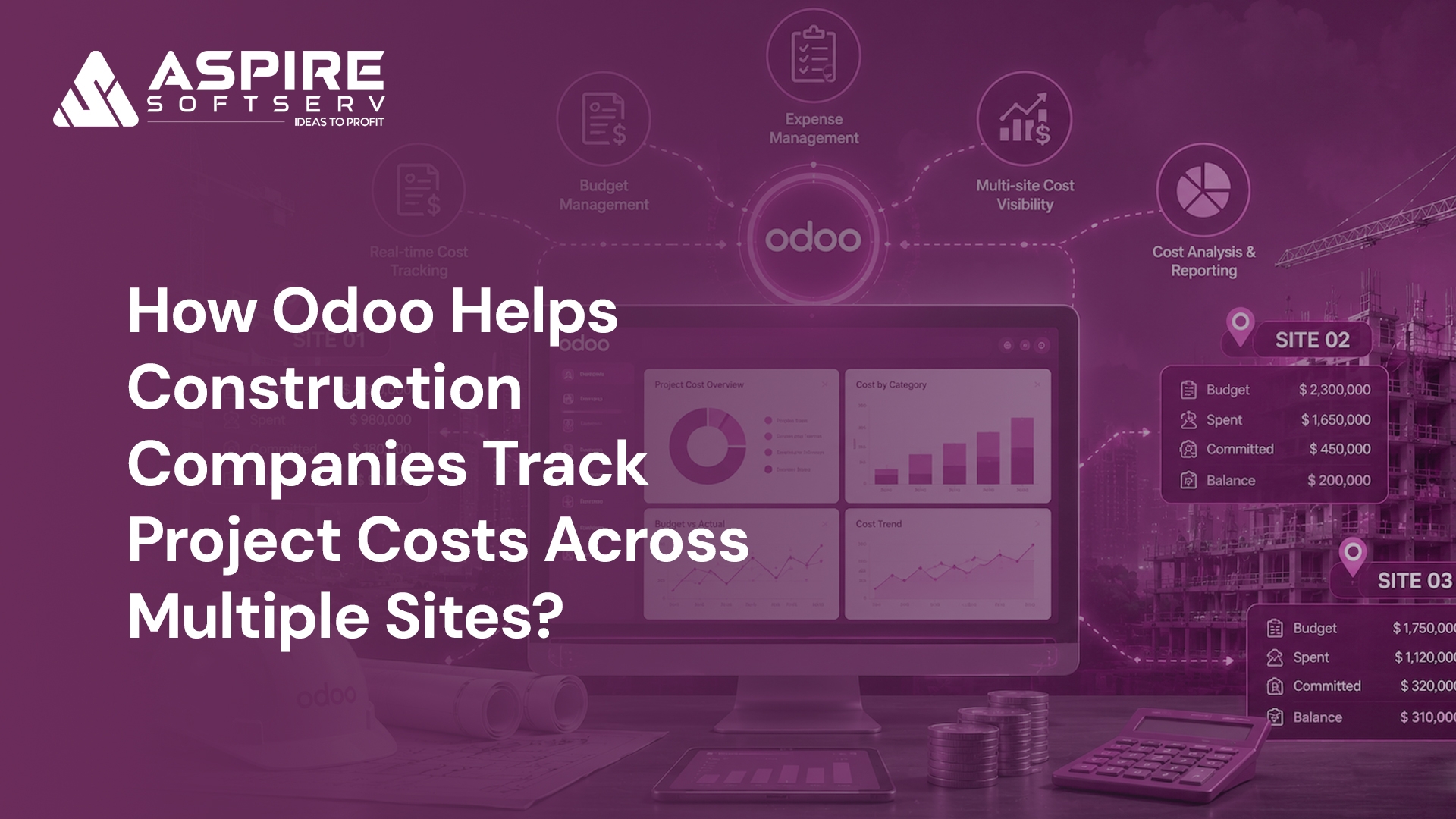
Your project is three months in. Costs are being spent across four active sites. But nobody on your team can tell you right now, today, how much has actually been spent, on what cost heads, and whether you are still within the budget you planned. That is not a reporting problem or a communication issue. That is a cost tracking problem, and it is more common than most construction firms admit.
Construction companies managing multiple sites deal with this reality every single week. Material invoices sit unmatched against purchase orders. Labor costs only get calculated at month end. Subcontractor payments are tracked in a separate spreadsheet that nobody updates consistently. Every delay in recording a cost is a delay in knowing your real financial position, which means every decision made in between is based on incomplete information.
Odoo ERP brings every cost type, including procurement, labour, subcontractors, and equipment, into one connected system. Every rupee or dollar spent gets recorded, categorized, and linked to the correct project the moment the transaction occurs. Across every active site. In real time. Without manual consolidation or waiting for someone to compile figures from multiple disconnected sources at the end of the month.
Where Construction Cost Tracking Breaks Down?
Construction firms lose money not in one large, visible mistake but through small, untracked costs that accumulate at every stage of every project. Without a connected system in place, cost overruns are not discovered until well after the damage has already been done and corrective action has become significantly more expensive.
Managing costs across multiple active sites makes the problem considerably worse. Each location generates its own invoices, timesheets, and purchase orders, and none of that data consolidates automatically into one accurate financial picture. Project managers are making spending decisions based on partial figures, and finance is reconciling numbers that are already days or weeks out of date.
1.No Project Budget Structure: Without defined budgets per project and per cost category, spending has no boundary and no reference point. Teams order materials and log labour hours without knowing whether the remaining budget supports those decisions. By the time a budget ceiling is identified, the commitments are already in place and reversing them creates costly vendor disputes.
2.Procurement Happens Without Checks: Purchase orders get raised before anyone has confirmed available budget against the relevant cost head. By the time the finance team reviews spending figures, commitments have already been made, and material orders are already in motion. Reversing those decisions without vendor disputes is rarely straightforward, and the budget damage is already recorded against the project.
3. Labor Costs Surface Too Late: Weekly or monthly timesheet submission cycles mean labour overruns are identified long after they have already occurred and compounded. By the time the hours are reviewed and costed, the project budget has already absorbed damage that could have been avoided. Real-time hour logging against specific project tasks is the only way to catch labour cost problems while they are still fixable.
4. Subcontractor Invoices Tracked Manually: Subcontractor costs are almost always managed in separate files that sit completely outside the main accounting system. Reconciling those figures against project budgets at the end of a billing cycle takes significant time and introduces errors that distort reported project margins. Payment disputes become harder to resolve when the supporting data lives in a spreadsheet only one person maintains.
5. No Cross-Site Cost Consolidation: Each site operates as a financial island with no automatic connection to the broader portfolio view. Consolidating cost figures across five or ten active sites requires manual aggregation that consumes significant finance team time and still produces numbers that are days behind real activity. Decisions made on that data carry risk that compounds with every additional site in operation.
6. Change Costs Go Unrecorded: Scope changes, material substitutions, and emergency site purchases happen constantly in active construction without triggering any formal recording in the financial system. These untracked costs accumulate quietly across weeks and months and only become visible when the project is already over budget and the window for corrective action has closed. Unrecorded changes are one of the most consistent sources of margin erosion in construction.
These are not isolated problems. They compound each other at every stage. A procurement gap creates a budget blind spot. A budget blind spot leads to overspending. Overspending discovered late means corrective action is no longer cost-effective. Odoo breaks this cycle by connecting every cost type in one system from the moment the project begins.
How Odoo Manages Construction Project Expenses?
Construction expense management fails when cost data is fragmented across systems that do not communicate with each other. Odoo solves this by connecting procurement, labour, subcontractor billing, and equipment costs inside one platform where every transaction links directly to the project that generated it, in real time, without manual intervention or end-of-month consolidation effort.
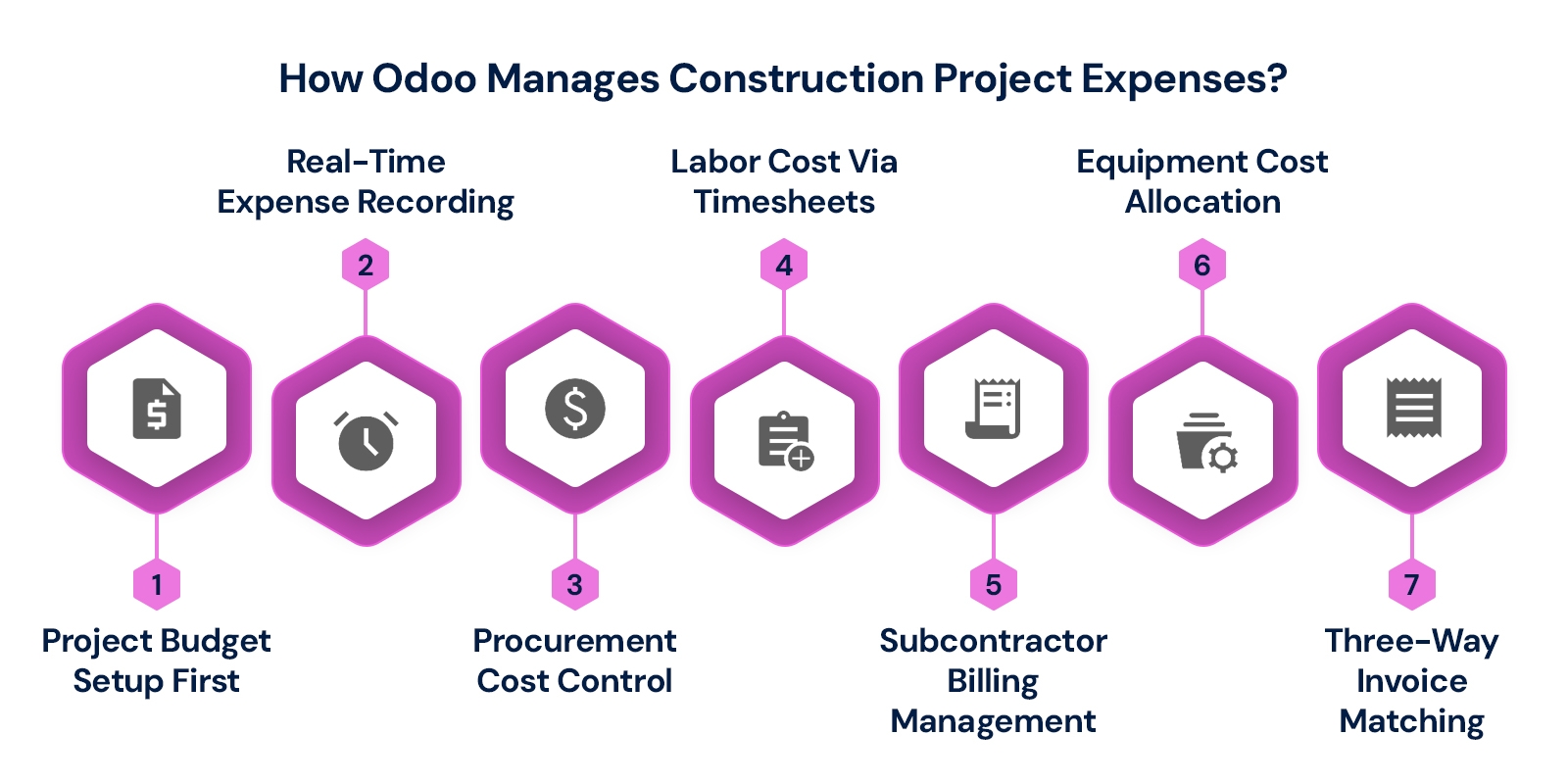
Project Budget Setup First: Before any spending begins, Odoo's Project and Accounting modules let you define budgets by project, site, and cost category including materials, labour, equipment, and overheads. Planned versus actual tracking is built in from the first transaction. Every cost recorded after setup is immediately measured against the corresponding budget line, always giving your team a real reference point.
Real-Time Expense Recording: Every expense, whether a vendor bill, an employee site cost, or a purchase order, gets recorded immediately and linked to the correct project, cost head, and site automatically. There is no manual allocation step at month end and no expense left unattributed in a holding account. Finance sees the actual cost position of every project at any point during the billing period without waiting for a close cycle.
Procurement Cost Control: Odoo's Purchase module runs budget availability checks before any purchase order moves to approval. Configurable approval workflows enforce spending limits at every tier. Vendor quotations are compared inside the system before any commitment is made. Unauthorized purchases cannot progress without passing through the defined authorization chain, which means procurement decisions are always made with current budget visibility, not assumptions.
Labor Cost Via Timesheets: Workers log hours from mobile devices directly against project tasks using Odoo Timesheets, without waiting for weekly batch submissions. Labor costs allocate to the correct project in real time as hours are recorded. Overtime accumulation is flagged automatically before it becomes a budget overrun that nobody planned for, giving supervisors the chance to make scheduling adjustments while there is still time to act.
Subcontractor Billing Management: Subcontractor contracts, progress billing milestones, and retention amounts are managed inside Odoo alongside all other project costs. Every payment links to a specific project and work package with a full audit trail. There is no separate tracking file maintained outside the system and no reconciliation delay when the project approaches completion. Billing disputes are resolved with documentary evidence that is always current.
Equipment Cost Allocation: Fuel consumption, maintenance expenses, and deployment hours are logged per asset inside Odoo and allocated to specific project sites as they occur. You know exactly what each machine is costing per project and per time period, not just a company-wide equipment total that gives no insight into where costs are being generated or which sites are consuming disproportionate equipment resources.
Three-Way Invoice Matching: Odoo automatically matches vendor invoices against the original purchase order and goods receipt before any payment is authorized. Discrepancies are flagged immediately and routed for resolution. Overpayments and duplicate invoices are caught at the system level during the normal transaction flow, not discovered months later during an audit when recovery is difficult and the cost impact has already been absorbed.
This is how Odoo ERP for construction expense management works in practice across every active site. Every cost type, whether procurement, labour, subcontractors, or equipment, follows the same connected flow. Recorded immediately. Linked to the correct project. Visible to the right people at the right time. Without manual aggregation or waiting for a month-end close.
How Odoo Turns Costs into Financial Clarity?
Once every cost is captured at source, including procurement, labour, subcontractors, and equipment, Odoo's Analytic Accounting consolidates those figures into project-level financial reports automatically. There is no manual aggregation step, no waiting for someone to compile numbers from multiple locations, and no version mismatch between what one department sees and what another is working from.
Budget versus actual comparisons update in real time as each transaction posts to the system. Project managers see their site's current financial position any time they need it, not at the end of a reporting cycle. Finance sees the consolidated view across the entire project portfolio from the same platform. Variance alerts trigger automatically when spending approaches defined thresholds, giving teams time to act before the budget is breached rather than after the damage is already done.
For construction companies managing five, ten, or fifteen simultaneous sites, this reporting capability fundamentally changes how decisions are made and when problems are caught. Cost overruns get identified early enough for intervention to be effective. Underperforming projects are flagged before margins erode beyond recovery. The monthly close stops being a period of uncomfortable financial discovery and becomes a routine confirmation of numbers that everyone already knows and has been managing actively throughout the period.
Odoo Implementation Built for Construction Industry
We are an Odoo implementation partner with hands-on experience deploying Odoo for construction and manufacturing businesses across complex, multi-site operational environments. Our implementations are configured around real project workflows including cost heads, approval structures, and subcontractor billing, not software defaults that require your team to adapt their processes to fit the system's assumptions.
Every Aspire Softserv engagement includes post go-live support as a standard deliverable, not an optional add-on. Deploying Odoo is one milestone in the process. Ensuring your teams use it correctly, that cost tracking runs exactly the way it was configured, and that your financial data is reliable from the very first month of operation that is what determines whether the implementation delivers genuine ROI or simply adds another system for your team to manage.
Real Benefits of Odoo Cost Tracking for Construction industry
Construction businesses that implement Odoo for project cost tracking stop reacting to financial problems after the damage is done and start preventing them through real-time visibility and system-enforced controls. These are the measurable outcomes that follow a correctly configured and properly adopted Odoo implementation across active project sites.
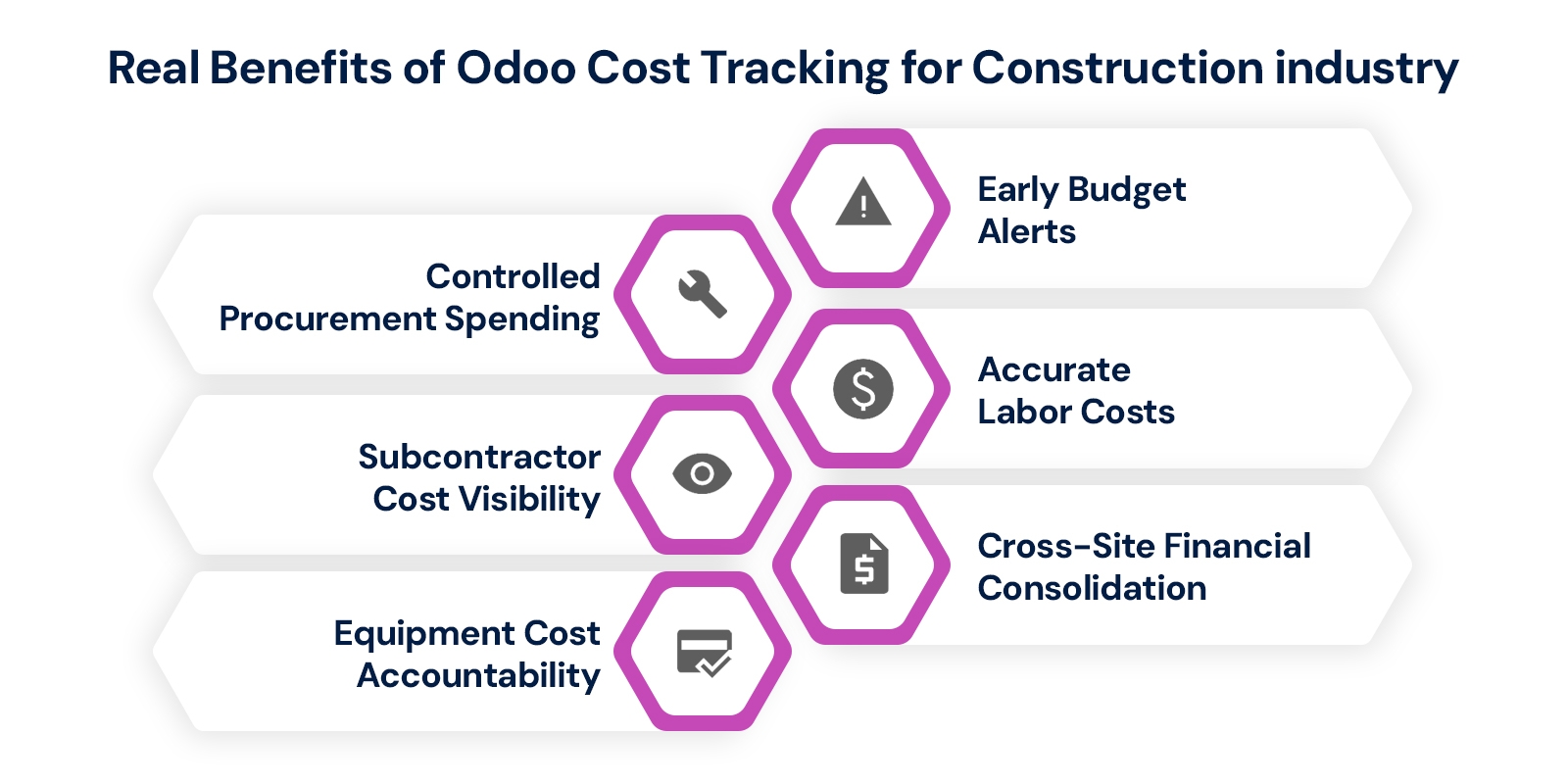
Early Budget Alerts: Cost variances are flagged in real time as spending approaches defined thresholds, not after the budget has already been exceeded. Project managers receive alerts while there is still time to make corrective decisions, adjust procurement plans, or reallocate resources before overruns become irreversible financial damage that cannot be recovered within the project margin.
Controlled Procurement Spending: Purchase orders cannot bypass budget checks or skip the approval chain because the system enforces controls at the point of requisition, before commitment is made. Every high-value procurement moves through configured approval workflows that verify budget availability first.
Accurate Labor Costs: Real-time timesheet integration means labor costs are visible and updated daily as hours are logged against project tasks, not calculated at month end when the opportunity to intervene has already passed. Overtime accumulation is flagged as it happens, allowing project supervisors to adjust workforce allocation and scheduling decisions before the cost impact compounds into an unmanageable overrun.
Subcontractor Cost Visibility: Every subcontractor payment is tied to a specific project and work package inside Odoo with a complete audit trail, eliminating the manual tracking files and reconciliation delays that make subcontractor cost management so time-consuming at project close.
Cross-Site Financial Consolidation: Finance gets one consolidated view across all active project sites simultaneously from a single platform, updated in real time as transactions post. There is no spreadsheet aggregation to run, no version conflicts between what different departments are looking at, and no reconciliation meetings required to align numbers.
Equipment Cost Accountability : Fuel, maintenance, and deployment costs are allocated per asset and per project as they occur, giving construction firms accurate equipment cost data at the job level rather than an aggregate company total that obscures where costs are actually being generated.
Final Thoughts
Construction cost overruns do not happen because of one large mistake. They happen because small costs go unrecorded at every stage, a purchase order without a budget check, a timesheet submitted four days late, a subcontractor invoice logged in a separate file. These gaps add up quietly until the damage is visible and expensive to reverse.
Odoo ERP for construction companies closes every one of those gaps. Budget planning, expense recording, procurement control, labor tracking, subcontractor billing, and financial reporting all run in one connected system. When cost tracking works correctly, project profitability stops being a monthly surprise and becomes something your team manages every single day.
Frequently Asked Questions
1. How does Odoo track project costs across multiple construction sites?
Odoo links every cost including purchase orders, timesheets, and subcontractor invoices to a specific project and site in real time, giving finance one consolidated view across all locations without manual aggregation.
2. Can Odoo set separate budgets for different project sites?
Yes. Odoo's Project and Analytic Accounting modules let you define independent budgets per project, per site, and per cost category, with actual spending measured against each budget line in real time.
3. How does Odoo control procurement spending before purchase orders go out?
Odoo runs budget availability checks before any purchase requisition moves forward. Configurable approval workflows enforce spending limits so no purchase order is issued without passing through the defined authorization chain first.
4. Does Odoo track subcontractor costs and billing in construction projects?
Yes. Odoo manages subcontractor contracts, progress billing, and retention inside the same platform as all other costs. Every payment ties back to a specific project and work package with a full audit trail.
5. How does Odoo calculate and report labor costs on construction projects?
Workers log hours from mobile devices against project tasks using Odoo Timesheets. Labor costs allocate automatically to the correct project in real time, with overtime flagged as it accumulates rather than at month end.
Take Control of Every Project Cost