

 Updated on 2 January 2026

Running a manufacturing unit sounds exciting from outside, but in reality it’s a full-time stress game. Every day something is on fire supplier delay, wrong material batch, machine breakdown, or customer complaining about quality issue. And when something goes wrong, people in management usually ask one question: “Where exactly the mistake happened?”
Now… that question sounds simple. But if your data is spread across Excel sheets, WhatsApp chats, different software, handwritten registers then forget about finding the answer on time. Everyone will blame everyone, and the actual root cause stays hidden.
This is where traceability becomes serious topic. It’s not some fancy trending word. It is basically knowing the full story of your product from which supplier material came, which employee handled it, which machine processed it, which quality inspector passed it.
And here comes the hero (or solution, you can say): Odoo ERP
Why Manual Tracking Does Not Work Anymore?
Let’s be honest. A lot of factories still try to manage production and quality with:
Excel sheets (half-filled, never updated properly)
Paper-based batch records (which disappear exactly when needed)
Separate software for inventory, different for accounting, different for production
Memory-based reporting (Sounds familiar right!!)
This type of system works "somehow" until a big mistake happens.
For example:
One customer complains about a faulty product. Now you want to trace which raw material was used in that batch. But nobody knows, because the label was handwritten and now unreadable.
Or you have to recall a specific batch due to regulatory compliance. But you don’t know which customers received that specific batch.
Or maybe auditors visit and ask for quality inspection history. And suddenly you start searching dusty files like a detective.
At that moment, business owners realize I need a proper ERP system. Not just any ERP a smart one.
Why Odoo ERP Software is Popular in Manufacturing?
Among so many ERP options in market, Odoo ERP Software became very popular in manufacturing companies. The biggest reason is flexibility. Unlike old traditional ERP systems where you have to change your process to fit the software, here software can adjust according to your actual process.
With the help of a good Odoo service provider company, you can set up modules for:
Manufacturing (MRP)
Inventory & Warehouse management
Quality checks
Maintenance of machines
Lot and Serial tracking
Sales, Purchase, Accounting (all integrated)
No more working in islands. Everything is connected. If material is received, it is immediately traceable in production. If production batch is complete, it automatically updates inventory. If quality check fails, production gets alert.
This is the difference between “using multiple tools” vs “using one strong ERP system like Odoo.”
How Odoo ERP Improves Traceability
By default, Odoo already supports lot tracking and serial number tracking, but if your manufacturing process is a bit unique you can customize it further with the help of an Odoo service provider.
Let me explain in simple terms how traceability becomes easy after implementing ERP system Odoo:
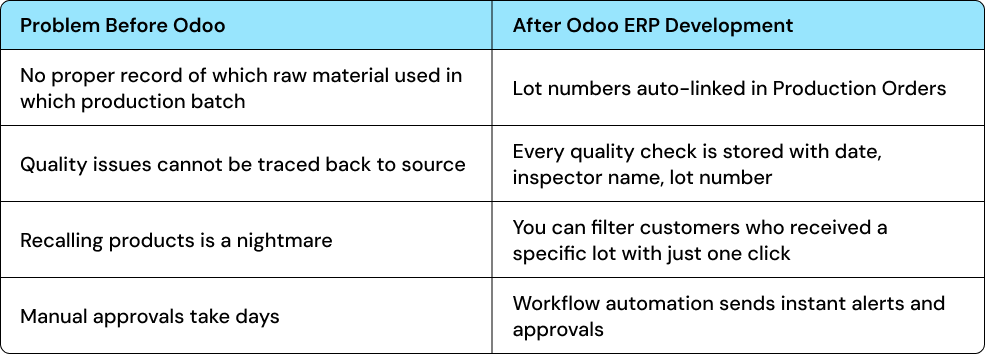
And the best part? Every operation is time-stamped and recorded. So no more blame games. System says who did what.
Let’s take one example. Suppose you manufacture food products like spices or snacks. Your government regulations require you to track raw ingredient sources and provide expiry-based traceability.
With Odoo ERP, your system can be customized like:
While receiving raw material, the supplier lot number and expiry date are scanned via barcode.
When issuing for production, same lot is auto-selected or warning message shows if expired.
After production, finished goods are also given internal tracking codes.
If tomorrow any complaint comes, you just search that code and full journey is visible.
Even for pharmaceuticals, chemical, textile, metal or automotive components, the same logic applies. Traceability = Confidence.
Improving Quality Control with Odoo
Traceability is only one side of problem. Second big headache is maintaining constant quality. If quality inspection is manual and depends on human memory, it will fail someday.
With Odoo, you can:
Create quality control checkpoints at different stages (incoming, in-process, final)
Define acceptable limits for measurements
Capture inspection data via tablet or machine interface
If any check fails, system blocks next process automatically
So rather than finding mistakes at final dispatch, you catch mistakes early.
Why You Need an Odoo
Important thing just installing Odoo is not enough. You need proper customization, because every manufacturing plant has different workflow.
A professional Odoo Development Company understands:
Your existing manual habits
Your technical capability
Your machine setup
Your reporting requirements
Based on that, they design a simple-but-effective ERP process. Not too complex, not too basic. Just the right fit.
Some factories need barcode scanning feature, some want tablet screens on shop floor, some want IoT sensor integration all these are possible but should be done by experienced Odoo ERP Development Services provider.
Final Thoughts Traceability is Not an Expense, It’s Insurance
Some people think ERP is costly. But honestly speaking, one quality issue or product recall can cost 100x more than an ERP setup.
With an ERP Software Implementation, you don’t just improve operations you protect your brand reputation, reduce wastage, and build customer trust.
If you are still managing production tracking manually, then maybe it's time to change. You don’t need to start big. Start module by module. But start fast.

Frequently Asked Questions
1. What is product traceability in manufacturing?
Product traceability is the ability to track and trace materials, components, and finished goods throughout the entire production process. It records where materials came from, which processes they went through, and where final products were delivered, enabling quick identification during quality issues or recalls.
2. How does Odoo ERP improve traceability in manufacturing?
Odoo ERP automates traceability by linking lot numbers and serial numbers to every production stage. It tracks raw material sources, work orders, quality inspections, and customer deliveries in one system. This eliminates manual record-keeping and enables instant recall tracking with complete batch genealogy reports.
3. Can Odoo track batch numbers and expiry dates automatically?
Yes, Odoo automatically tracks batch numbers, lot numbers, and expiry dates throughout the supply chain. When receiving materials, the system captures supplier lot information and expiry dates. During production and sales, Odoo ensures FIFO/FEFO compliance and alerts users about expired or near-expiry inventory automatically.
4. Which industries need product traceability systems like Odoo?
Food and beverage, pharmaceutical, automotive, aerospace, electronics, and chemical manufacturing industries require traceability systems. These sectors face strict regulatory compliance requirements from FDA, ISO, GMP, and other authorities. Odoo helps maintain audit trails, quality records, and recall capabilities required by these regulations.
5. How long does it take to implement Odoo traceability features?
Basic Odoo traceability implementation typically takes four to eight weeks, depending on manufacturing complexity and customization needs. This includes system configuration, lot tracking setup, quality control points, user training, and data migration. Complex integrations with barcode scanners or IoT devices may require additional time.
Simplify Manufacturing Traceability with Odoo