

 Updated on 1 January 2026

Unplanned production downtime is every manufacturer’s nightmare. A single unexpected halt can delay orders, disappoint customers, and cut into profits. According to industry studies, large manufacturing facilities can lose anywhere between $10,000 to $25,000 per minute of downtime. Even for smaller businesses, the impact is significant, with costs stretching beyond just lost production into overtime expenses, late delivery penalties, and damaged customer trust.
The good news is that much of this downtime is preventable. Businesses that rely on outdated tools, scattered spreadsheets, or disconnected systems often face problems that build up unnoticed until production stops. This is exactly where Odoo ERP Development Service can transform the game.
Why Downtime Happens in the First Place?
Most downtime doesn’t come from “random bad luck.” It’s usually the result of issues that could have been anticipated:
Material shortages – stockouts happen when inventory tracking is inaccurate or purchasing is reactive instead of proactive.
Unplanned equipment breakdowns – when machines are run until failure instead of being serviced on time.
Poor production scheduling – jobs clash, resources are overbooked, or critical staff aren’t available.
Slow decision-making – managers don’t get visibility into problems until it’s too late.
Miscommunication between teams – sales promise one thing, procurement prepares another, and production is left scrambling.
Each of these issues alone is disruptive. Together, they create a cycle of inefficiency that repeatedly halts production.
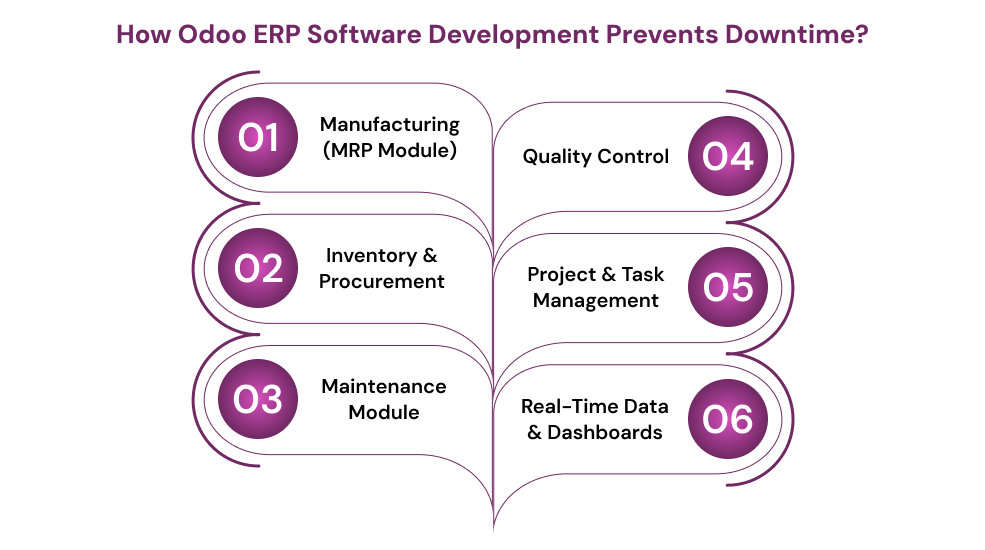
How Odoo ERP Software Development Prevents Downtime?
Odoo ERP is an open-source, modular system that unifies business functions into one platform. Unlike rigid, off-the-shelf ERP tools, Odoo can be customized through Odoo ERP software development to fit each company’s exact workflows.
Here’s how it directly helps prevent downtime
Manufacturing (MRP Module)
Tracks work orders in real time.
Allocates resources to avoid scheduling conflicts.
Monitors production lead times and highlights delays before they cause stoppages.
Inventory & Procurement
Updates stock levels instantly across multiple warehouses.
Automates reordering based on minimum stock rules.
Ensures raw materials are available before production starts.
Maintenance Module
Supports preventive maintenance by tracking machine usage and setting service intervals.
Enables predictive maintenance when connected with IoT sensors, predicting failures before they happen.
Minimizes downtime caused by unexpected equipment breakdowns.
Quality Control
Automates quality checkpoints during production.
Ensures defective batches are flagged early, avoiding rework or last-minute recalls.
Project & Task Management
Helps coordinate teams working on product launches or large orders.
Keeps tasks aligned with deadlines, preventing delays in handovers between departments.
Real-Time Data & Dashboards
Managers can see machine status, production KPIs, and resource utilization instantly.
Early warnings help prevent small issues from becoming full shutdowns.
Advantages of Preventing Downtime
Downtime is expensive not only because of lost production but also because of ripple effects:
Idle labour costs – workers still need to be paid even when machines aren’t running.
Wasted raw materials – partially processed goods can spoil during stoppages.
Overtime costs – catching up later usually means paying staff extra.
Damaged reputation – late deliveries push customers to competitors.
By reducing downtime, Odoo helps manufacturers protect margins, improve delivery reliability, and strengthen customer loyalty.
Why Custom Development Matters?
Every factory operates differently. A pharmaceutical manufacturer has strict compliance needs, while an automotive supplier focuses on just-in-time production. A generic ERP rarely covers these differences.
That’s why Odoo ERP software development is so important:
Custom modules can be built for industry-specific workflows.
Third-party integrations (IoT, MES, legacy tools) can be added seamlessly.
Reports can be tailored to the KPIs managers track.
User interfaces can be simplified for operators on the shop floor.
Customization ensures that Odoo doesn’t just manage downtime but actively supports the way the business works.
Steps to Implement Odoo ERP Software Development
Assessment of Current Processes – identify where downtime usually happens.
Module Selection – choose Odoo apps that fit (manufacturing, maintenance, inventory, etc.).
Customization – adapt workflows, reports, and dashboards.
Integration – connect with machines, IoT devices, and third-party systems.
Training – ensure staff know how to use the system effectively.
Continuous Improvement – review performance data and fine-tune the system.
This phased approach ensures smooth adoption and maximum impact on downtime reduction.
Future-Proofing Production With ERP
Technology in manufacturing is moving fast smart machines, IoT, and AI-driven analytics are becoming standard. Businesses that rely on manual systems will struggle to keep up.
By investing in Odoo ERP software development today, companies build a foundation that can integrate with future technologies. Whether it is predictive analytics, robotics, or advanced supply chain automation, Odoo’s modular and customizable nature ensures it can evolve with the business.
Conclusion
Downtime is not just an operational inconvenience. it’s a financial drain and a competitive risk. The companies that succeed in today’s market are the ones that predict problems, respond quickly, and keep production running smoothly.
With a customized Odoo ERP solution, manufacturers can:
Ensure raw materials are always available.
Keep machines running with preventive maintenance.
Align teams with clear workflows and real-time data.
Avoid costly disruptions that hurt both revenue and reputation.
Simply put, investing in Odoo ERP software development is an investment in uptime, efficiency, and long-term growth.
Frequently Asked Questions
1. What causes production downtime in manufacturing?
Production downtime typically results from equipment breakdowns, material shortages, poor scheduling, quality issues, and communication gaps between departments. Preventive maintenance and real-time monitoring significantly reduce these disruptions.
2. How does ERP software prevent production downtime?
ERP software prevents downtime by automating inventory reordering, scheduling preventive maintenance, providing real-time production visibility, and coordinating teams through unified workflows that identify issues before they halt production.
3. How much does manufacturing downtime cost per hour?
Manufacturing downtime costs range from $600,000 to $1.5 million per hour for large facilities. Smaller operations face substantial losses through idle labour, wasted materials, overtime expenses, and damaged customer relationships.
4. What is preventive maintenance in Odoo ERP?
Preventive maintenance in Odoo tracks machine usage hours, schedules regular service intervals, sends automated maintenance reminders, and logs equipment history to prevent unexpected breakdowns that cause costly production stoppages.
5. Can Odoo ERP integrate with existing manufacturing equipment?
Yes, Odoo ERP integrates with IoT sensors, MES systems, PLCs, and legacy manufacturing equipment through custom development, enabling real-time machine monitoring, predictive maintenance, and automated data collection from the shop floor.
Implement Odoo ERP for Production