

In today's competitive manufacturing landscape, inventory management has become a make-or-break capability. Modern manufacturers face unprecedented complexity: global supply chains spanning multiple continents, warehouses in diverse locations, fluctuating customer demands, and production schedules that change by the hour. Traditional inventory systems built for a simpler era are cracking under the pressure.
The challenges are clear. Disconnected systems create data silos where your sales team, production floor, and warehouse operate with different numbers. Manual tracking introduces errors that cascade through operations. Delayed updates mean decisions are made on yesterday's data. The result? Costly stockouts, excess inventory tying up capital, production delays, and frustrated customers.
But here's what's changed: the manufacturers thriving today aren't just managing inventory they're controlling it in real time. They know exactly what's in stock, where it's located, and when to reorder, all without manual intervention. This isn't a luxury anymore; it's a competitive necessity.
In this guide, you'll discover:
Why real-time inventory visibility is critical for modern manufacturers
How Odoo ERP development solves the core inventory challenges
Key features that deliver instant inventory control
Measurable business results from real implementations
A practical roadmap for successful Odoo implementation
Why Real-Time Inventory Control Matters
The manufacturing ERP market is growing at 6.6% annually through 2031, and there's a reason why. Manufacturers are dealing with sprawling supply chains, multiple warehouse locations, and production schedules that shift by the hour. Traditional inventory systems simply can't keep up.
The cost of getting inventory wrong is staggering. Stockouts mean production lines go idle. Excess inventory ties up working capital that could fuel growth. Manual tracking creates errors that ripple through your entire operation. The manufacturers winning right now are the ones who can see their inventory status in real time and act on it immediately.
That's where Odoo ERP development comes in not just another inventory management system, but a complete platform that connects procurement, production, sales, and logistics into one unified view. For manufacturers specifically, that integration is everything.
Why Manufacturers Choose Odoo ERP Over Traditional Systems?
Manufacturing contributes $2.94 trillion to the U.S. economy, with over 244,000 establishments competing for market share. Many of these companies are rethinking how they manage inventory. The old way disconnected systems, delayed updates, manual reconciliation doesn't work when customer expectations have never been higher.
Odoo manufacturing ERP addresses the core challenges manufacturers face:
Unified Data Environment
Everything from raw materials to finished goods lives in one system. No more jumping between platforms or reconciling data from different sources. When your sales team makes a promise, they're looking at the same inventory numbers as your production floor in real time.
Built for Manufacturing Workflows
Odoo isn't a generic business system with manufacturing bolted on. It's designed around how manufacturers actually work, with deep integration between inventory, MRP, procurement, and quality control.
Customization Without Chaos
The open-source architecture means you can tailor Odoo to match your specific processes without getting locked into vendor limitations. Need custom workflows for your production process? An Odoo ERP development company build without expensive proprietary modifications.
Scalability That Grows With You
Start with basic inventory tracking and add modules as your needs evolve. Whether you're managing one facility or ten, Odoo scales without forcing you to rip and replace your entire system.
Real-Time Inventory Control: Key Features That Matter
Let's get specific about what Odoo inventory management system delivers:
Multi-Location Stock Visibility: Track raw materials, work-in-progress, and finished goods across every warehouse, plant, and storage location. Real-time updates mean decision-makers always know exactly what's available and where it is.
Automated Replenishment Intelligence: Configure reorder points by SKU, and Odoo handles the rest. When stock hits your threshold, the system automatically generates purchase orders or production requests. This prevents stockouts without building excess inventory that drains your cash.
AI-Powered Demand Forecasting: Using historical sales data and trend analysis, Odoo predicts what you'll need before you need it. Better forecasting means smarter procurement, optimized production scheduling, and less waste.
Advanced Warehouse Management: Organize your warehouse with hierarchical structures zones, racks, shelves and track items with batch and serial numbers. This improves picking accuracy, speeds up fulfillment, and makes traceability bulletproof.
Flexible Stock Movement Rules: Configure push and pull rules to automate how inventory moves within and between warehouses. Support for cross-docking and drop-shipping optimizes material flow without constant manual intervention.
Complete Traceability: Every inventory movement is logged with full detail from arrival to shipment. This documentation is critical for quality audits, regulatory compliance, and quickly resolving issues when they arise.
Real-Time Analytics and Reporting: Customizable dashboards show you the KPIs that matter inventory turnover, aging stock, vendor performance, production backlogs, and inventory valuation. When problems emerge, you see them immediately instead of discovering them weeks later.
Barcode and RFID Integration: Eliminate manual data entry errors with inbuilt barcode scanning, while RFID technology can be integrated into warehouse workflows. Faster operations with fewer mistakes.
How Odoo Delivers Real-Time Performance
For technical teams evaluating Odoo implementation for manufacturing, the architecture matters:
Odoo achieves real-time inventory visibility through event-driven processing where every stock movement receiving, transfers, consumption, shipment instantly triggers synchronized updates across purchasing, production, and sales modules without manual intervention or batch delays.
The business logic layer is modular and Python-based, executing inventory rules, replenishment algorithms, and manufacturing workflows asynchronously. Background processes handle complex calculations while keeping user interfaces responsive, so warehouse operators experience zero lag when recording transactions even during peak operations.
The data layer uses PostgreSQL with row-level locking and transaction queuing, ensuring data consistency while supporting concurrent access from multiple users and locations. Optimized database indexing and in-memory caching return stock queries in milliseconds, while change notifications push updates to all active user sessions immediately, ensuring everyone sees identical, current inventory data across all facilities.
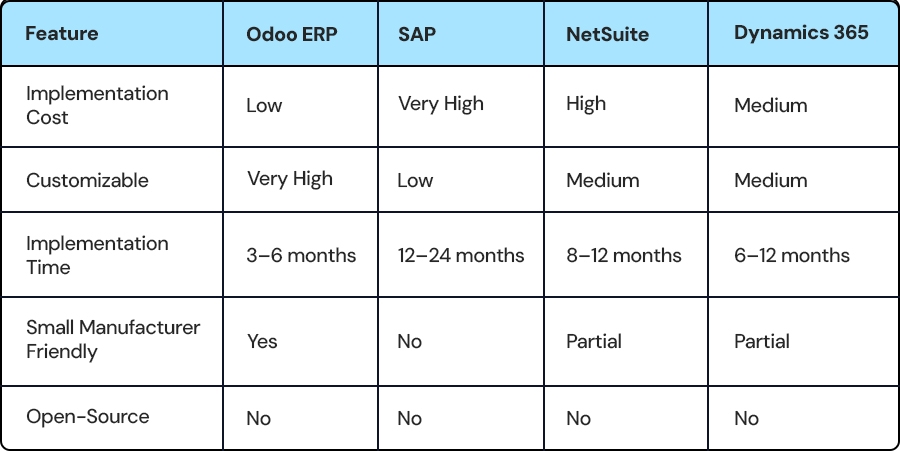
Odoo vs Traditional ERP: A Clear Comparison
Odoo is a suite of fully integrated open source business apps that offers simplicity in everyday use. It is very intuitive. It is the all-in-one ERP that allows you to manage all aspects of a company in a single software.
Real-World Success: Manufacturers Getting Results
Electronics Manufacturer: Implemented Odoo to handle batch and serial number tracking for regulatory compliance. Result: They achieved rapid recall capability and maintained strict quality standards without disrupting manufacturing flow.
Mid-Sized Multi-Facility Manufacturer: Four facilities with disconnected inventory systems struggled with stockouts and excess inventory. After implementing Odoo real-time inventory control, they cut stockouts by 40%, reduced excess inventory by 25%, and accelerated production cycles. The financial impact was immediate and significant.
Automotive Components Supplier: Manual inventory tracking caused order fulfillment errors. With Odoo and barcode scanning, order accuracy improved from 92% to 99.7%, and fulfillment increased from 45% to 89%.
The Business Impact: What Manufacturers Actually Achieve
67% of organizations describe their Odoo ERP implementation as very successful or successful, and manufacturers implementing Odoo are seeing measurable improvements:
Operational Efficiency Gains: Automated inventory updates and synchronized workflows cut manual workload and eliminate delays. Typical results include 30-50% reduction in manual data entry and 40-60% faster order processing.
Optimized Working Capital: Organizations reduced inventory costs by an average of 11%, with best-in-class manufacturers achieving up to 22% reduction. Balancing stock quantities frees up cash for growth investments instead of sitting on shelves.
Better Customer Service: When you have accurate, instant stock visibility, you can fulfill orders reliably and respond to demand changes fast. That directly impacts customer satisfaction and retention.
Reduced Waste and Downtime: Aligning material availability with production schedules minimizes idle time and scrap. Less waste means better margins.
Regulatory Compliance Made Easier: Comprehensive traceability supports audits and adherence to industry standards. When recalls happen, you can identify affected batches immediately.
The ROI Reality: What Implementation Actually Costs and Returns
The average ROI for ERP projects is around 150%, with payback periods typically between 1 to 3 years. For manufacturers, the return comes from:
Reduced inventory carrying costs: 10-22% typical reduction
Fewer stockouts: Leading to increased sales
Lower operational costs: Through automation
Better cash flow: From optimized inventory levels
Reduced waste and scrap: Improving margins
66% of organizations reported improved operational efficiency due to their ERP systems, and 76% enhanced their interactions with suppliers. Most manufacturers achieve full payback within 12-24 months.
Implementation Strategy: Getting It Right
Success with Odoo ERP software development starts with proper planning:
Map Your Current Processes: Understand existing workflows, identify pain points, and document customization needs before you start. This prevents scope creep and ensures you're solving the right problems.
Configure Modules Strategically: Leverage Odoo's framework to tailor modules and integrate with existing systems. Start with core inventory and manufacturing modules, then expand.
Migrate Data Carefully: Accurate migration from legacy systems is critical. Test thoroughly to prevent inconsistencies that create problems later.
Deploy in Phases: Roll out functionality in stages with role-based training. Engage users early and show them how the system benefits their daily work.
Monitor and Optimize: Use KPIs and dashboards to refine inventory rules and workflows after deployment. Continuous improvement ensures you get maximum value.
Plan for Ongoing Support: Utilize vendor support and stay current with system upgrades to keep your ERP aligned with business growth.
Drive User Adoption for ERP Success: Foster strong user adoption to ensure Odoo ERP becomes a trusted tool for productivity and growth.
Looking Ahead: AI, Machine Learning, and IoT
In 2025, AI-enhanced automation and deeper IoT device integration are transforming how Odoo handles inventory. Over 80% of ERP systems are expected to incorporate AI or machine learning capabilities by 2025.
Odoo is integrating AI-powered demand forecasting, anomaly detection, and predictive maintenance capabilities. IoT integration continues expanding with smart sensors and automated data capture that elevate inventory visibility and reduce downtime. These innovations keep manufacturers using Odoo competitive as markets evolve.
Conclusion: Transform Your Manufacturing Inventory Management
Real-time inventory control isn't a luxury it's a competitive necessity. Manufacturers who can see their inventory status instantly, make decisions based on accurate data, and automate repetitive processes are the ones winning in today's market.
Odoo manufacturing ERP delivers this capability at a fraction of the cost and complexity of traditional systems. With proven ROI of 150%, implementation timelines of 3-6 months, and the flexibility to customize without vendor lock-in, Odoo is the smart choice for manufacturers serious about operational excellence.
Frequently Asked Questions
How long does Odoo ERP implementation take for manufacturers?
Implementation timelines vary based on complexity, but most manufacturers see initial deployment in 3-6 months with phased rollouts continuing as needs expand.
Can Odoo integrate with our existing manufacturing equipment?
Yes. Odoo supports IoT device integration and can connect with manufacturing equipment through APIs and standard industrial protocols.
Is Odoo suitable for small to mid-sized manufacturers?
Absolutely. 74% of U.S. manufacturing establishments are small firms, and Odoo's modular approach lets you start with essential features and scale up as you grow.
What's the total cost of ownership compared to other ERP systems?
Odoo typically offers lower total cost of ownership than traditional ERP systems because of its open-source foundation, flexible licensing, and reduced customization complexity.
How does Odoo handle multi-location inventory management?
Odoo provides real-time tracking across unlimited locations with configurable rules for stock movement, replenishment, and transfer between facilities.
Can we customize Odoo for our specific manufacturing process?
Yes. Odoo's open-source architecture and modular design support deep customization to match your unique workflows without vendor lock-in.
Start Real-Time Inventory