

 Updated on 15 June 2026

Your firm invested in ERP six months ago. The modules are active. The procurement team is logging purchase orders. The finance dashboard shows data. But your project is already four weeks behind schedule and when you ask why, nobody has a clear answer.
This situation is more common than most construction leaders will say publicly. Digital transformation in construction has accelerated sharply over the last five years, with ERP adoption becoming standard practice across mid-to-large contractors. And yet project delays have not reduced proportionally. Timelines still slip. Budgets still overrun. Weekly meetings still produce surprises that should have been visible days earlier.
The reason is not that ERP doesn't work. The reason is that most ERP systems were designed for manufacturing, logistics, and retail then adapted for construction as an afterthought. That adaptation has specific, repeatable gaps. And those gaps are exactly where construction schedule slippage begins. Understanding where those gaps sit, and why they are built into the system rather than introduced by the user, is what allows a construction firm to finally fix the problem rather than keep working around it.
Why Having ERP Is Not the Same as Having Control?
ERP creates the appearance of operational control. Dashboards look structured. Procurement logs are populated. Financial summaries are generated on schedule. Leadership sees data and reasonably concludes that the system is working.
What the system is often not doing is connecting that data across the moving parts of a live construction project in real time. Generic ERP was engineered for predictable, repeatable environments where the same process runs the same way every cycle. Construction is structurally different. Site conditions change daily. Scope revisions arrive mid-project. The workforce is distributed across locations with no fixed desk, unreliable connectivity, and no capacity to operate a system designed for a back-office desktop.
These are not configuration problems that better implementation would solve. They are construction ERP software limitations that are baked into the original design of systems built for other industries. They follow a consistent pattern. And that pattern is where construction project management software problems begin.
Here are the five reasons ERP is not preventing project delays on your sites explained as design gaps, not user errors.
5 Reasons Your ERP Is Not Stopping Construction Delays
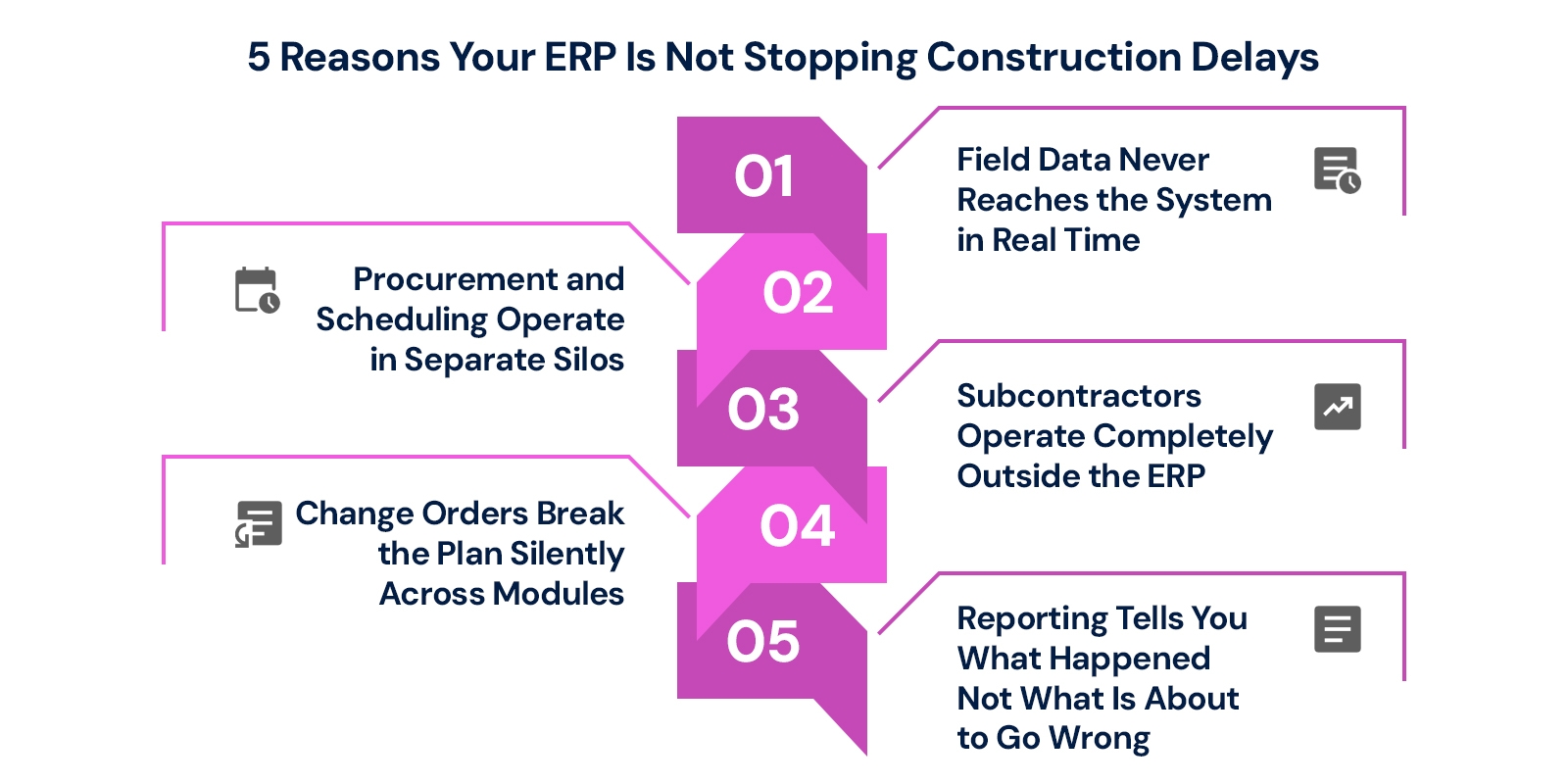
1. Field Data Never Reaches the System in Real Time
What is happening on site: Foremen, labour supervisors, and equipment operators do not use ERP. Material consumption, daily progress, and labour hours are recorded on paper, logged in WhatsApp messages, or stored in someone's memory and then entered by an office administrator hours or sometimes days later.
What that causes: Project managers are making construction resource-allocation decisions on data that is already stale by the time they see it. A material shortage flagged three hours late can cascade into a two-day site stoppage. By the time the back office registers the gap, the schedule has already absorbed the damage.
The design gap: Generic ERP has no mobile-first, offline-capable interface built for actual site conditions. It was designed for a desktop workstation in a controlled office environment, operated by a trained administrator whose job is data entry. BOQ tracking that depends on someone typing figures into a desktop module at the end of a shift is not real-time visibility it is a delayed approximation that compounds every hour it falls further behind actual site activity.
Grounding detail: Real-time field visibility is now the top-cited reason construction firms cite when replacing their existing ERP system. When field-to-office data sync is the leading driver of replacement decisions, the previous system failed to deliver it not because it was poorly implemented, but because it was never designed to deliver it.
2. Procurement and Scheduling Operate in Separate Silos
What is happening: In most ERP configurations, the purchasing module and the project scheduling module share a database but not a logic layer. A purchase order exists in one place. A Gantt milestone exists in another. Connecting them requires a human to manually check one against the other which happens inconsistently or not at all under the pressure of active site management.
What that causes: A delayed material delivery does not automatically push a milestone. The site manager discovers the problem when the delivery truck does not arrive, not 48 hours earlier when there was still time to act. By the time the schedule is adjusted, the subcontractor crew is already on site, the crane is already booked, and the rescheduling cost is already committed.
The design gap: Generic ERP was not built around construction's critical-path logic. It records what was ordered and what arrived. Material procurement delays require a system that models what a delayed delivery means for Phase 3 starting on Thursday and that cascade logic simply does not exist in a system that processes procurement and scheduling as two independent functions with no automated dependency between them.
Grounding detail: When procurement and scheduling are disconnected, the financial impact of a delay is documented weeks after it occurs — when nothing can be done about it. ERP module integration that stops at shared data storage without shared operational logic is not connected enough for construction.
3. Subcontractors Operate Completely Outside the ERP
What is happening: ERP tracks internal teams, internal purchase orders, and internal inventory. But construction execution depends heavily on subcontractors — and their commitments, confirmations, mobilisation status, and progress updates exist in WhatsApp threads, email chains, and verbal conversations that never reach the system.
What that causes: The ERP dashboard shows all internal tasks marked as in progress. Meanwhile, the subcontractor responsible for the next phase has not mobilised. The system reads green. The site is stalled. There is no RFI tracking, no vendor commitment tracking, and no escalation trigger when a confirmation deadline passes without a response.
The design gap: No subcontractor portal. No timestamped commitment log. No alert when a subcontractor goes unresponsive past a deadline that would affect the downstream schedule. Generic ERP was never designed to bring external execution parties into the project loop because, in the manufacturing and retail environments it was built for, external parties did not operate as primary delivery dependencies in the same way.
Grounding detail: Subcontractor billing delays and coordination failures trace back almost universally to the absence of a shared system of record. Delays rarely begin with a structural failure. They begin with an unanswered message, a mobilisation that never happened, and a commitment that had no paper trail anywhere in the system supposed to be tracking the project.
4. Change Orders Break the Plan Silently Across Modules
What is happening: Scope changes are routine in construction drawing revisions, client-initiated changes, site condition discoveries. When a change is approved, someone updates one part of the system. The other parts stay as they were. The finance module reflects the original budget. The project schedule still shows the original timeline. The procurement list has not been adjusted.
What that causes: Two or three versions of the plan are now running in parallel across different modules. The project manager is tracking against the original scope. The site is executing against the revised scope. Construction budget variance accumulates between them silently until a deadline is missed or a cost overrun is discovered and by then, the compounding is already weeks deep.
The design gap: Change order management in construction requires simultaneous updates across budget, schedule, and procurement the moment a change is approved. Generic ERP processes these in separate modules with no auto-cascade logic connecting them. Scope creep construction-style does not fail loudly or visibly. It accumulates across disconnected modules and becomes visible only when the project is already over budget and past the intervention window.
Grounding detail: Misaligned modules cause delayed job costing accuracy and margin erosion that compounds as project scale increases. The longer three modules remain out of sync on the same change, the wider the gap between what is being planned and what is being built.
5. Reporting Tells You What Happened Not What Is About to Go Wrong
What is happening: ERP reporting in most construction deployments is retrospective. Weekly reports confirm that a milestone was missed after it was already missed. Monthly summaries document overruns that occurred three weeks ago. There is no mechanism to flag that a milestone is at risk in the next 72 hours — only confirmation that it was not met after the deadline has passed.
What that causes: By the time a report surfaces a delay, the window to intervene has closed. The crane is committed. The subcontractor has moved to the next site. The workforce is booked elsewhere. The cost is locked in and absorbed. Construction project forecasting that runs on historical snapshots cannot support the kind of forward-looking decision-making that prevents delays from becoming unrecoverable.
The design gap: Generic ERP lacks a predictive layer. There is no concept of critical-path dependencies in the reporting engine, no milestone risk scoring, and no trigger-based escalation when a task falls behind a threshold that would affect a downstream phase. It was built to record and report not to anticipate and alert. Milestone-based project alerts are not a feature that can be bolted onto a system without a construction-native architecture underneath it.
Grounding detail: Predictive scheduling, risk detection, and automated escalation are now standard in construction-native platforms. Their absence in adapted generic ERP is not a missing feature. It is a reflection of what the system was fundamentally designed to do.
Generic ERP vs Construction-Native ERP: What the Gap Looks Like
The five reasons above follow the same structural pattern: a system doing exactly what it was designed to do, in an operational environment it was never designed for. That pattern becomes clearer when the two approaches are placed side by side.
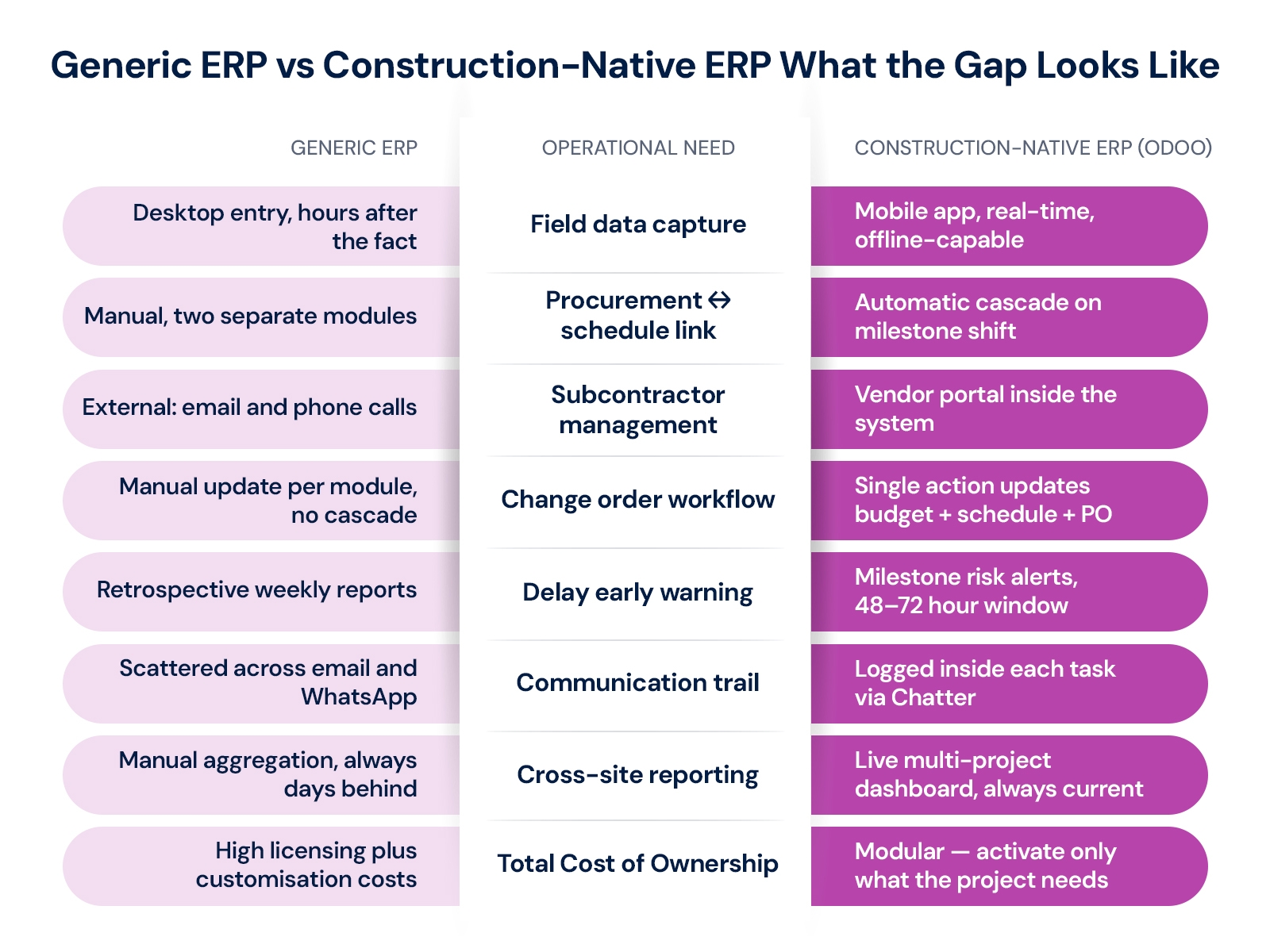
The pattern in this table is not a list of feature gaps. It is a structural difference in how each system handles time, dependency, and external coordination. Generic ERP manages data in isolated modules. Construction-native ERP connects procurement, scheduling, subcontractors, and field teams so that a change in one area propagates automatically across every dependent process which is how construction projects actually operate.
How Odoo Closes the Gaps That Generic ERP Cannot
The five problems above are not fixable through better user training or tighter processes around a system that was not designed for them. They are design gaps what happens when a platform built for predictable business environments is asked to manage the controlled chaos of an active construction site. Odoo ERP for construction addresses each gap directly, through modules built around construction workflows rather than adapted from other industry defaults.
Field-to-office data sync: Odoo's mobile-first interface allows foremen and site supervisors to log daily progress reports, material consumption, and labour hours directly from site data flows immediately into project costing and scheduling without manual re-entry. DPR digitisation replaces the paper pipeline. Offline capability means remote site connectivity gaps do not break the data chain. Modules: Project + Timesheets + Field Service
Procurement linked to the project schedule: When a purchase order is raised in Odoo, it connects directly to the milestone it serves. A delayed delivery flags automatically in the project plan. Smart replenishment rules tied to project milestones trigger material orders before a shortage can affect the schedule. If a phase shifts, Odoo adjusts procurement timelines and alerts suppliers automatically. Modules: Purchase + Inventory + Project
Subcontractors inside the system: The Odoo vendor portal allows subcontractors to confirm deliveries, log progress, and raise RFIs directly within the platform tracked inside the ERP, not in a parallel WhatsApp conversation. Every commitment is timestamped. Escalation triggers fire when a confirmation deadline passes. Communication history is logged in the Chatter, attached to the specific task, accessible from site on mobile. Modules: Purchase + Vendor Portal + Project + Discuss
Change orders managed end-to-end: A change order in Odoo updates the revised budget in Accounting, the adjusted task list in Project, and the modified procurement plan in Purchase through a single workflow. No manual re-entry across three modules. No version drift between what finance is tracking and what the site is executing. Construction budget variance is visible in real time, not three weeks later. Modules: Project + Accounting + Purchase
Risk alerts before delays lock in: Milestone risk indicators and automated escalation notifications give project managers a 48–72 hour window to act before a delay becomes unrecoverable. Multi-project dashboards give leadership live visibility across all active sites without waiting for a weekly report. The shift from retrospective reporting to proactive alerting through real-time project tracking is the single biggest operational difference between generic and construction-native ERP. Modules: Project Dashboard + Automated Actions + Reporting
What Changes When Construction Cost Tracking and Scheduling Work Together?
Construction firms that implement Odoo for project management stop discovering problems after the intervention window has closed and start catching them while corrective action is still affordable. These are the outcomes that follow a correctly configured implementation across active sites:
Procurement decisions made with current budget data :no purchase order moves forward without a budget availability check and a defined approval chain
Labor costs visible daily : hours logged in real time against project tasks, overtime flagged as it accumulates rather than at month end
Subcontractor commitments tracked in the system : not in a spreadsheet maintained by one person that nobody else can access or trust
Change orders that update the entire plan : budget, schedule, and procurement aligned from the moment a scope change is approved
Alerts that arrive before deadlines : not reports that document what happened after the deadline passed
Construction KPIs stop being a monthly discovery exercise and become something the project team manages actively every single day.
Final Thoughts
Construction project delays are not usually caused by one large, visible failure. They are caused by small, connected gaps a field update that arrived two days late, a procurement flag that never triggered a schedule adjustment, a subcontractor commitment that existed only in a message thread, a change order that updated one module while two others stayed behind.
These gaps compound quietly at every stage of every project. By the time they surface in a weekly report, the cost of addressing them is already significantly higher than the cost of preventing them would have been.
Odoo construction project management closes every one of those gaps inside one connected platform. When every cost, every schedule dependency, and every external commitment is tracked in real time and in the same system, project profitability stops being a monthly surprise and delayed projects stop being the default outcome.
Frequently Asked Questions
1. Why do construction projects still get delayed even when ERP software is in place?
Most ERP systems were built for manufacturing or retail, not construction. They lack real-time field-to-office data sync, procurement-to-schedule cascade logic, and subcontractor coordination tools which means the gaps where construction delays actually begin are left unmanaged.
2. What are the most common construction ERP implementation failure reasons?
The most common reasons are: field data that never reaches the system in real time, procurement and scheduling modules that do not share logic, subcontractors managed entirely outside the ERP, and reporting that is retrospective rather than predictive.
3. What is the difference between generic ERP and construction-native ERP?
Generic ERP manages data in separate modules with no automatic dependency logic between them. Construction-native ERP connects procurement, scheduling, subcontractors, and field teams so that a change in one area automatically updates every dependent process which reflects how construction projects actually operate.
4. How does Odoo ERP help reduce construction project delays?
Odoo connects field data capture, procurement, subcontractor tracking, change order management, and milestone alerts on one platform. Delays are flagged before the intervention window closes, not after the deadline has already passed.
5. Can Odoo handle subcontractor coordination for construction projects?
Yes. Odoo's vendor portal allows subcontractors to confirm deliveries, log progress, and raise RFIs directly inside the system. Every commitment is timestamped and every deadline is monitored, with automatic escalation when a confirmation goes past its due date.
Gain Real-Time Project Visibility Today!