


 Updated on 10 June 2026


Every week your approvals run on email is a week your competitors are closing projects faster.
Architecture is a business where the creative work gets most of the attention, but it's the operational side that determines whether you actually make money. Missed sign-offs, lost feedback threads, and drawings being revised without a clear record these aren't minor inconveniences. They eat into margins, delay handovers, and slowly wear down client trust.
Odoo is an ERP platform built for exactly this kind of complexity. It pulls your project management, document control, approval workflows, and client communication into one place so nothing gets lost, nothing gets billed twice, and no one's working off an outdated drawing.
This post breaks down how architecture firms can use Odoo ERP to take control of two of their biggest operational headaches: client approvals and design revisions.
How Slow Approvals Drain Your Project Profitability?
Architecture firms lose thousands every year not because of bad design, but because approvals get stuck. When sign-offs run on email, your team waits, budgets inflate, and clients grow frustrated before a single brick is laid.
The problem isn't effort it's the absence of structure. Without a defined system, feedback disappears, accountability vanishes, and every revision cycle becomes a guessing game that nobody wins.
The core problem with most approval processes in architecture firms isn't a lack of effort it's a lack of structure. Here's what that looks like in practice:
Feedback Gets Lost: Client comments buried in email threads create confusion about what was actually requested. Teams spend hours hunting down approvals that should take minutes to locate and confirm.
Versions Multiply Everywhere: Without a central system, teams unknowingly work on outdated drawings while newer versions exist elsewhere. One wrong file leads to rework that was completely avoidable with proper version control.
Billing Gaps Appear: Untracked revision requests never get matched against the original project scope. Firms quietly absorb the cost of extra work that should have triggered a formal, billable change order.
Accountability Disappears: No one can prove what was approved, when it happened, or who authorized it. This creates disputes, delays, and legal vulnerabilities that damage client relationships and put projects at serious risk.
Timelines Collapse: Waiting for approvals keeps contractors idle and pushes handover dates further back. Every day of delay adds overhead costs while fixed project budgets continue shrinking without any productive work happening.
The fix isn't more follow-up emails. It's a system that routes approvals automatically, tracks every decision, and flags scope changes before they become billing disputes.
How Odoo Structures the Approval Process for Architecture Firms?
Odoo replaces scattered email approvals with a defined, automated workflow. Every request moves through the right people in the right order, with notifications handled automatically and every decision permanently recorded.
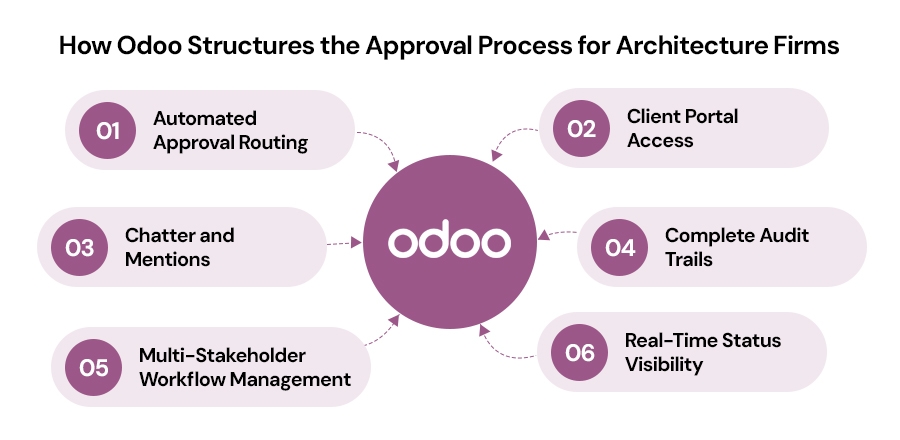
1. Automated Approval Routing: Odoo moves every request through a defined sequence Concept Design to Client Review to Final Approval automatically. Notifications go to the right person at each stage with zero manual follow-up required from your team.
2. Client Portal Access: Clients get a dedicated portal to review drawings, leave structured feedback, and formally approve files without installing any software. It works on mobile, making it easy for clients to respond quickly from anywhere.
3. Chatter and Mentions: Comments, decisions, and file discussions attach directly to the relevant task or document inside Odoo. Nothing gets separated into a side email thread, so the full context of every decision stays permanently accessible and searchable.
4. Complete Audit Trails: Every approval is automatically timestamped with the approver's identity and the decision made. If a dispute arises six months later, your complete approval history is one click away and legally defensible.
5. Multi-Stakeholder Workflow Management: Architecture projects involve clients, engineers, consultants, and municipal authorities all approving different things at different times. Odoo manages parallel approval chains simultaneously, reducing the coordination overhead that normally slows multi-party projects to a crawl.
6. Real-Time Status Visibility: Project managers see exactly where every approval stands at any given moment no chasing, no guessing. Live dashboards show pending approvals, overdue sign-offs, and completed stages across all active projects in one view.
In our implementations, approval cycle times drop significantly once the Approvals module is configured and clients are onboarded to the portal. The system removes the guesswork entirely.

How Architecture Firms Track Changes Without the Chaos?
Revisions are unavoidable in architecture. What separates profitable firms from struggling ones isn't the number of changes they handle it's whether their revision process is structured enough to protect timelines, control scope, and capture every billable hour.
Version Control System: Odoo assigns systematic revision numbers to every uploaded document. Superseded versions are archived and flagged automatically, so your team always works on the current approved drawing without manually checking which file is latest.
Centralized Document Storage: Every CAD file, BIM export, PDF, and contract lives in one organized system with tagging and full-text search. Role-based access ensures the right people see the right files without exposing sensitive documents to unauthorized team members.
Approval-Based Revision Gates: Every revision stage requires explicit sign-off before moving forward. Upload, stakeholder review, client feedback, and version finalization each have defined approval gates that prevent unauthorized changes from slipping through without the right people noticing.
Internal Review Process: Before any drawing reaches the client, it passes through senior architect sign-off, QA validation, and compliance checks internally. This structured internal gate catches costly errors early and protects your firm's professional reputation consistently.
Revision Request Management: Incoming revision requests are categorized by type minor adjustment or major design change with time and cost impact estimates captured upfront. Each request links back to the original task, keeping full context intact throughout.
Change Order Integration : When a revision exceeds the agreed scope, Odoo flags the overage and calculates the additional cost automatically. A formal change order goes to the client for approval before any extra work begins, protecting your revenue.
Connecting revision tracking to change orders is where most firms recover significant unbilled revenue. Odoo makes that connection automatic, not something your team has to remember.
Which Odoo Modules Handle Approvals and Revisions?
You don't need to implement everything at once. Most architecture firms start with two or three modules and build from there as their process matures. Each module delivers standalone value while working better together.
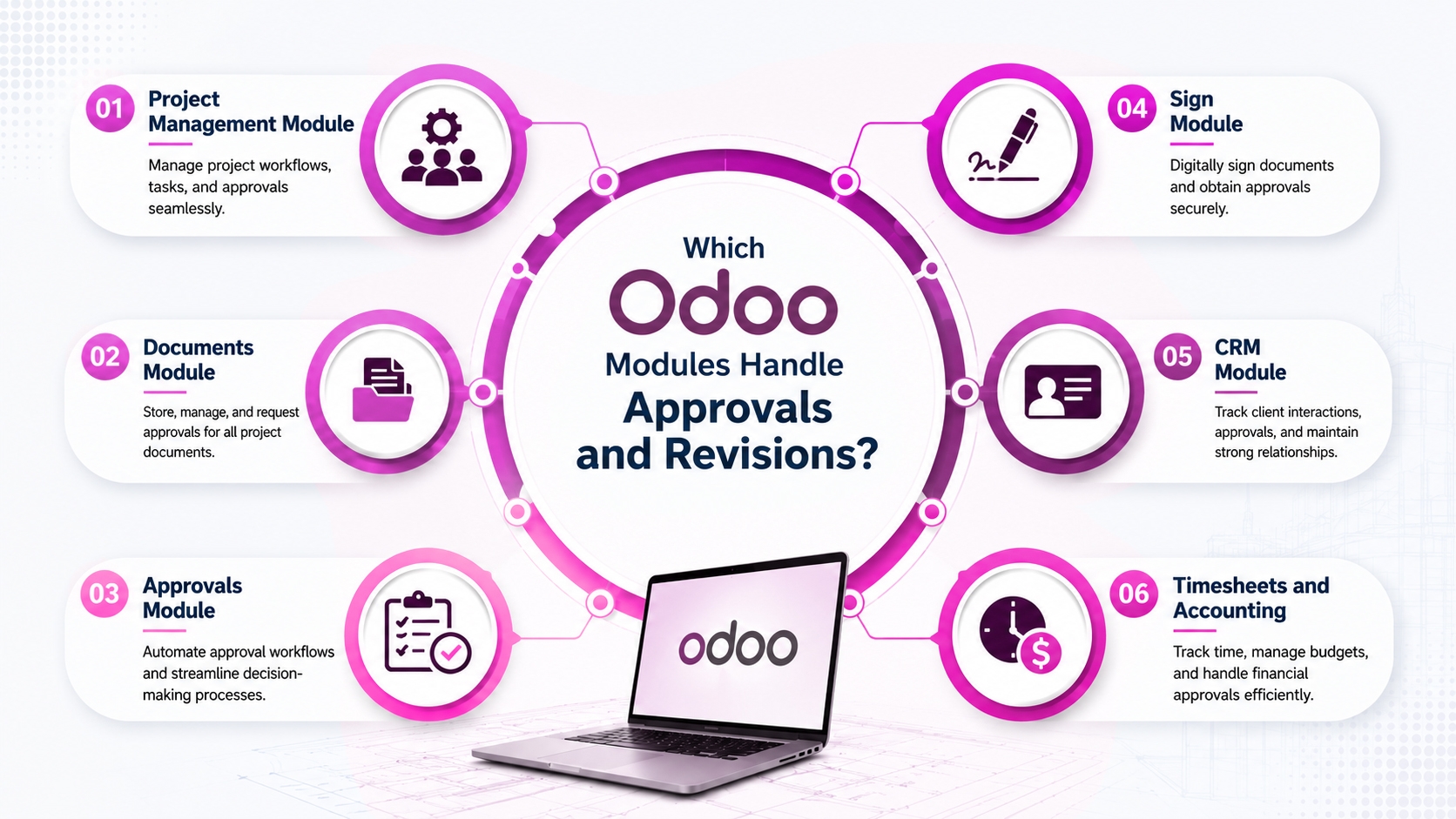
Project Management Module Manages project stages, milestones, Gantt charts, task assignments, and resource allocation in one view. Teams track progress across multiple concurrent projects, identify scheduling conflicts early, and keep every deliverable moving toward its deadline without manual coordination overhead.
Documents Module Stores CAD files, BIM exports, contracts, and compliance documents with complete version history and tagging. Automated workflows trigger notifications when drawings reach specific review stages, eliminating the need to manually alert team members about document status changes.
Approvals Module Builds custom approval workflows with automated routing, configurable hierarchies, and decision tracking built in. Rules adapt to different project types, revision categories, and stakeholder combinations so your approval process matches how your firm actually operates, not a generic template.
Sign Module Handles digital signatures for contracts and formal approvals natively inside Odoo no third-party tool like DocuSign required. Generates legally binding approval certificates automatically and removes the paper-based bottlenecks that slow down milestone sign-offs on every project.
CRM Module Tracks every client interaction from initial inquiry through final project handover in one organized system. Analyzing approval patterns over time helps your team identify which clients or project types consistently generate delays, so future estimates and planning improve accordingly.
Timesheets and Accounting Tracks billable hours against every project phase and revision cycle with detailed reporting built in. When a change order is approved, the billable work flows directly to invoicing nothing gets lost between your project management and finance teams.
Every module you add reduces the number of disconnected tools your team manages. Start lean, expand deliberately, and let the system grow with your firm's operational needs.

Why Odoo Works Specifically for Architecture Firms?
Generic project management tools solve part of the problem. They give you task lists, maybe a Gantt chart, maybe file storage. But they don't connect your client approvals to your document versions, which aren't connected to your change orders, which aren't connected to your invoices.
Odoo connects all of it. That's the actual value not any single module, but the fact that a client approval in the portal updates the project stage, notifies the team, and creates a timestamped record that's linked to the specific document version that was approved. Everything is in one place because it's one system.
Odoo's open-source foundation means your implementation partner can configure it to match how your firm actually works your approval stages, your review process, your revision naming conventions. You're not bending your workflow to fit the software.
At Aspire Softserv, we've helped project-driven firms implement and configure Odoo to fit the way they actually run projects not a textbook version of it. The difference between a working Odoo setup and an underused one almost always comes down to how it was configured in the first place.
Getting Started: You Don't Have to Do It All at Once
The most common implementation mistake is going live with everything at once. Start with Project and Documents to centralize files and define your stages, then add Approvals and Sign once your team is comfortable.
Each phase delivers value immediately. By full deployment, your team isn't learning something new they've been using parts of the system for months and the transition feels natural.
Frequently Asked Questions
1. Does Odoo work with AutoCAD or Revit files?
Odoo doesn't replace your design software. It organizes, versions, and manages the files those tools produce handling storage, approvals, and distribution around them.
2. Can clients use the portal without any training?
Yes. The portal is browser-based, mobile-friendly, and requires no installation. Clients review drawings, comment, and approve files in a few straightforward clicks.
3. How does Odoo handle out-of-scope revision requests?
Your team logs a time and cost estimate upfront. If it exceeds scope, Odoo generates a formal change order requiring client approval before any extra work begins.
4. Is Odoo practical for smaller architecture firms?
Absolutely. Modular pricing means you only pay for what you activate. A small firm can start with just Project, Documents, and Approvals and expand gradually.
5. How long does Odoo implementation typically take for an architecture firm?
A phased implementation starting with core modules typically takes four to eight weeks. Timeline depends on firm size, existing processes, and how much custom configuration is required.
Ready to simplify approvals and revisions?