


 Updated on 10 April 2026

An Enterprise Resource Planning (ERP) software has become an essential and inevitable tool for any trading business that aims to function productively, stay competitive, and maintain healthy profit margins in an increasingly complex market environment.
The trading industry operates in a uniquely challenging fashion revolving around multiple transactions, fluctuating purchase costs, unpredictable consumer demand, and constant changes in logistics and regulations. Managing profit margin control in trading business within this environment requires far more than spreadsheets or basic accounting tools.
Here comes the role of Odoo, a comprehensive suite of integrated business applications embedded with powerful solutions for managing every dimension of a trading business. In this blog, we explore exactly why margins erode and how Odoo fixes it.
What Does Margin Control Mean in a Trading Business?
Margin control is the active process of managing the gap between your purchase cost and selling price accounting for every expense in between, including freight, duties, warehouse handling, and payment terms.
In a trading business, your gross margin comes down to a simple formula: Selling Price − Cost of Goods = Gross Profit. But your net margin factors in every operational cost that quietly chips away at that number throughout the order lifecycle.
The critical challenge is that, unlike manufacturers who control their production variables, traders are almost entirely at the mercy of supplier pricing, logistics costs, and market fluctuations. A 2% untracked shift in purchase price can silently eliminate your margin on an entire product line.
5 Reasons Trading Businesses Keep Losing Margin
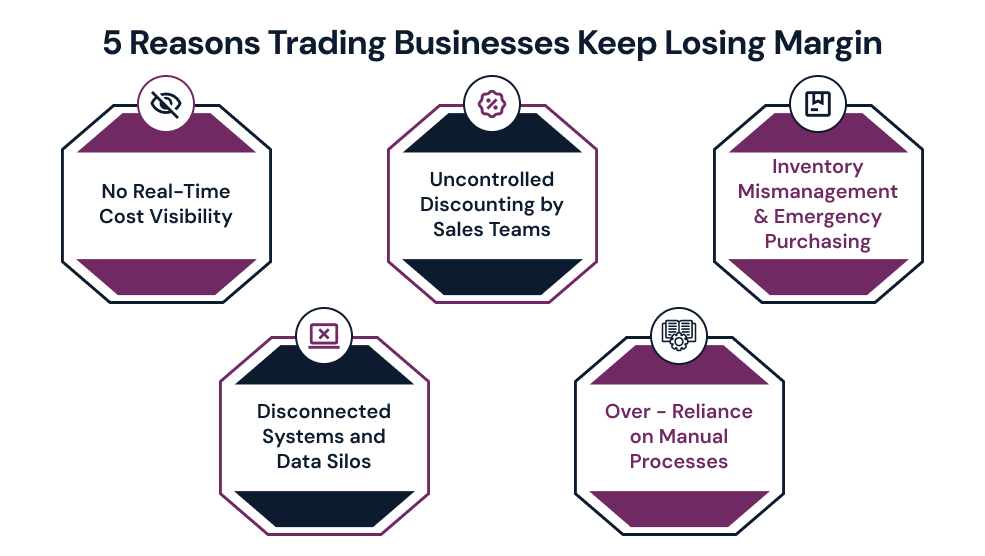
1. No Real-Time Cost Visibility
Purchase prices fluctuate, supplier invoices carry unexpected surcharges, and freight rates shift week to week but most trading companies update these numbers manually in spreadsheets, if at all. By the time a sales rep quotes a price, the cost data they are working from is already outdated, causing products to be sold at margins that look healthy on paper but are negative once all real costs are factored in.
2. Uncontrolled Discounting by Sales Teams
Sales teams face constant pressure to close deals, and without system guardrails or visibility into actual product cost, a rep will readily offer a 15% discount to win an order not realising the margin on that transaction just turned negative. When anyone can override a price without triggering an approval workflow, margin leakage across dozens of weekly transactions becomes completely inevitable.
3. Inventory Mismanagement and Emergency Purchasing
Overstocking ties up working capital in slow-moving goods while understocking forces emergency purchases often at 20–30% above standard supplier pricing just to fulfil urgent orders. Both scenarios compress margins from opposite ends, and without demand-based reordering rules in place, most trading businesses are making inventory decisions based on instinct rather than accurate, real-time data.
4. Disconnected Systems and Data Silos
In a typical trading business, sales uses one tool, the warehouse uses another, and finance works from a third meaning each department operates from a different, incomplete version of the truth. When purchase costs are finalised, that information does not automatically flow to the pricing team or sales staff, leading to decisions made on stale data and margin reports that arrive at month-end, long after the damage is already done.
5. Over-Reliance on Manual Processes
Spreadsheets are not a margin control strategy they are a source of compounding margin risk. A single formula error in a cost calculation cascades silently through dozens of quotes and orders, and with no automation in place, there are no alerts when margins dip below acceptable levels and no blocks when unauthorised discounts are applied. By the time the problem is discovered, it has already cost the business significantly.
What Poor Margin Control Is Actually Costing You
The impact of weak profit margin control in trading business extends far beyond shrinking profit numbers. Businesses suffer chronic cash flow strain from mispriced orders, capital locked in poorly managed inventory, and a structural inability to scale because margins are too thin to absorb the cost of growth.
Most damaging of all, critical business decisions ksupplier renewals, product re-orders, pricing strategy get made on data that does not reflect reality. It is not just a profitability problem; it is a strategic visibility problem that compounds with every passing month.
How Odoo Fixes Margin Control for Trading Businesses?
Odoo is a fully integrated, modular ERP platform built to bring Sales, Purchase, Inventory, Accounting, and operations together in one connected system eliminating the silos and manual processes that cause margin leakage in the first place.
Unlike generic software that manages one function at a time, Odoo was designed so that every module communicates in real time. A cost update in purchasing flows instantly into inventory valuation, which flows into sales pricing meaning every person in your business works from the same accurate, live data at all times.
1. Real-Time Cost Tracking with AVCO and FIFO
Odoo's Inventory module supports Average Cost (AVCO) and First-In-First-Out (FIFO) valuation methods, keeping product costs automatically updated with every goods receipt. There is no manual entry, no lag, and no stale cost data reaching your sales team at the point of quotation.
This means every salesperson quotes from a live cost figure, not a number someone typed into a spreadsheet last Tuesday eliminating one of the most common and costly pricing errors in trading.
2. Landed Cost Management
Odoo's Landed Costs feature allows businesses to allocate freight charges, customs duties, insurance, and handling fees directly to product costs at the time of receipt. Every hidden cost is captured before a sale is ever priced ensuring your margin calculations reflect what goods genuinely cost to land in your warehouse, not just the supplier invoice value.
Businesses that previously ignored landed costs were unknowingly selling products at a loss. Odoo eliminates that blind spot by making every cost component visible and automatically factored in.
3. Margin-Based Approval Rules on Quotations
Using Odoo's native approval workflow, businesses can configure rules that automatically flag or block any quotation falling below a defined margin threshold. A sales rep initiates the quote as normal, but if the margin is below the floor, a manager is instantly notified and must approve before it is sent reserving speed for the sales team while giving management airtight margin protection.
This single feature alone can recover significant monthly margin losses, as it turns what was previously an informal process into a governed, auditable system of controls.
4. Smart Pricing with Multi-Tier Pricelists
Odoo's pricelist system enables businesses to build structured pricing by customer segment, product category, volume tier, or sales channel all applied automatically at the point of quotation. Pricing is never left to individual judgment; it is governed by rules that ensure every deal starts from the right number before any negotiation begins.
Whether you serve retail customers, wholesalers, or key accounts, Odoo applies the correct price list automatically removing inconsistency and ensuring margin discipline across every customer type and channel.
5. Discount Governance by User Role
Discount limits in Odoo are set per user role, meaning a junior sales representative simply cannot offer discounts beyond their authorised level without triggering an escalation. This replaces the informal, uncontrolled discounting culture common in trading businesses with a transparent, auditable framework that every team member operates within.
Managers gain full visibility into every discount applied across the team, making it straightforward to identify patterns of over-discounting and take corrective action before margins are permanently damaged.
6. Integrated Inventory, Sales, and Purchase in One System
When a purchase order is confirmed in Odoo, cost data flows through to inventory valuation automatically. When a sale is made, stock levels update in real time. When inventory hits a reorder point, a purchase request is triggered automatically eliminating the emergency buying situations that force businesses to purchase at inflated prices and destroy carefully planned margins.
This end-to-end integration means every department sales, warehouse, and finance works from the same live data, making fragmented decision-making and data silos a problem of the past.
7. Real-Time Margin Reporting and Analytics
Odoo's reporting suite delivers product-level and customer-level profitability data in real time, with margin reports sliceable by product, category, salesperson, region, or time period. Instead of discovering margin erosion at month-end, management can identify underperforming products or sales patterns as they emerge and course-correct immediately before a small dip becomes a significant loss.
These live dashboards transform how trading businesses make decisions shifting from reactive month-end damage control to proactive, data-driven margin management that protects profitability at every level.
Key Benefits of Using Odoo for Margin Control in Trading
Beyond solving the five core problems outlined above, businesses that implement Odoo for margin control typically experience a broader set of operational improvements:
Improved pricing accuracy across every product, customer, and channel
Reduced operational errors from automated cost updates and approval workflows
Better supplier negotiations enabled by consolidated purchasing data and spend visibility
Faster, more confident decisions backed by real-time dashboards instead of end-of-month reports
Scalable growth without the margin compression that typically accompanies rising transaction volumes
These are not one-time gains. They compound as the business scales because the system scales with it.
Take Control of Your Trading Margins Starting Today
The margin problem in trading businesses is not a people problem. Your sales team is not incompetent, your warehouse staff are not careless, and your finance team is not asleep. The problem is systemic built into disconnected tools, manual processes, and the complete absence of automated controls at each transaction point.
Odoo solves this not with complexity, but with structure and integration. A single connected platform, live cost data flowing across every module, intelligent approval workflows, and real-time margin visibility give trading businesses the control they have always needed but never had the technology to implement affordably.
Every sale your business makes should be contributing to your bottom line not eroding it. If your current system cannot guarantee that, then the cost of staying where you are is already greater than the cost of making the switch to Odoo.
Ready to see how Odoo transforms profit margin control in your trading business? Book a free consultation with our Odoo specialists and get a personalised demo today.
Frequently Asked Questions
Q1. What is profit margin control in a trading business?
It is the process of actively monitoring the gap between purchase cost and selling price including all hidden costs to ensure every transaction contributes to real profitability.
Q2. Why do trading businesses lose margins even when sales are high?
Uncontrolled discounts, inaccurate landed costs, poor inventory management, and disconnected systems silently erode profits a problem known as margin leakage often invisible until month-end reporting.
Q3. How does Odoo help with margin control in trading companies?
Odoo provides real-time cost tracking, landed cost allocation, margin-threshold approval rules, pricelist governance, and live margin reporting all integrated in one platform to eliminate margin blind spots.
Q4. Is Odoo suitable for small and mid-sized trading businesses?
Yes. Odoo's modular design means businesses start with only the modules they need Sales, Purchase, Inventory and scale up as they grow, at a fraction of the cost of SAP or Oracle.
Q5. Which Odoo modules matter most for-profit margin control?
The five key modules are Inventory (cost valuation), Purchase (vendor pricing and reordering), Sales (approval rules and pricelists), Accounting (margin reporting), and Odoo Studio (custom margin alert rules).
Stop margin loss get a personalised Odoo demo.