


 Updated on 10 February 2026


The clock is ticking for one of the most significant transitions in enterprise software history. Over 18,000 companies worldwide still run SAP ECC 6.0, and they have less than two years to make a decision that will shape their business operations for the next decade. December 31, 2027, marks the end of mainstream maintenance for SAP ECC 6.0, particularly for systems using Enhancement Packages (EHP) 6-8. After this date, standard support, security updates, and bug fixes will cease leaving businesses vulnerable to security risks, compliance issues, and operational disruptions.
But here's the critical question that many CFOs, CIOs, and business leaders are asking: Is upgrading to SAP S/4HANA your only option, or is there a smarter, more cost-effective path forward? This isn't just a technical upgrade it's a strategic inflection point that presents an opportunity to fundamentally rethink how your ERP supports your business goals.
In this comprehensive guide, we'll explore what the 2027 deadline really means, examine your options, and help you understand the key factors in choosing the right ERP solution for your organization's future.
What Actually Happens When SAP Support Ends in 2027?
When SAP's mainstream maintenance ends on December 31, 2027, the consequences extend far beyond missing out on new features. Businesses face a cascade of operational, security, and compliance challenges that compound over time, creating mounting risks and escalating costs that threaten competitive viability and regulatory standing.
End of Standard Support: SAP will cease providing security patches, bug fixes, and legal updates for ECC 6.0 systems. When critical issues arise and they will there's no vendor assistance to resolve them. You're essentially operating mission-critical business systems without a safety net, leaving your organization vulnerable to system failures with no official recourse.
Compliance Nightmare: Industry-specific regulations like GDPR, SOX, FDA 21 CFR Part 11, and HIPAA require current, supported software systems with regular security updates. Auditors will flag unsupported ERP systems as compliance violations, potentially resulting in failed audits, substantial fines, legal complications, and damaged business relationships with partners who demand compliant vendors.
Cybersecurity Exposure: Unpatched vulnerabilities become open invitations for cyberattacks, ransomware, and data breaches. Every month without security updates increases your exposure exponentially as hackers actively exploit known weaknesses. The financial and reputational damage from a single breach can dwarf the cost of proactive ERP migration, making cybersecurity risk the most urgent concern.
Operational Risks: System failures without vendor support mean extended downtime that can cost tens of thousands of dollars per hour. Your IT team will struggle to diagnose and fix issues in increasingly outdated code while business operations grind to a halt. Critical processes like order fulfillment, inventory management, and financial reporting become fragile and unreliable.
Talent Shortage: Finding developers and consultants willing to work on obsolete technology becomes increasingly difficult and expensive. Your best technical staff migrate to modern platforms, leaving critical knowledge gaps. New hires view legacy system experience as career-limiting, meaning you'll struggle to maintain even basic system support with a shrinking pool of aging specialists.
The "Do Nothing" Trap: Extended maintenance programs seem like safe temporary solutions but merely delay inevitable migration while accumulating technical debt. Costs escalate through premium support fees, emergency fixes, and workarounds. Meanwhile, migration complexity increases as your system falls further behind, data grows messier, and competitive disadvantages widen against rivals using modern, agile ERP platforms.
Your Post-SAP ECC Options: Three Paths Forward
When facing the 2027 deadline, businesses essentially have three strategic paths:
Path 1: Migrate to SAP S/4HANA. This option keeps you within the SAP ecosystem but requires understanding that it's not a simple upgrade it's a major re-implementation project. S/4HANA is built on an entirely different technical foundation (the HANA in-memory database), requiring significant code remediation, process changes, and typically 12 to 24 months of implementation time. The costs are substantial, often reaching millions of dollars for mid-sized enterprises.
Path 2: Switch to an alternative modern ERP platform. This path offers the opportunity to break free from vendor lock-in and explore platforms that may be more aligned with your current business needs. Options include Odoo, Microsoft Dynamics 365, Oracle NetSuite, and other modern ERP solutions. These alternatives often provide more agility, lower total cost of ownership, and faster implementation timelines.
Path 3: Adopt a hybrid or phased approach. Some organizations choose to keep SAP for certain core modules while modernizing other areas with best-of-breed solutions. This allows you to test new systems without complete disruption and create a gradual transition strategy that minimizes risk.
The critical insight here is that this isn't merely a technical decision it's a strategic choice that will determine your operational flexibility, cost structure, and competitive positioning for years to come. Many companies are discovering that their business needs have evolved significantly since SAP ECC was originally implemented. What served a traditional manufacturing operation in 2005 may not support today's omnichannel, cloud-first, agile business models.
Critical Factors for Choosing Your Next ERP Solution
Before defaulting to S/4HANA or jumping to the newest platform, ask yourself these strategic questions:
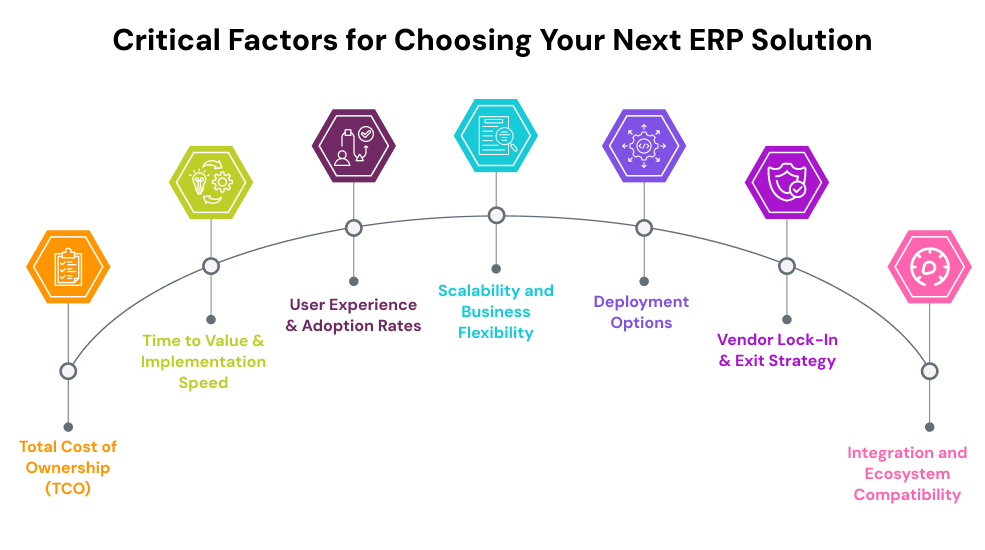
Total Cost of Ownership (TCO): Look beyond initial license fees to understand the complete financial picture. TCO includes infrastructure costs, implementation and customization expenses, ongoing maintenance fees, and the often-hidden costs of vendor lock-in, forced upgrades, and proprietary add-ons. When evaluating ERP options, project costs over 5 and 10-year periods. Some systems appear affordable initially but become increasingly expensive as your business scales or needs change.
Time to Value and Implementation Speed: How quickly can your new ERP deliver tangible ROI? Implementation timelines vary dramatically from 3-6 months for modern, modular systems to 18+ months for complex enterprise platforms. Consider not just the calendar time but the business disruption during migration. Extended implementations drain resources, distract management attention, and delay the benefits you're investing to achieve.
User Experience and Adoption Rates: Here's a sobering statistic: poor user adoption is the number one reason ERP projects fail. A powerful system that nobody wants to use delivers zero value. Modern, intuitive interfaces with mobile accessibility can dramatically improve productivity and reduce training requirements. Compare legacy complexity against contemporary user experience standards your employees are accustomed to consumer-grade applications in their personal lives and expect the same from business software.
Scalability and Business Flexibility: Can your chosen ERP grow with your business? Consider how easily you can add modules, users, locations, or even entirely new business models. The difference between customization (expensive code changes) and configuration (parameter adjustments) matters enormously. Systems built on flexible, modular architectures adapt to change far more gracefully than monolithic platforms.
Deployment Options: Cloud, on-premise, or hybrid deployment models each have strategic implications. True cloud-native solutions offer operational simplicity, predictable costs, and automatic updates. On-premise systems provide maximum control and may be necessary for specific regulatory requirements. Hybrid approaches attempt to balance both but can introduce complexity. Beware of "cloud-washed" solutions legacy systems simply hosted in data centers without true cloud architecture benefits.
Vendor Lock-In and Exit Strategy: This consideration is particularly relevant for companies leaving SAP after years of dependency. Proprietary architectures make you captive to a single vendor's pricing, upgrade cycles, and strategic decisions. Open-source foundations provide transparency, community support, and the ability to take control of your own destiny. Ask yourself: what happens if you need to switch again in ten years?
Integration and Ecosystem Compatibility: Modern businesses require seamless data flow across dozens of systems. Evaluate the quality and availability of APIs, pre-built connectors for your critical applications, and the vibrancy of third-party app marketplaces. Your ERP should be a platform for innovation, not an integration bottleneck. Consider future needs too how will the system accommodate artificial intelligence, Internet of Things devices, and technologies that don't even exist yet?
Why Growing Numbers of Businesses Are Choosing Odoo After SAP?
Mid-sized and growth-focused enterprises are discovering Odoo as a compelling alternative to traditional enterprise ERP. Rather than monolithic systems, Odoo offers modular, all-in-one platform with over 40 integrated business applications. Implement only needed modules and add others as requirements evolve, providing flexibility traditional systems cannot match.
1.Open-Source Advantages
Odoo's open-source foundation eliminates vendor lock-in with full source code access and customization freedom. Pricing remains transparent without hidden license traps or surprise audit fees. A global community of 7 million users and 40,000 third-party applications creates a rich ecosystem of extensions and support options.
2. Superior Implementation and Cost Benefits
Odoo implementations average three to six months compared to SAP's 12-24 months, delivering faster time-to-value. Total cost of ownership runs 50-70 percent lower than traditional ERP systems. A mid-sized manufacturer spending $2 million annually on SAP could save $1 million yearly by switching to Odoo.
3. Universal Industry Applicability
Odoo serves diverse industries effectively: manufacturers manage complex supply chains, retailers leverage integrated inventory systems, professional services firms appreciate project accounting, healthcare organizations ensure compliance. Wholesale distributors and logistics providers find Odoo adaptable to specific workflows. Enterprise-grade functionality without enterprise-grade complexity and cost makes Odoo the strategic choice.
SAP vs Odoo: A Side-by-Side Comparison
| Criteria | SAP | Odoo |
|---|---|---|
| Implementation Complexity & Timeline | 12–24+ months; requires specialized ABAP developers and costly consultants | 3–6 months; straightforward migration using standard web development skills |
| Total Cost of Ownership (TCO) | High license fees, significant infrastructure costs, ongoing maintenance, and forced upgrade cycles | 50–70% lower TCO with transparent, predictable pricing and no surprise escalations |
| Customization & Flexibility | Customization is complex and expensive, heavily dependent on specialized consultants | Open-source flexibility with Python-based development, enabling strong in-house ownership |
| Cloud Readiness | Cloud options exist but are complex in hybrid and multi-cloud environments | True cloud-native architecture with SaaS and self-hosted deployment flexibility |
| User Experience | Improved from ECC, yet still complex and training-intensive | Modern, intuitive UI with minimal learning curve and full mobile optimization |
| Best Fit For | Fortune 500 enterprises with large SAP footprints and highly complex global operations | Growth-stage and mid-market organizations prioritizing agility, cost efficiency, and flexibility |
Odoo makes particular sense when you're looking to reduce ERP costs by 50 percent or more, need faster implementation and time-to-value, want flexibility without dependency on expensive consultants, require agility to adapt to changing business models rapidly, and are building for the future rather than maintaining the past.

How an Experienced Odoo Service Provider Accelerates Your Success?
Choosing Odoo is just the beginning successful implementation requires deep expertise in both SAP ecosystems and Odoo's architecture. The right implementation partner transforms a complex migration into a streamlined transition, minimizing risks while maximizing ROI. From initial assessment through post-launch optimization, experienced Odoo service providers ensure your investment delivers measurable business value from day one.
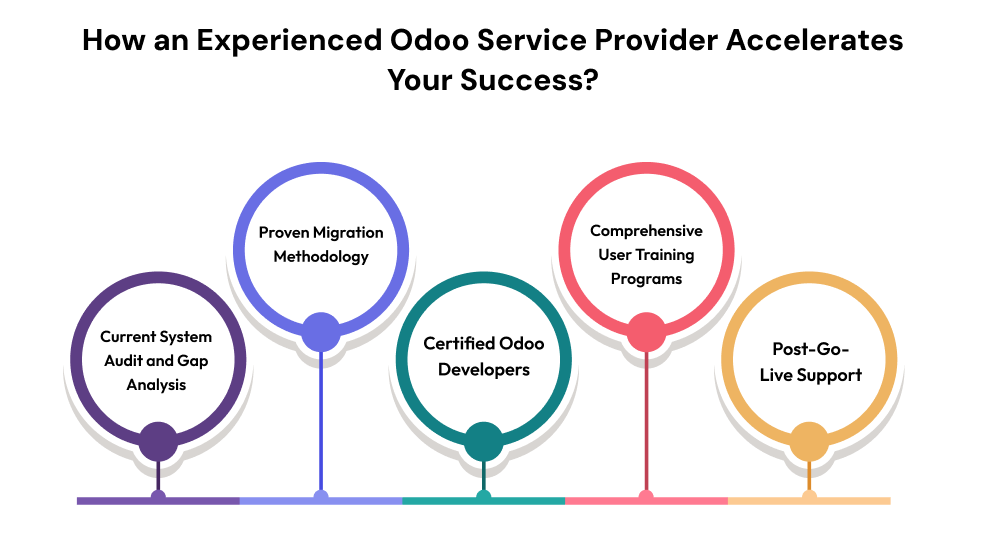
1. Current System Audit and Gap Analysis
Expert partners conduct thorough audits of your SAP ECC environment, documenting processes, customizations, integrations, and data structures. They identify gaps between current capabilities and business requirements, revealing opportunities to eliminate unnecessary complexity. This comprehensive assessment creates a clear migration roadmap aligned with your strategic objectives, ensuring nothing critical is overlooked.
2. Proven Migration Methodology
Established migration frameworks reduce risk through structured, phased approaches tested across dozens of implementations. Experienced providers use standardized data mapping templates, automated migration tools, and validation protocols that ensure accuracy and completeness. Their battle-tested methodologies anticipate common pitfalls like data quality issues or integration challenges and address them proactively before they impact timelines or business operations.
3. Certified Odoo Developers
Certified developers bring deep technical expertise in Odoo's Python-based architecture, database structures, and module ecosystems. They understand both standard configurations and custom development best practices, ensuring solutions are maintainable and upgrade-friendly. Their experience across multiple industries and use cases means faster problem-solving, cleaner code, and implementations that leverage Odoo's full potential rather than fighting against its design.
4. Comprehensive User Training Programs
Effective training goes beyond button-clicking to help users understand how Odoo improves their daily workflows. Quality providers offer multi-format learning live sessions, video libraries, quick reference guides, and sandbox environments for hands-on practice. They identify department champions, provide role-specific training tailored to actual job functions, and ensure your team can operate independently with confidence, driving higher adoption rates and faster productivity gains.
5. Post-Go-Live Support
Launch day is just the beginning of your Odoo journey. Experienced providers offer tiered support with rapid response times, helping resolve issues before they impact operations. They provide performance monitoring, system optimization recommendations, and ongoing consultation as your business evolves. This long-term partnership ensures your ERP continues delivering value, adapts to changing requirements, and positions you to leverage new Odoo capabilities as they emerge.
Conclusion:
December 31, 2027, marks the end of SAP ECC 6.0 support and a pivotal moment for your organization. Delaying creates mounting security vulnerabilities, compliance risks, and integration failures while implementation partners book up and migration complexity grows exponentially.
Your options require careful evaluation. SAP S/4HANA demands substantial investment and 12-24 months implementation. Odoo offers 50-70% lower costs, 3-6 month timelines, and flexible architecture. Choose based on your size, budget, and appetite for transformation.
Odoo delivers enterprise functionality without complexity for mid-market companies. Its intuitive interface, transparent pricing, rapid implementation, and modular architecture address SAP pain points across manufacturing, retail, and professional services while maintaining competitive agility.
Frequently Asked Questions
Q1: Can we continue using SAP ECC 6.0 after 2027 with extended support?
Yes, but at 2-5% additional annual costs without functional enhancements. Extended support is a temporary bridge, not a solution it delays inevitable migration while increasing complexity.
Q2: How long does a typical SAP-to-Odoo migration take?
Mid-sized businesses: 3-6 months. Complex organizations: 6-9 months. Significantly faster than S/4HANA's 12-24+ months. Timeline depends on data quality, customizations, and integration complexity.
Q3: What happens to our existing SAP customizations when migrating to Odoo?
Direct conversion isn't possible. Reevaluate each customization's business value 30-40% become unnecessary in Odoo's flexible environment. Rebuild only what truly adds value.
Q4: Is Odoo suitable for large enterprises, or is it only for small to mid-sized businesses?
Odoo serves companies of all sizes, though it's optimal for 50-5,000 employees. Success depends on complexity and requirements, not size agility-focused enterprises thrive.
Q5: What are the typical cost savings when moving from SAP ECC to Odoo?
Expect 50-70% TCO reduction over five years. A company spending $2M annually on SAP typically reduces costs to $600K-$1M with Odoo's transparent pricing.
Q6: How do we handle change management when transitioning from SAP to a completely different system?
Build cross-functional teams, identify department champions, communicate benefits early, provide multi-format training, offer robust transition support, and celebrate quick wins to build adoption momentum.