

Key Takeaways
Business Needs TallyPrime focuses on accounting, GST, and invoicing, while Odoo connects multiple business operations.
Accounting and GST Both support accounting and GST workflows, but Odoo integrates financial data with other business functions.
Business Operations Odoo offers dedicated apps for inventory, sales, CRM, and manufacturing, while TallyPrime is primarily accounting-focused.
Cost and Implementation Costs depend on licensing, users, customization, integrations, training, and maintenance.
Choosing the Right Software TallyPrime suits accounting-focused businesses, while Odoo suits businesses looking to manage multiple operations and scale.
Choosing the right business software can affect how efficiently a company manages accounting, inventory, sales, and daily operations. Odoo and TallyPrime are both popular options, but they serve different business needs. TallyPrime focuses strongly on accounting and financial management, while Odoo ERP connects accounting with a wider range of business applications.
This guide compares Odoo vs. Tally across key features, pricing considerations, advantages, and business requirements to help you decide which solution is the better fit.
Odoo vs. Tally: Key Differences at a Glance
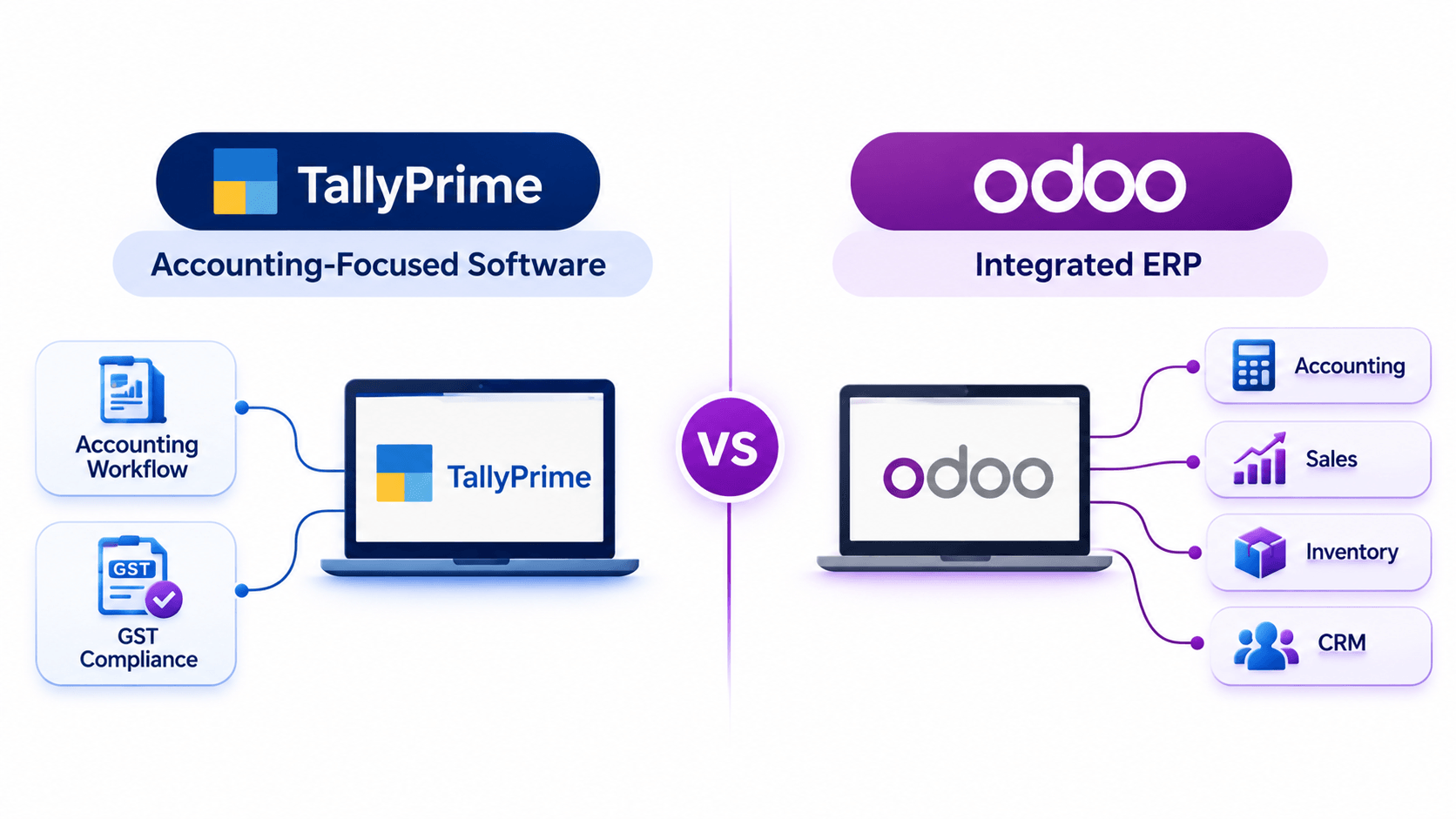
The main difference between Odoo and Tally is their scope. TallyPrime is primarily accounting and business management software, whereas Odoo is a modular enterprise resource planning (ERP) platform.
| Feature | Odoo ERP | TallyPrime |
|---|---|---|
| Primary focus | Integrated business management | Accounting and financial management |
| Accounting | Available through its accounting app | Core capability |
| Inventory | Inventory and warehouse management apps | Inventory tracking and accounting-related workflows |
| Sales and CRM | Dedicated sales and CRM apps | More focused on accounting and business transactions |
| Customization | Configurable apps and further customization options | Configuration options suited to accounting workflows |
| Integrations | Connects business applications; additional integration may require setup | Supports relevant integrations and connected workflows |
| Best suited for | Businesses needing connected operations | Businesses prioritizing accounting and financial processes |
What Is Odoo ERP?
Odoo ERP is business management software that brings multiple functions together in one platform. Businesses can choose applications based on their needs instead of managing every department through separate systems.
Its applications cover accounting, sales, customer relationship management (CRM), inventory, purchasing, manufacturing, and other business operations.
For example, a distributor can use Odoo to connect a sales order with inventory availability, delivery activities, and invoicing. This helps teams work with connected information rather than repeatedly entering the same data into different tools.
Odoo can be a suitable option for businesses that want to centralize operations and add functionality as their requirements change. However, implementation, configuration, and user training need to be planned carefully.
What Is TallyPrime?
TallyPrime is accounting and business management software widely used for financial transactions, invoicing, tax-related workflows, and reporting. In India, businesses commonly evaluate it for GST accounting, bookkeeping, and financial records.
It also supports inventory-related workflows and business reports, making it useful for organizations that need more than basic bookkeeping but do not necessarily require a broad ERP platform.
For a small business that primarily needs accounting, GST reporting, and transaction management, TallyPrime may offer a practical fit. Companies with more complex processes across sales, inventory, manufacturing, and other departments may need to assess whether additional systems or integrations are required.
Odoo vs. Tally: Feature-by-Feature Comparison
Accounting and Financial Management
Both platforms support accounting workflows, but their broader purposes differ. TallyPrime emphasizes bookkeeping, invoicing, financial statements, and GST-related processes. Odoo connects accounting with other business applications, allowing financial information to relate to sales, purchasing, and inventory activities.
For businesses comparing Odoo vs. Tally for GST, the decision should be based on required tax workflows, reporting, compliance needs, and the configuration available for the relevant Indian business setup. Verify current functionality before making a decision.
Inventory Management
TallyPrime supports inventory tracking alongside its accounting capabilities. Odoo offers dedicated inventory and warehouse management functionality, which may be useful for businesses handling multiple locations, replenishment, transfers, or more involved warehouse workflows.
The right choice depends on inventory complexity. A business tracking straightforward stock movements may have different needs from a distributor managing several warehouses and connected sales channels.
Sales and CRM
Odoo includes dedicated sales and CRM applications that connect customer opportunities, quotations, and sales activities with other business processes. TallyPrime is more accounting-oriented, so businesses seeking advanced CRM workflows may need additional software or integrations.
Customization and Integrations
Odoo offers configurable applications and customization possibilities to support specific workflows. The extent of customization depends on the edition, hosting approach, technical requirements, and implementation partner.
TallyPrime provides configuration options for common accounting and business workflows, with integration possibilities depending on the requirements. Before choosing either system, identify the applications you already use and confirm how data will move between them.
Scalability and Reporting
Odoo may suit businesses that plan to connect more departments and workflows over time. TallyPrime may remain suitable as accounting needs grow, depending on transaction volume, reporting requirements, and operational complexity.
Odoo vs. Tally: Pricing and Implementation Costs
There is no universal cost winner in the Odoo vs. Tally pricing and implementation cost comparison. Total cost depends on the product plan, number of users, required applications, hosting, customization, integrations, training, and ongoing support.
Odoo costs can vary according to the selected plan and implementation scope. TallyPrime costs depend on the applicable license or subscription arrangement and any additional tools or services required.
Compare the total cost of ownership, not just the initial software price. Request current quotes, list essential features, estimate implementation effort, and account for maintenance and future changes before deciding.
Pros and Cons of Odoo and Tally
Advantages and Limitations of Odoo
Advantages of Odoo
Connects multiple business functions on one platform.
Offers applications for CRM, sales, inventory, and other workflows.
Supports configurable processes and expansion into additional applications.
Limitations of Odoo
Implementation may require planning, training, and specialist support.
Advanced customization and integrations can increase costs and complexity.
Advantages and Limitations of TallyPrime
Advantages of TallyPrime
Strong focus on accounting and financial management.
Supports common invoicing, GST, and reporting workflows.
May be a practical choice for businesses with primarily accounting-led requirements.
Limitations of TallyPrime
Broader operational workflows may require additional tools or integrations.
Businesses seeking a unified ERP environment should evaluate whether its capabilities meet their requirements.
Odoo vs. Tally: Which Is Better for Your Business?
The answer to “Which is better for business, Odoo or TallyPrime?” depends on what your business needs today and how it expects to grow.
Choose TallyPrime if your main priorities are accounting, invoicing, GST-related workflows, and financial reporting, and your existing processes work well.
Consider Odoo ERP if you want to connect accounting with sales, CRM, inventory, purchasing, manufacturing, or other business functions through an integrated platform.
Before deciding, list your essential workflows, compare current product capabilities, estimate total costs, and involve the employees who will use the system. A product demonstration based on your real business processes is more useful than choosing solely by feature count.
Choosing Between Odoo and Tally
Odoo and TallyPrime address overlapping but different business needs. TallyPrime is a strong candidate for accounting-focused requirements, while Odoo may be better suited to businesses seeking connected operations across multiple departments.
The right choice depends on your workflows, budget, integration requirements, and growth plans. Evaluate both platforms against those needs before committing to an implementation.
If your business is considering Odoo, Aspire SoftServ can help you assess your requirements and explore an appropriate odoo implementation approach.
Frequently Asked Questions: Odoo vs Tally
1. What is the main difference between Odoo and TallyPrime?
Odoo manages multiple business operations, while TallyPrime primarily focuses on accounting and financial management.
2. Which is better for small businesses: Odoo or TallyPrime?
TallyPrime suits accounting-focused businesses, while Odoo is better for businesses needing integrated business management.
3. Is Odoo better than Tally for GST accounting?
Both support GST-related workflows. TallyPrime focuses on GST accounting, while Odoo offers GST capabilities within its broader ERP system.
4. Can Odoo replace TallyPrime for accounting?
Yes, Odoo can handle accounting and financial management, depending on the business's requirements.
5. Can I migrate data from TallyPrime to Odoo?
Yes, relevant accounting, customer, vendor, and inventory data can be migrated with proper planning and validation.
6. What is the difference between Odoo ERP and Tally accounting software?
Odoo connects multiple business functions, whereas TallyPrime primarily manages accounting, taxation, and financial records.
7. Which is more cost-effective: Odoo or TallyPrime?
TallyPrime may be more cost-effective for accounting needs, while Odoo can offer better value for businesses requiring multiple integrated applications.

Ramesh Karangiya is an ERP leader with extensive experience delivering enterprise solutions across the IT and services industry. With hands-on expertise in Odoo, web technologies, and Java-based frameworks, he builds stable, well-integrated ERP systems that improve process efficiency and scale with business growth.