


 Updated on 8 May 2026

Multi-location businesses face unprecedented complexity in inventory management today. Global supply chains, omnichannel sales, and customer expectations for instant fulfillment create operational challenges that traditional warehouse systems cannot adequately address. Modern enterprises need intelligent, connected solutions built specifically for multi-warehouse operational excellence.
Without centralized warehouse management systems, businesses encounter critical bottlenecks including inventory discrepancies across locations, delayed inter-warehouse transfers, poor demand forecasting, and fragmented visibility. These operational inefficiencies directly erode profitability, damage customer satisfaction, increase holding costs, and create competitive disadvantages across every sales channel.
Odoo delivers an all-in-one ERP solution that transforms multi-warehouse chaos into operational clarity. This comprehensive guide explores how Odoo manages intelligent stock transfers, automates reordering rules based on real-time demand, and delivers complete real-time inventory visibility across unlimited warehouse locations for sustainable business growth.
What is Multi-Warehouse Inventory Management?
Multi-warehouse inventory management enables businesses to track, control, and optimize stock across multiple physical locations through one centralized inventory system. This unified approach dramatically reduces operational losses, improves order fulfillment accuracy, and supports data-driven business decisions that enhance both profitability and competitive positioning.
Effective multi-warehouse systems integrate real-time stock tracking, automated replenishment workflows, and intelligent routing algorithms. These capabilities ensure inventory reaches the right location at the right time, minimizing stockouts and overstocking while maximizing warehouse space utilization, supply chain velocity, and customer satisfaction metrics.
1.Retail Chains
Retail chains manage stock across dozens of store locations and back-end warehouses simultaneously. A centralized inventory system keeps shelves stocked, prevents overselling, and enables fast inter-branch transfers directly improving customer experience and operational efficiency at every location.
2.Manufacturing Plants
Manufacturing plants depend on precise raw material tracking across multiple production floors and storage areas. Integrated Odoo warehouse management ensures materials are available on time, production schedules stay on track, and finished goods are dispatched efficiently to the right destinations.
3.Distribution Hubs
Distribution hubs coordinate high volumes of incoming and outgoing shipments across wide networks daily. Without centralized control, fulfillment slows and errors multiply. Real-time stock visibility enables hubs to prioritize, route, and manage inventory flows with greater speed, accuracy, and confidence.
4.Pharmaceutical & Healthcare
Pharmaceutical companies manage temperature-controlled storage, batch tracking, expiration date monitoring, and regulatory compliance across warehouses. Odoo ensures FIFO/FEFO inventory rotation, lot traceability for product recalls, and complete audit trails meeting FDA and GMP standards.
Key Challenges in Multi-Warehouse Inventory Management
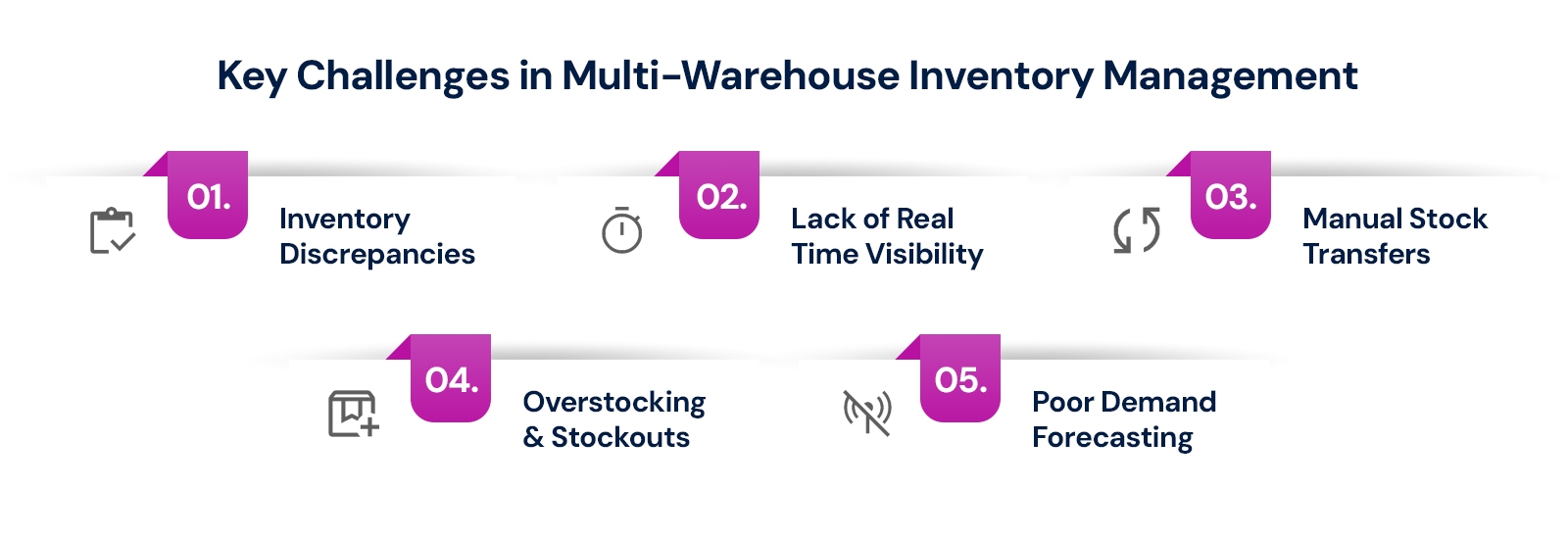
Businesses without a robust warehouse management system face serious, compounding operational issues. Managing inventory manually across multiple locations introduces costly errors, growing inefficiencies, and financial risks that worsen quickly as business volume and complexity scale.
These challenges manifest across procurement, fulfillment, financial reporting, and customer service functions. Organizations lacking real-time visibility make decisions on outdated information, leading to reactive rather than proactive management.
1. Inventory Discrepancies
Inventory discrepancies arise when physical stock levels don’t match system records, causing fulfillment errors, customer complaints, and financial losses. Without real-time synchronization across warehouses, these mismatches grow silently and become increasingly difficult and expensive to investigate and correct.
2. Lack of Real-Time Visibility
Without real-time stock tracking, procurement and fulfillment decisions are made on outdated information. Blind spots across locations lead to duplicate purchases, missed sales, and an inability to respond quickly to sudden demand shifts or supply disruptions.
3. Manual Stock Transfers
Manual stock transfer processes introduce human errors, miscommunication, and costly delays between warehouse locations. Teams waste hours on paperwork, chasing confirmations, and reconciling records time better spent on higher-value tasks that genuinely drive operational efficiency and business growth.
4. Overstocking & Stockouts
Poor stock control creates overstocking at certain locations while others face critical shortages. Both outcomes are expensive excess inventory ties up cash and space, while stockouts cause lost sales and push customers toward competitors who can deliver reliably.
5. Poor Demand Forecasting
Without reliable historical data and inventory forecasting tools, businesses react to demand rather than anticipate it. Rushed purchases, inflated costs, and missed opportunities follow. Accurate demand planning requires a connected ERP system analyzing real trends across all warehouse locations.
This is where Odoo makes a difference delivering a fully integrated ERP inventory system that eliminates these challenges through intelligent automation, real-time visibility, and seamless warehouse operations.

How Odoo Handles Multi-Warehouse Inventory?
Odoo transforms multi-warehouse complexity into competitive advantage through three integrated pillars: centralized inventory management for unified control, multi-location tracking for granular visibility, and smart routing for automated workflows.
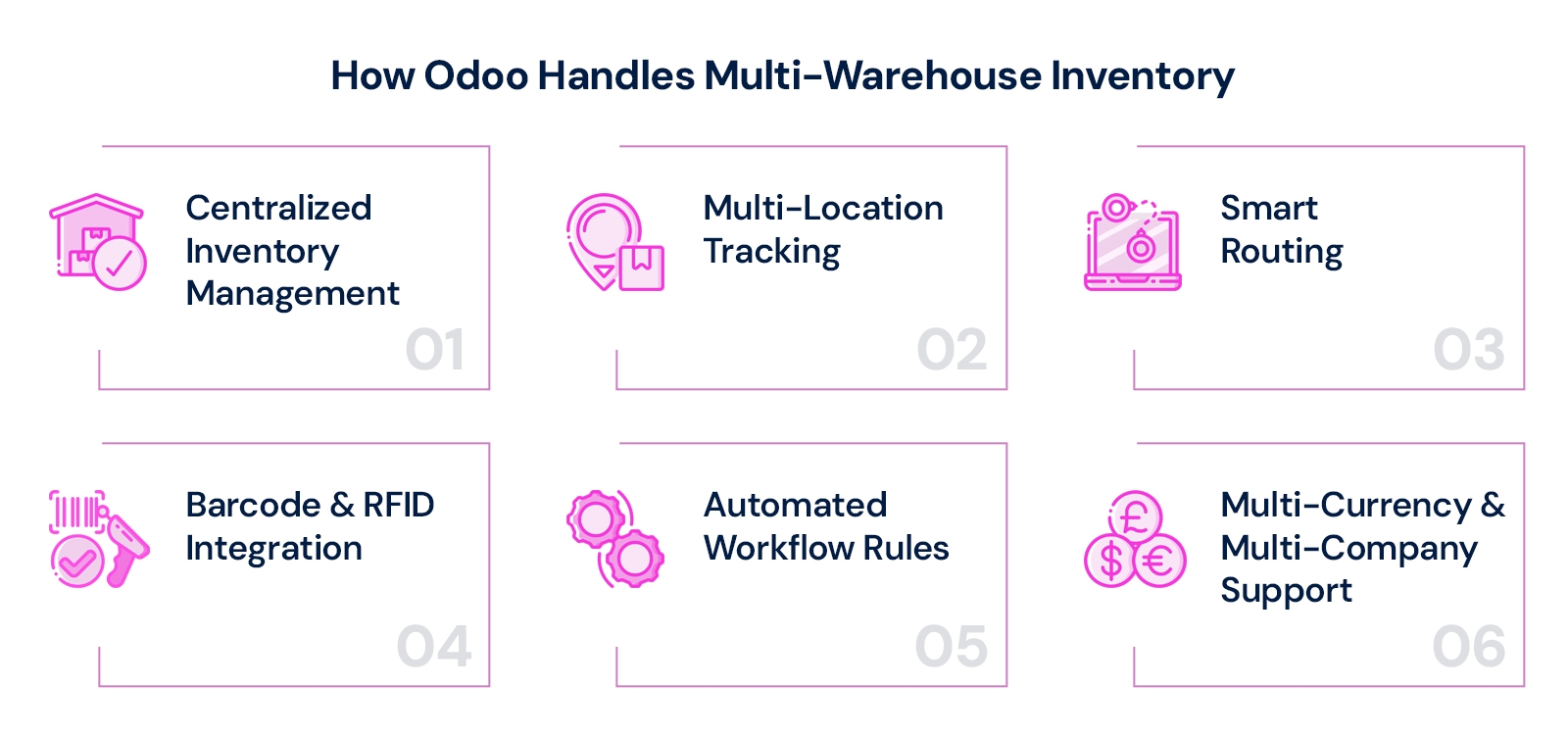
1. Centralized Inventory Management
Odoo manages multiple warehouses under one unified platform, eliminating disconnected spreadsheets and fragmented systems. The centralized dashboard provides operations managers complete real-time visibility into stock levels across all locations, enabling instant identification of surplus stock, shortage alerts, and transfer needs.
2. Multi-Location Tracking
Odoo's inventory tracking extends beyond warehouse-level visibility to bin, shelf, aisle, and room-level precision. Lot and serial number tracking adds critical traceability for perishables, electronics, pharmaceuticals, and regulated products, creating complete audit trails from receipt through delivery.
3. Smart Routing
Odoo's intelligent routing engine automates stock flow between locations using push and pull rules. Push rules trigger automatic movements when stock arrives; pull rules generate transfers based on downstream demand like sales orders or manufacturing requests, eliminating manual coordination.
4. Barcode & RFID Integration
Warehouse staff validate stock movements using barcode scanners or RFID technology, reducing input errors and accelerating warehouse operations. Odoo's mobile barcode app works offline, eliminating WiFi coverage issues while providing instant stock updates, real-time inventory adjustments, and picking validation.
5. Automated Workflow Rules
Odoo generates transfer orders, purchase orders, and manufacturing orders automatically based on predefined business rules and demand signals. These automated workflows reduce manual intervention by up to seventy-five percent, freeing teams to focus on strategic activities rather than repetitive administrative tasks.
6. Multi-Currency & Multi-Company Support
Global businesses manage warehouses across different countries, currencies, and legal entities within one Odoo instance. The system handles currency conversions, regional tax compliance, inter-company transfers, and consolidated financial reporting while maintaining location-specific pricing and inventory valuation methods.
Industry Use Cases
Odoo's multi-warehouse capabilities serve diverse industries with unique operational requirements. From strict regulatory compliance to rapid fulfillment demands, the system adapts to industry-specific workflows while maintaining centralized control and real-time visibility.
1. Manufacturing
Odoo's warehouse management tracks raw materials from receiving through production, auto-allocating inventory to work orders via bills of materials. Automated inter-warehouse transfers eliminate manual coordination, improving planning, reducing waste, and optimizing working capital across facilities.
2. Retail & E-Commerce
Odoo synchronizes online and offline inventory in real-time, preventing overselling across stores, warehouses, and e-commerce channels. Automated reorder rules replenish popular products proactively, while multi-warehouse overviews enable quick stock redistribution to higher-demand locations.
3. Trading & Distribution
Odoo optimizes distributor warehouse networks with intelligent routing, automated transfers, and demand-based fulfillment. Real-time supply chain visibility helps teams identify bottlenecks early, reallocate stock proactively, and reduce fulfillment times without adding operational complexity.
4. Pharmaceutical & Healthcare
Odoo automates batch tracking, serial numbers, FIFO/FEFO rotation, and expiry alerts across temperature-controlled warehouses. Complete lot traceability, quality control checkpoints, and audit trails ensure FDA and GMP compliance throughout the entire production lifecycle.
5. Healthcare & Medical Devices
Odoo tracks medical devices and surgical supplies via serial numbers from manufacturer to patient, supporting recalls, warranties, and maintenance. Automated reordering prevents critical shortages while real-time visibility enables emergency inter-facility transfers, ensuring continuous patient care.
Benefits of Using Odoo for Multi-Warehouse Management
Odoo delivers measurable improvements across every dimension of warehouse management, making it one of the most capable ERP inventory systems available for growing businesses.
Centralized Control: Manage all warehouses, locations, and stock movements from a single platform, eliminating data silos and inconsistencies.
Automation: From reordering rules to transfer orders, Odoo automates repetitive tasks, freeing teams to focus on higher-value work.
Scalability: Odoo grows with your business whether you add a new warehouse, product line, or sales channel, the system adapts without costly reconfiguration.
Cost Reduction: Smarter purchasing, reduced manual errors, and optimized stock levels together lower operational costs significantly over time.
Better Decision-Making: Real-time dashboards and forecasted inventory reports give managers the data they need to make confident, informed decisions every day.
Conclusion
Managing inventory across multiple warehouses no longer has to be a source of operational pain and inefficiency. Odoo brings together centralized control, intelligent automation, and real-time stock visibility into a single powerful ERP platform that scales seamlessly with your business growth and evolving requirements.
From automated stock transfers and smart reordering rules to live reporting dashboards and multi-location tracking, Odoo equips businesses with comprehensive tools needed to run efficient, accurate, and responsive warehouse operations. Whether managing two warehouses or twenty locations, efficiency gains are real, measurable, and sustainable.
Ready to transform your warehouse management? Consult an Odoo expert or request a demo today to see how Odoo can streamline your operations from day one.
Frequently Asked Questions
1.What is multi-warehouse inventory in Odoo?
It allows businesses to manage stock across multiple warehouses or locations in one system, with centralized control, real-time tracking, and synchronized inventory data.
2.How do stock transfers work in Odoo?
Odoo manages stock transfers through automated or manual orders, using routing rules and barcode validation, ensuring real-time tracking and smooth movement between locations.
3.What are reordering rules in Odoo inventory?
Reordering rules automatically trigger purchase or manufacturing orders when stock drops below a minimum level, maintaining optimal inventory without manual intervention.
4.Can Odoo track inventory in real-time across warehouses?
Yes, Odoo updates inventory instantly across all warehouses, reflecting every movement and providing live stock levels, forecasts, and complete visibility from a single dashboard.
5.Is Odoo suitable for eCommerce and retail inventory management?
Yes, Odoo centralizes inventory across online and offline channels, prevents overselling, automates replenishment, and ensures accurate stock visibility for consistent customer experience.
6.How can businesses optimize warehouse operations using Odoo?
Businesses can optimize operations using smart routing rules, bin-level tracking, automated reordering, and real-time dashboards to reduce errors, improve efficiency, and speed up fulfillment.
Ready for error-free warehouse visibility?