

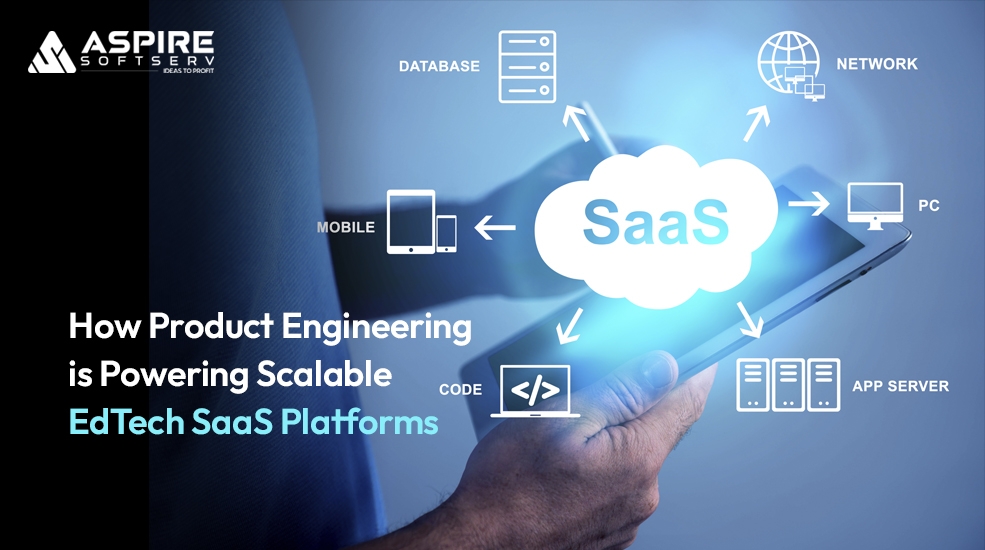
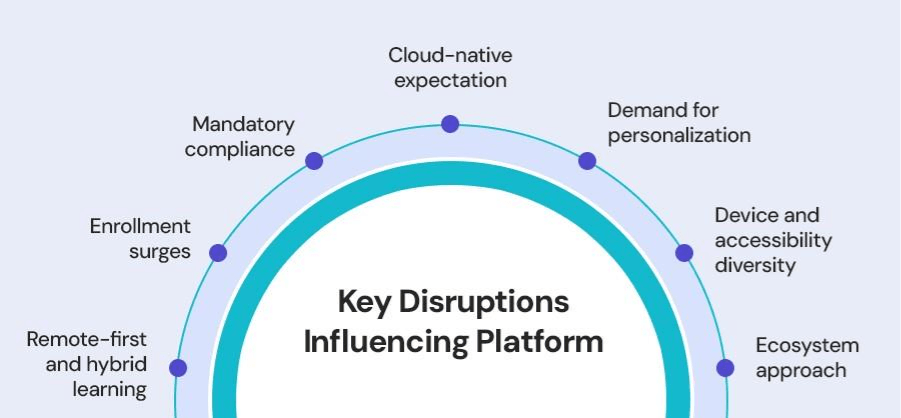
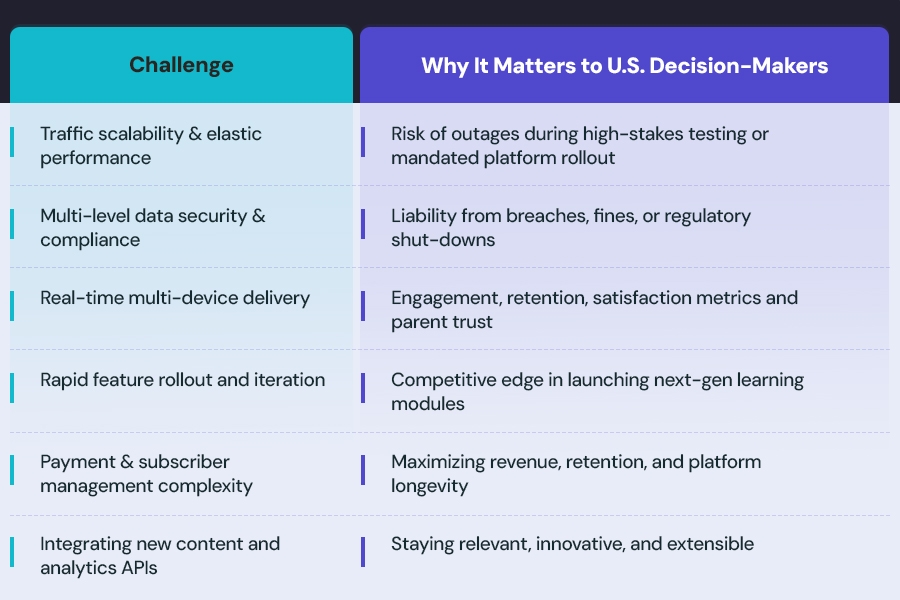
EdTech's digital revolution has accelerated at unprecedented speed in the United States, driven by hybrid learning models, surging virtual enrollments, and the relentless pursuit of personalized education. Education leaders whether heads of K-12 districts, university CIOs, or EdTech startup founders face complex, fast-evolving challenges: scaling platforms for millions of simultaneous users, delivering real-time learning experiences across devices, complying with rigorous data privacy mandates (FERPA, GDPR, CCPA), and staying ahead with AI, analytics, and cloud-native innovations.
Yet, success demands more than generic software or off-the-shelf SaaS platforms. It requires product engineering services tailored to the intricacies of digital education, empowering stakeholders to create scalable, secure, future-proof environments for students and educators.
This comprehensive guide explores:
The core technical disruptions shaping U.S. EdTech today
How next-generation product engineering solutions specifically address these challenges
Architectural best practices, frameworks, and real-world implementation flows
Actionable strategies to future-proof your EdTech SaaS platform
Strategic opportunities to leverage specialized engineering expertise
The Current Landscape: U.S. EdTech Today
EdTech Platform Requirements Across Educational Segments
K-12 School Districts:
Robust parental controls and COPPA compliance
Seamless integration with existing Student Information Systems (SIS)
Support for diverse learning levels within single platforms
Cost-effective scaling solutions within budget constraints
Higher Education Institutions:
Advanced research collaboration tools and comprehensive data analytics
Integration with legacy systems and complex IT infrastructures
Sophisticated proctoring and academic integrity solutions
Multi-language capabilities for international students
Professional Upskilling Platforms:
ROI tracking and corporate integration capabilities
Flexible certification and badging systems
Advanced analytics for workforce development metrics
Diverse payment models including corporate billing
What Are Product Engineering Services for EdTech?
Product engineering services deliver specialized technical expertise to design, develop, and scale education platforms that:
Handle massive user surges, ensuring seamless access for thousands or millions of students
Integrate secure, compliant data management systems that exceed current U.S. regulatory requirements
Implement cloud-native architectures with microservices and automated CI/CD for error-free deployment
Embed AI and analytics for adaptive learning, automated feedback, and data-driven retention
Ensure responsive design and accessibility across all devices, browsers, and educational environments
Enable frictionless SaaS monetization through tiered subscriptions, secure payments, and usage models
These specialized product engineering capabilities move far beyond basic development, providing the strategic and technical foundation required to dominate the modern EdTech landscape.
Architecting Scalable EdTech SaaS: Technical Deep Dive
1. Cloud-Native Platform Foundation
Best-in-class EdTech SaaS platforms require ground-up architecture for elasticity and resilience. Utilizing AWS, Google Cloud, or Azure, platforms benefit from:
Serverless architectures (AWS Lambda, Azure Functions) for instantaneous auto-scaling
Multi-region deployment with auto-healing clusters to guarantee uptime during outages
Content Delivery Networks (CDN) for global content access and latency control
Technical Implementation Example: Student records video content on mobile → instant cloud upload → content indexed, transcoded, and distributed via CDN for real-time classroom access → behavior tracked via serverless event triggers for rapid iteration.
Ready to implement cloud-native architecture? Our team delivers serverless solutions that scale automatically with your user base.
2. Microservices and Agile Development
Modern engineering breaks monoliths into microservices each feature (LMS, user management, video streaming, assessments) scales independently with zero downtime updates through automated pipelines.
DevOps Implementation:
CI/CD pipelines: New learning modules tested, validated, and deployed without interrupting live courses
Kubernetes orchestration: Fault-tolerant clusters ensure constant uptime during peak usage
3. Secure Data Management and Compliance
EdTech platforms must protect PII, access patterns, and payment data through:
End-to-end encryption (AES-256)
Multi-factor authentication for all user access
Automated FERPA/CCPA audit reports for institutional compliance
Role-based access management with distinct privileges for all user types
4. AI-Driven Learning Analytics
Advanced product engineering integrates real-time analytics and AI:
Adaptive assessments: AI analyzes progress and suggests personalized content paths
Instant feedback: Sentiment analysis guides instructor intervention strategies
Predictive analytics: Algorithms identify at-risk students and recommend interventions
Discover how AspireSoftServ delivers product engineering services for AI-first EdTech platforms that increase engagement by 40% on average.
5. Multi-Device Accessibility Design
Platforms must ensure:
WCAG compliance for accessibility across all user abilities
Automated testing across browsers and devices
Dynamic content optimization for phones, tablets, desktops, and smart displays
6. SaaS Monetization and Payment Systems
Revenue optimization requires:
Flexible subscription models: Free, premium, and enterprise tiers
Usage-based pricing: Pay-per-module or content consumption
PCI DSS compliant payments: Secure, seamless transaction processing
Self-service management: Automated upgrade/downgrade workflows
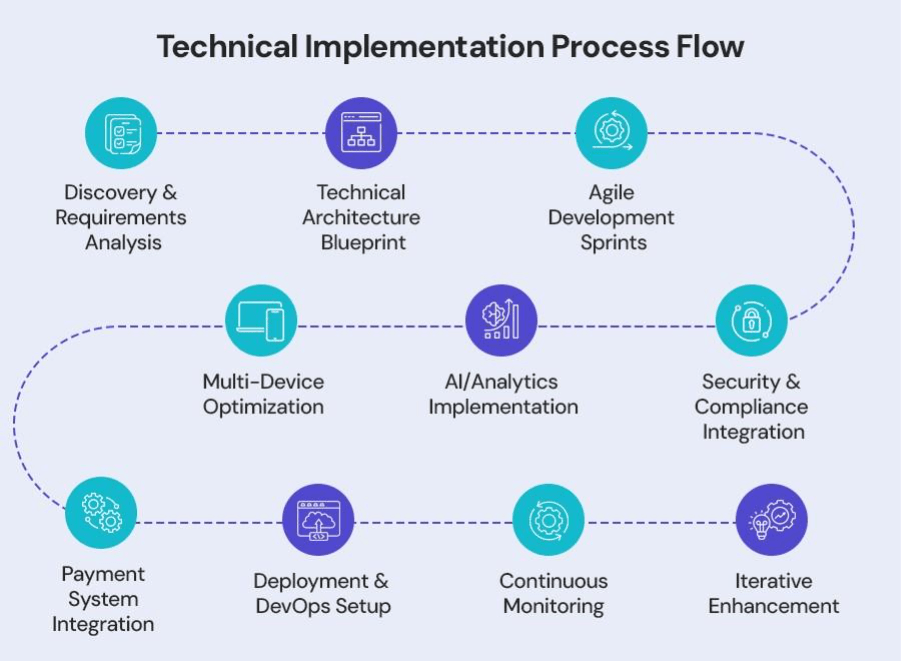
Technical Implementation Process Flow
Leading product engineering consulting follows this comprehensive development lifecycle:
Real-World Implementation Scenarios
Scenario 1: Scaling Collaboration for 60,000+ Students
Challenge: Urban district launches online project environment during finals requiring real-time collaboration tools.
Engineering Solution: Microservices-based suite on Kubernetes with serverless backend adaptation, multi-tiered access controls, and real-time performance monitoring.
Scenario 2: Secure AI-Powered Proctoring
Challenge: University implements proctoring system tracking video, keystrokes, and browser behavior for 8,000 students.
Solution: Encrypted multi-region storage, role-based API access, automated cheating detection with human review workflows, and complete audit trail generation.
Need secure proctoring implementation? Our product engineering experts have deployed privacy-compliant systems for 50+ educational institutions.
Scenario 3: Professional Upskilling Revenue Optimization
Challenge: EdTech startup faces payment friction causing subscriber drop-offs after initial engagement.
Solution: Modular billing system supporting multiple payment methods, automated retention campaigns, usage analytics, and adaptive upselling based on learning progress.
Implementation Best Practices
Cloud-Native Modularization
Build each feature as independent, scalable services
Use standardized API contracts for rapid integration and iteration
Security-First Development
Integrate compliance validation in every code repository
Maintain comprehensive access logging for full audit trails
Accessibility as Standard
Run automated accessibility scans for all releases
Support multi-language content and assistive technologies
Performance Optimization
Implement predictive scaling for academic calendar peaks
Use intelligent caching and queue management systems
Deploy progressive web technologies for offline functionality
Advanced Technical Capabilities
API-First Educational Ecosystems
Modern platforms require comprehensive integration strategies:
SIS connectors for automated enrollment synchronization
LMS bridges maintaining cross-platform data consistency
Content provider APIs expanding catalogs without development overhead
Analytics interfaces feeding institutional dashboards
Enterprise Security Beyond Compliance
Leading platforms implement advanced security layers:
Zero-trust architecture validating every request regardless of location
Behavioral biometrics for continuous authentication
ML-powered threat detection identifying unusual access patterns
Automated incident response isolating compromised accounts instantly
Looking to implement enterprise-grade security? Our expert product engineering team has deployed zero-trust architectures for platforms serving 2+ million students.
Strategic Decision Factors for U.S. EdTech Leaders
Educational technology decision-makers prioritize advanced engineering solutions because:
Public trust: Secure, resilient platforms ensure student privacy and parental confidence
Competitive advantage: Rapid AI-driven feature deployment outpaces legacy competitors
Revenue protection: Robust monetization models secure enterprise partnerships
Compliance readiness: Automated auditability and zero-downtime updates are now mandatory
Measurable ROI Outcomes
Successful EdTech leaders focus on quantifiable engineering partnership results:
Uptime improvements from 99.5% to 99.99% during peak periods
User engagement increases of 25-40% through AI personalization
Development velocity gains with 50% faster feature releases
Compliance cost reductions of 60% through automation
Revenue growth acceleration via optimized monetization
Future-Ready Technology Integration
Product engineering services prepare platforms for emerging educational technologies:
AR/VR integration for immersive learning experiences
Blockchain credentialing for tamper-proof academic records
Advanced AI tutoring providing 24/7 personalized support
IoT connectivity enabling smart classroom environments
Edge computing reducing latency for real-time collaboration
Specialized Content Management
Educational content requires unique CMS approaches:
Version control workflows tracking changes and approvals
Multi-format optimization for video, simulations, and assessments
Collaborative authoring enabling efficient expert content creation
Automated accessibility verification ensuring WCAG compliance
Ready to future-proof your platform with next-generation content management? Our product engineering consulting includes specialized CMS architectures for educational workflows.
Strategic Partnership Integration
References to specialized engineering capabilities should naturally guide qualified prospects toward comprehensive technical services. Strategic positioning after solution highlights drives organic service discovery without compromising content value.
Conclusion
EdTech's future belongs to organizations that build resilient, scalable, innovative solutions for rapidly evolving educational challenges. Advanced product engineering capabilities enable U.S. education leaders to meet surge demand, secure sensitive data, launch cutting-edge learning features, and monetize effective platforms.
The educational technology landscape evolves at unprecedented speed, with new regulatory requirements, technological capabilities, and user expectations emerging constantly. Success requires anticipating future needs and building platforms that adapt and scale seamlessly.
Investing in strategic partnerships with experienced product engineering professionals isn't just infrastructure insurance it's the path to market dominance in a sector where student success, institutional reputation, and business viability depend on platform reliability and innovation.
Whether scaling K-12 platforms for hundreds of thousands of students, building university research collaboration tools, or creating corporate upskilling platforms, the right technical partnership transforms vision into market-leading reality.
The question isn't whether to invest in advanced product engineering services it's whether you'll lead educational transformation or follow more forward-thinking competitors. In EdTech, that choice determines not just business success, but the quality of education delivered to millions of American learners. collaboration tools, or creating professional upskilling platforms for corporate clients, the right technical partnership can transform your vision into a market-leading reality.
The question isn't whether to invest in advanced product engineering it's whether you'll lead the transformation or follow in the wake of more forward-thinking competitors. In EdTech, that choice determines not just business success, but the quality of education delivered to millions of learners across America.
Scale Smarter, Educate Better