


Artificial Intelligence (AI) is taking over industries, rationalizing processes, and creating new opportunities for business. Nevertheless, it has numerous advantages that enterprises must consider in terms of ethical consequences. Therefore, for leaders who are in a position to provide leadership in selecting AI/ML vendors, there is the need to fully comprehend these ethical issues so as to guarantee the safe implementation of AI.
This guide examines the ethical implications of AI for enterprises and offers valuable insights to help businesses make informed choices when selecting AI development company and other AI-related services. In this tutorial, we will identify critical areas that most vendors neglect regarding ethics and explain what organizations need to focus on to achieve the best ethical standards in their AI strategy.
1. Understanding the Ethical Implications of AI
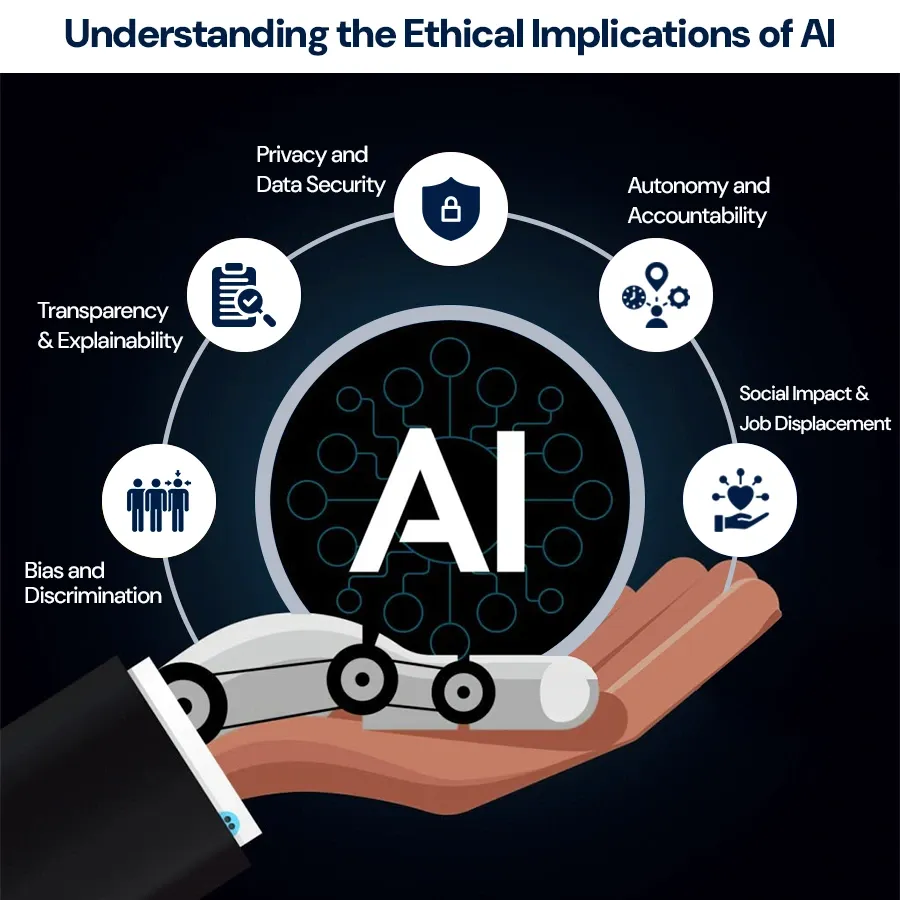
With the latest advancements in AI techniques, they have become part of decision-making processes in business, finance, healthcare, manufacturing, and other industries. These systems have the benefits mentioned above; however, several ethical questions arise that enterprises need to answer. Key ethical issues include:
Bias and Discrimination
AI models are learned from data and so in case this data had biased data then AI can intensify or even replicate the same biases. For example, facial recognition systems have been proven to provide greater error margins for people of color making the notion of fairness & discrimination questionable in key applications.
Transparency and Explainability
Most AI works on a closed model, where the process of arriving at a particular decision is opaque to outsiders. This lack of such an explanation can be an issue, especially in higher-risk areas such as in making medical diagnoses or determining a suspect’s guilt since it is also important to be informed of how an AI system arrived at a specific decision.
Privacy and Data Security
AI systems may use data containing the personal data of an individual, some of which may be of a personal nature. The confidentiality of this data is important required especially when capturing personal information to meet the GDPR and CCPA have high standards that organizations must abide by when processing the personal data of the users.
Autonomy and Accountability
It becomes almost herculean to ascertain who is liable when Self-Generated AI systems are fully autonomous. If an AI system makes a decision that leads to harm, it raises the question of who should be held accountable: This can be the system developer, the enterprise deploying the system, or indeed the AI itself.
Social Impact and Job Displacement
The work that AI performs loses its human component and can down-right eliminate jobs, causing discussions on the subject of job creation and distribution. With the incorporation of AI in businesses, the business has to take action with a long-term view of what AI may do to society and act in a way to avoid the negative effects of AI.
To do this, one has to identify the right AI/ML vendor and this is done by understanding the following ethical challenges. In the following section, tools that vendors may lack in treating these concerns and what should enterprises consider when choosing their AI partner shall be discussed.
2. Ethical Oversights by AI/ML Vendors
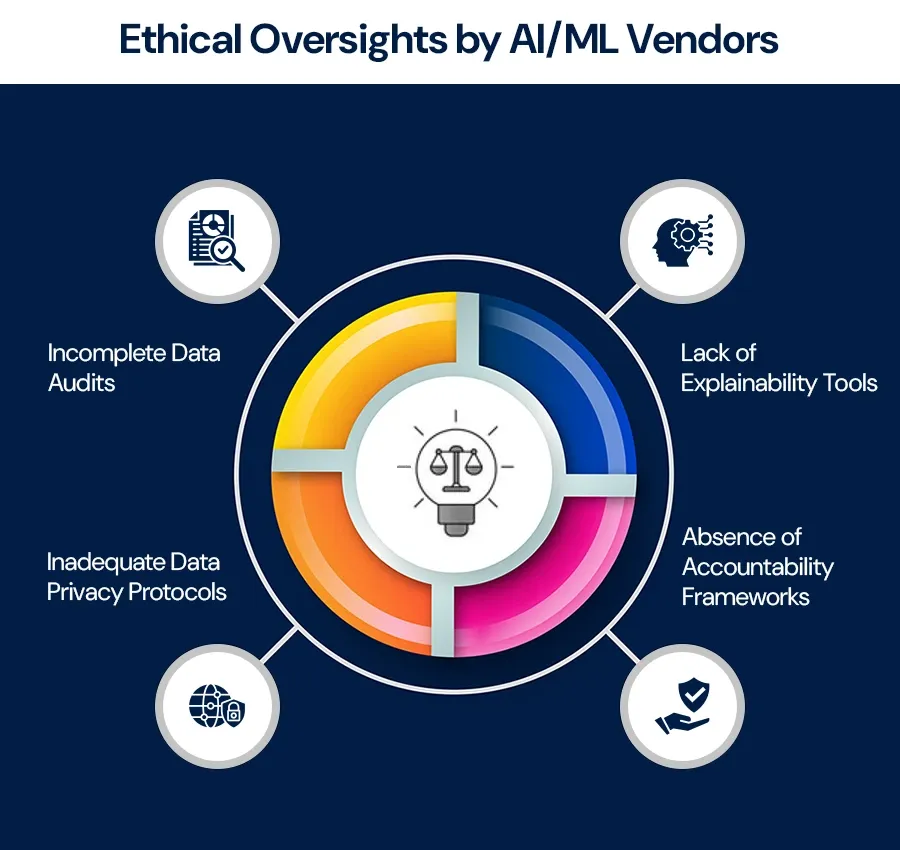
As the use of AI becomes more widespread, many AI/ML vendors focus primarily on the technical aspects of development, often neglecting the ethical implications of AI systems. Such negligence have adverse effects in the future as indicated below. Here are some common ethical pitfalls that vendors often overlook:
Incomplete Data Audits
One of the major trends many AI vendors overlook is the proper data audit to uncover bias in the training data sets. Systemic audit is not performed, and AI models can consciously or unconsciously maintain a racist approach to people by their race, gender, or other characteristics of their social status. This lack of attention to bias can cause unfair and, from an organizational perspective, incorrect conclusions that affect individuals in the wrong way.
Lack of Explainability Tools
However, in order to achieve higher performance indicators, some of the vendors provide less transparent information. In doing so, they may create AI models that decision-makers would have a hard time interpreting or even understanding. If the recommendations from the use of AI assistant cannot be explained then the people will lose trust in the system and subsequently stop using it, especially in areas such as health or finance.
Inadequate Data Privacy Protocols
Data security is crucial for AI systems, but some vendors overlook it, exposing them to AI security risks like breaches and unauthorized access. They need strict data protection measures as; leakage of data or misuse of PII may result. You have to make sure that your specific vendors who work with artificial intelligence provide compliance with data protection regulations such as GDPR and CCPA to avoid legal and reputational problems.
Absence of Accountability Frameworks
People are not exactly sure who is to blame when human-type AI systems are unable to provide an output or their output is wrong. Unfortunately, not many vendors have an elaborate system to handle such occurrences. Lacking these structures puts enterprises at risk of incurring more legal obligations and actions that are embarrassing for the company in case of mistakes or harm done by the AI systems.
Such potential gaps must be recognized by enterprises and the latter must expect better ethical standards from their AI/ML suppliers. This means special attention should be paid to how every vendor solves these problems to make AI’s deployment ethical.
3. Key Criteria for Selecting an Ethical AI/ML Vendor
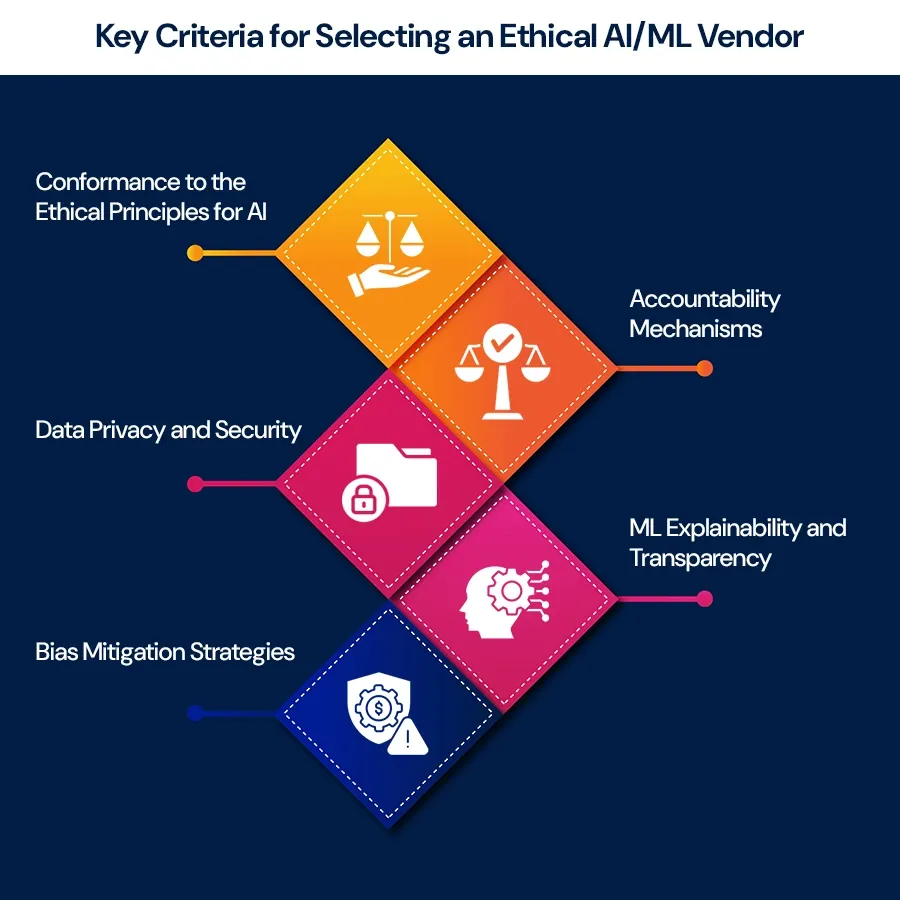
Another consideration to be taken under this factor is the need to consider ethics in business importance as well as the AI/ML technical value of the vendors when choosing one from the other. The ethical use of artificial intelligence ensures responsible deployment, minimizes risks, and fosters trust with stakeholders. Here are the essential criteria to consider when evaluating potential AI partners:
Conformance to the Ethical Principles for AI
But where can we find those vendors who have a commitment not just in words but in action? A good vendor will ensure that all the stakeholders get value for their money through a fair, open, and accountable AI development process. Key questions to ask include:
Is there an ethics team or ethics advisor who is continuously assigned to the organization?
Most importantly, how do they manage to meet ethical standards in all the phases of their development?
Are they open with how they gathered the data, developed models, and what frameworks they used to come up with the conclusions made?
Good ethical practice is very important when it comes to the implementation of Artificial Intelligence systems so as to avoid issues such as bias or unfair deeds. Ensuring ethical use of artificial intelligence should be a central part of any vendor’s approach.
Best Practices Relative to Data Privacy and Security
Businesses should ensure that their data is protected while engaging in artificial intelligence because confidential information is at the center of it. To safeguard your organization (and your customers), vitally ensure that your vendors’ data security policies are sound. Look for vendors who:
Offer ways to encrypt, store, and anonymize data so as to protect individuals’ and organizations’ rights.
No data input/ output without following GDPR/ CCPA/ HIPAA /etc if they apply to the business.
Carry out periodic data inventory checks in order to identify and minimize privacy threats.
If, for instance, you are working on a project that involves the collection of customer data. It will be important to ensure that customer data is safe and their privacy is protected. Hence developing a trusting relationship with the customers aspect of ethical use of AI systems is to regulate data security so as to avoid running afoul of the law.
Bias Mitigation Strategies
Bias in an AI system can cause unfair and prejudiced decisions to be made in your business and, consequently, negatively impact your business and entice a deluded reputation. Hypotheses and methods also require distinct plans on how the bias can be avoided in chosen vendors. Look for vendors who:
This should be done to techniques that ensure that bias is not introduced into the model during the training phase using a non-biased dataset.
Check for bias at different phases within what may be called the ‘AI value chain’, such as precustomization and post-implementation.
Accommodate bias nurturing techniques, for instance use of data perturbation, random sampling, or fairly balanced algorithms.
By proactively addressing bias, vendors can help ensure the ethical use of artificial intelligence, delivering fair and equitable outcomes for all.
Machine Learning Explainability and Transparency
Since transparency is very critical in the implementation of AI in decision-making, it is paramount that this aspect be effectively addressed. To ensure that vendors create transparent tools and practices regarding their AI models, the following postures should be adopted. Look for vendors who:
Create tools that offer recommendations for action and decision-making based on AI algorithms that can be easily understood.
Classify models that will allow stakeholders to view and comprehend why the AI results are being generated.
Offer life-life dashboards or reports in which they describe the model’s training processes alongside data used and ways of validating it.
Transparency not only increases trust in AI and improves its acceptance but also is a requisite to meet the tendencies toward regulations such as GDPR’s ‘right to explanation.’
Accountability Mechanisms
It is, therefore, good that key AI vendors have corporate responsibility mechanisms to hold them accountable in case of the occurrence of blunders. Key accountability features include:
Well-documented service level agreements that provide for outlined demarcation and expected performance from the vendor.
Proper channels through which one can raise concerns about the failure of an AI system or an inconsistency that has cropped up.
This means that the various steps taken, and actions to be initiated in case a customer complains or disputes a decision by the system should be very clear to the stakeholders.
Strong accountability measures help mitigate risks and ensure that enterprises are prepared to address any issues that arise from AI system deployment, supporting the ethical use of artificial intelligence.
4. Questions to Ask AI/ML Vendors
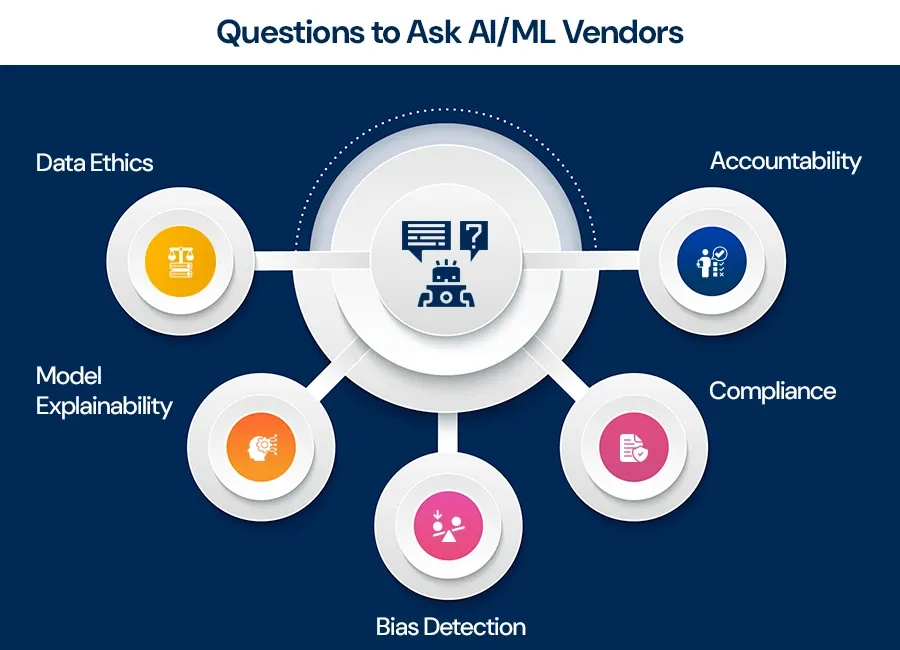
To ensure you partner with an AI/ML vendor who addresses the ethical implications of AI for enterprises, ask these critical questions during your evaluation:
Data Ethics
In what ways do you acquire the data and how do you control for different sorts of bias in the data?
Ensure the data used in training models is diverse and unbiased to address the ethical implications of AI.
In terms of data privacy, how do you handle this?
Ask the vendor to verify whether the service provider adheres to the GDPR and CCPA, among other regulations, concerning data privacy, as well as their policies towards the same.
Model Explainability
How do your AI models come to the decision?
Check for the extent of the vendor’s TCF by asking whether the vendor can give comprehensible descriptions of how the AI applications arrived at a decision.
What builds model transparency?
Ask about the current employment of explainable AI or tools or methods that make models understandable by users.
Bias Detection
What steps do you take when conducting a data science project and searching for biases in the models?
Ask about processes for detecting and reducing bias, ensuring fairness, and addressing the ethical implications of AI throughout the development lifecycle.
How do you keep track of how fairly or unfairly things are being done in the future?
The four principles of the recommended plan are to observe that the AI system is operating as intended; monitor for ‘hidden’ bias; update the AI system when bias is detected; and continuously inspect for bias in real-world contexts.
Compliance
Do you need help with data protection laws like GDPR, CCPA, GPDR, and others?
Make sure the vendor passes all the legal requirements for protecting such important information.
Can you come up with compliance documentation?
Seek evidence, which includes certifications or audit trails suggesting the vendor’s commitment to the issues of privacy and security.
Accountability
For most machines and systems, there are simple answers to these questions in terms of manufacturer liability: the manufacturer is who you go to when your machine is damaged or becomes a danger to the operator or others.
Clarify accountability structures to manage the ethical implications of AI and potential risks.
5. Ethical Frameworks for Application to Your Enterprise AI
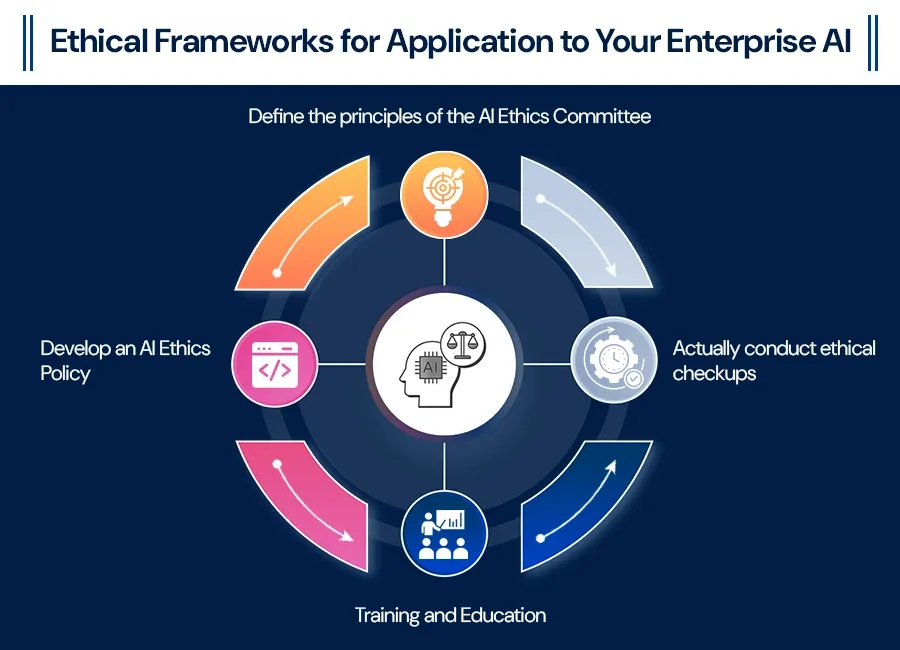
To ensure the ethical use of artificial intelligence, enterprises must establish internal frameworks to address the ethical implications of AI. Here are the key steps:
Define the Principles of the AI Ethics Committee
Create a cross-functional team to:
- Supervise AI projects to make sure the latter complies with ethics.
- Consider some risks that might occur within the process and discuss them: bias, fairness, etc.
- They concluded that it is important to continuously monitor and audit AI systems once they have been deployed.
Develop an AI Ethics Policy
Create an internal policy with:
- Recommendations concerning the protection of data.
- Anthropometric standards for bias and prejudice.
- Mechanisms for openness and ethicality in artificial intelligence decisions.
Actually Conduct Ethical Checkups
Conduct audits to ensure AI systems are ethically sound:
- Check bias in one end product developed by AI models.
- Conduct risk analysis on data privacy to cover the data.
- While democratizing AI decision-making determines its transparency.
Training and Education
Train your teams on AI ethics, focusing on:
- Reducing bias and its identification.
- Data protection measures as well as laws.
- Explainability of the involved model in order to achieve clear decision-making processes by the AI system.
Ongoing education will empower your teams to make informed decisions, fostering an organizational culture that prioritizes the ethical use of artificial intelligence.
See Also: AI in Banking- How Does AI Enhance Banks?
Conclusion:
As AI continues to reshape industries, addressing the ethical implications of AI is essential for responsible implementation. In other words, companies can avoid risk, be fair to their customers and regulators as well and develop trust with the best AI development companies through proper internal structures.
Some of these actions are creating an AI Ethics Committee, AI Ethics Policy, and performing AI audits, and ensuring the various working teams are aware of such ethical practices as bias and data privacy. The structured responsibility towards ethical AI shall facilitate a better business and societal outcome, contribute to the improvement of accountability, and increase the transparency of AI solutions, thus rewarding success.
Transform Your Business with AI-Driven Solutions!