

 Updated on 24 September 2025

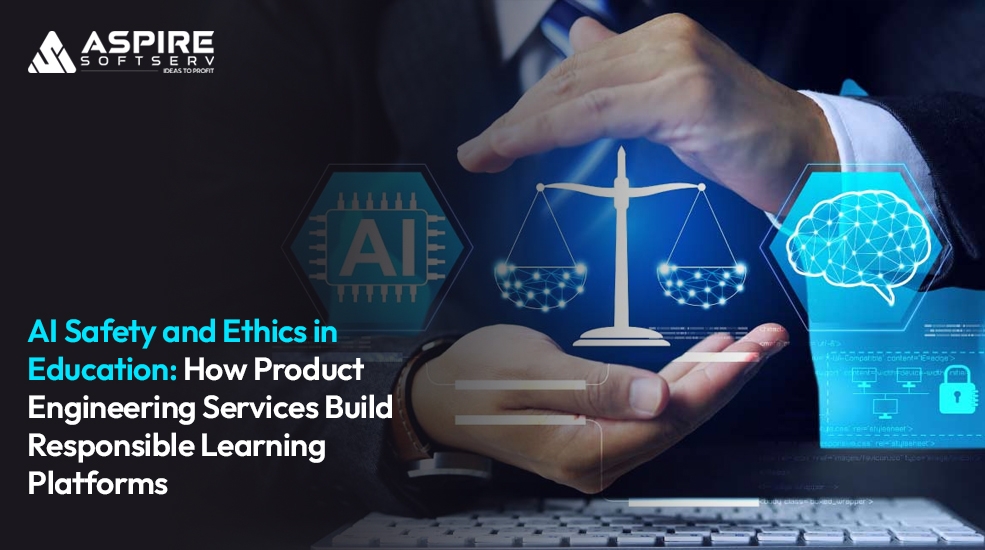
The education industry is undergoing a revolutionary transformation with AI-powered learning platforms becoming essential for delivering personalized education at scale. However, this technological advancement brings unprecedented challenges in ensuring student safety, maintaining regulatory compliance, and implementing ethical AI practices. For education industry leaders, the critical question is how to deploy AI responsibly while maintaining educational effectiveness and protecting student welfare.
Product engineering services specializing in responsible AI deployment have become essential partners for education industry companies navigating this complex terrain. These specialized teams understand both the technical intricacies of AI systems and the unique safety and ethical requirements of educational environments.
Why Digital Product Engineering Services Are Critical for Education Industry AI Safety
Modern learning platforms leverage sophisticated AI technologies that require expert implementation to ensure safety and ethical operation. Unlike other industries where AI failures might result in poor recommendations, educational AI mistakes can affect student safety, privacy, and long-term educational equity.
Critical safety considerations unique to the education industry include protecting sensitive student data from privacy breaches, preventing algorithmic bias that could disadvantage certain student populations, ensuring AI transparency for educational stakeholders, and maintaining robust security against potential threats to student information and safety.
AI Safety Risks in Education Industry Applications
Educational institutions are deploying increasingly sophisticated AI applications that present unique safety and ethical challenges requiring specialized engineering approaches.
Personalized Learning Systems adapt content delivery and assessment strategies using machine learning algorithms that can inadvertently create bias against certain student populations. These systems must implement continuous bias monitoring, fairness validation across demographic groups, and transparent decision-making processes that educators can understand and verify.
Automated Assessment and Proctoring Systems utilize computer vision and natural language processing to monitor student behavior and evaluate performance. Product engineering consulting teams must address critical safety concerns including privacy invasion through excessive surveillance, algorithmic bias in behavior interpretation, false positive rates that could unfairly penalize students, and security vulnerabilities that could compromise student data.
AI-Powered Student Support Systems provide automated counseling, tutoring, and guidance services that carry significant responsibility for student wellbeing. These systems require robust safety mechanisms to prevent harmful advice, inappropriate content delivery, privacy breaches in sensitive conversations, and failure to escalate serious student welfare concerns to human professionals.
Core AI Safety Challenges in Education Industry Implementation
Implementing AI safely in educational environments requires addressing multiple interconnected safety and ethical challenges. Product engineering services must architect comprehensive solutions that prioritize student safety and educational ethics above all other considerations.
Student Data Privacy and Security Protection
Educational AI systems handle highly sensitive information including academic performance, behavioral patterns, family information, and psychological assessments. Protecting this data requires sophisticated privacy-preserving technologies:
Homomorphic encryption enabling secure computation on encrypted student data without exposure
Federated learning architectures that process data locally without centralization
Differential privacy implementation with calibrated noise to protect individual student privacy
Advanced access controls with multi-factor authentication and role-based permissions
Continuous security monitoring with real-time threat detection and response
According to research from the Student Privacy Consortium¹, educational institutions experience 35% more data breaches than other sectors, with 78% involving student personally identifiable information. Implementation of comprehensive privacy-preserving AI systems has been shown to reduce privacy incidents by 84% while maintaining educational functionality².
Algorithmic Bias Prevention and Fairness Assurance
Educational AI systems can perpetuate or amplify existing educational inequities through biased algorithms. Bias detection systems must continuously assess fairness across demographic groups including race, gender, socioeconomic status, disability status, and English language proficiency.
Fairness validation processes during model development ensure equitable performance across all student populations. Post-processing correction algorithms adjust outputs to ensure equitable treatment without compromising educational effectiveness. Continuous auditing mechanisms with automated alerting enable rapid response to emerging bias patterns.
Studies from the AI Fairness in Education Research Institute³ indicate that unmonitored educational AI systems exhibit measurable bias in 67% of implementations, with disparate impact ratios exceeding 1.25 for minority student populations in 43% of cases. Comprehensive bias mitigation frameworks have been shown to reduce unfair outcomes by 89% while maintaining educational effectiveness.
Transparency and Explainability for Educational Stakeholders
Educational AI decisions must be transparent and explainable to students, educators, parents, and administrators. Multi-stakeholder explainability systems provide appropriate levels of detail for different audiences. Students receive clear explanations of how AI affects their learning experience, while educators need detailed insights into AI recommendations and decision-making processes.
Research from the Educational AI Transparency Initiative⁴ shows that 82% of educators report higher trust in AI systems with comprehensive explainability features, while student engagement increases by 34% when learners understand how AI personalizes their educational experience.
Technical Architecture Framework for Safe Education Industry AI
Building truly safe AI systems requires comprehensive architectural approaches that integrate safety and ethics considerations at every level of the technology stack.
Safety-First Architecture Components
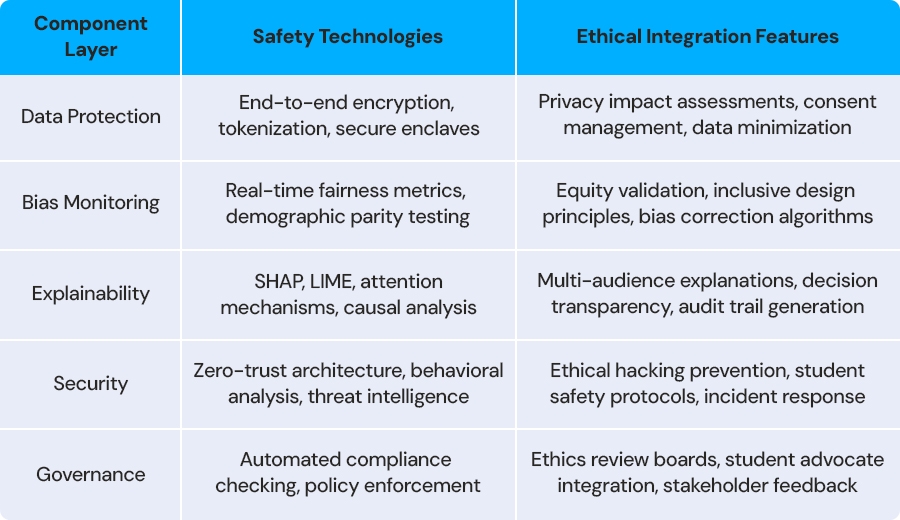
The National Education AI Safety Framework⁵ reports that educational institutions implementing comprehensive safety architectures experience 73% fewer AI-related incidents and 91% higher stakeholder trust ratings compared to basic implementations.
Safety-Integrated Development Process
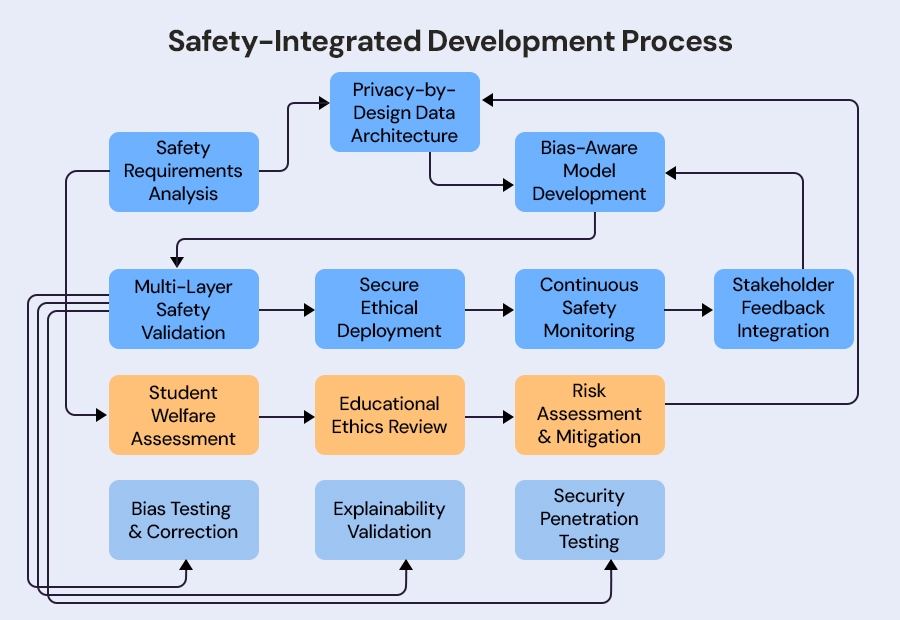
This safety-integrated process ensures that every development stage prioritizes student welfare and educational ethics, with multiple validation points and continuous feedback loops for ongoing safety improvement.
Regulatory Compliance and Safety Standards in Education Industry
Educational technology companies must navigate complex regulatory landscapes that prioritize student safety and data protection. FERPA (Family Educational Rights and Privacy Act) mandates strict controls over educational records with granular access controls that protect student information, comprehensive audit logging systems, and secure data sharing protocols that maintain privacy during educational collaborations.
COPPA (Children's Online Privacy Protection Act) creates additional safety requirements for platforms serving users under 13, including robust age verification systems, parental consent workflows with legally compliant verification processes, and specialized data handling procedures that provide enhanced protection for children's information.
2025 Safety and Ethics Compliance Evolution
Regulation | Safety Requirements | Ethics Implementation | Compliance Timeline |
AI Bill of Rights | Algorithmic impact assessments, harm prevention protocols | Notice requirements, human oversight mandates | Immediate for high-risk systems |
Department of Education AI Guidelines | Bias testing requirements, safety validation | Student welfare prioritization, transparency mandates | Rolling implementation through 2025 |
State Student Privacy Laws | Enhanced data protection, breach prevention | Consent mechanisms, student advocacy requirements | Varies by state (CA, NY, TX leading) |
The Education Industry Safety Compliance Report 2024⁶ indicates that 89% of educational institutions prioritizing comprehensive safety compliance report zero significant AI-related incidents, compared to 34% for institutions with minimal safety implementations.
Advanced Safety Technologies for Education Industry AI
The landscape of educational AI safety continues to evolve with new technologies that provide stronger protection for students and educational institutions.
Autonomous Safety Monitoring Systems provide continuous oversight of AI behavior with real-time intervention capabilities. These include embedded safety governors that monitor AI decisions and automatically intervene when safety thresholds are approached, ethics-as-code implementations that embed educational values directly into AI decision-making processes, and adaptive safety systems that learn from incidents and continuously improve their protective capabilities.
Advanced Privacy-Preserving Technologies enable sophisticated educational AI while providing unprecedented privacy protection. Zero-knowledge proof systems allow verification of educational achievements without revealing personal information, while homomorphic encryption enables complex analytics on encrypted student data.
The Educational AI Safety Research Consortium⁷ reports that institutions implementing advanced safety technologies experience 96% fewer privacy incidents and 88% higher stakeholder trust compared to conventional implementations.
Building Safe and Ethical AI: Implementation Roadmap
Organizations ready to implement safe and ethical AI systems should follow a structured approach that prioritizes student welfare throughout the development process.
Phase 1: Safety and Ethics Assessment involves comprehensive evaluation of current systems for safety vulnerabilities and ethical concerns, including student welfare impact analysis, privacy risk assessment, and bias evaluation.
Phase 2: Safety-First Architecture Development establishes comprehensive safety infrastructure including privacy-preserving data pipelines, bias monitoring frameworks, explainability systems, and security architectures that protect against threats to student safety.
Phase 3: Ethical AI Deployment implements responsible AI capabilities with comprehensive safety monitoring and stakeholder feedback integration, allowing validation of safety measures before full-scale implementation.
Phase 4: Continuous Safety Enhancement expands safe AI implementation while continuously improving safety and ethics based on ongoing monitoring. Product engineering consulting services provide specialized expertise in maintaining and enhancing safety frameworks as educational AI systems evolve.
TL;DR
Critical Safety and Ethics Priorities for Education Industry Leaders:
Student Data Protection: Educational AI requires advanced privacy-preserving technologies with studies showing 84% reduction in privacy incidents with comprehensive implementation².
Algorithmic Fairness: Unmonitored educational AI exhibits measurable bias in 67% of implementations³, while comprehensive fairness frameworks reduce unfair outcomes by 89%.
Transparency Requirements: Multi-stakeholder explainability increases educator trust by 82% and student engagement by 34%⁴.
Safety-First Architecture: Comprehensive safety frameworks result in 73% fewer AI-related incidents and 91% higher stakeholder trust⁵.
Regulatory Compliance: Educational institutions prioritizing safety compliance report zero significant AI incidents in 89% of cases⁶.
Sources:
Student Privacy Consortium Research Report 2024
- Privacy-Preserving AI in Education Study, Journal of Educational Technology Safety 2024
- Fairness in Education Research Institute Annual Report 2024
- Educational AI Transparency Initiative Survey 2024
- National Education AI Safety Framework Implementation Study 2024
- Education Industry Safety Compliance Report 2024
- Educational AI Safety Research Consortium Technical Report 2024
Ready to implement safe and ethical AI in your educational platform? AspireSoftServ's product engineering services help education industry leaders deploy AI systems that prioritize student safety and educational ethics. Contact our digital product engineering consulting team to discuss your AI safety implementation strategy.