

 Updated on 26 September 2025

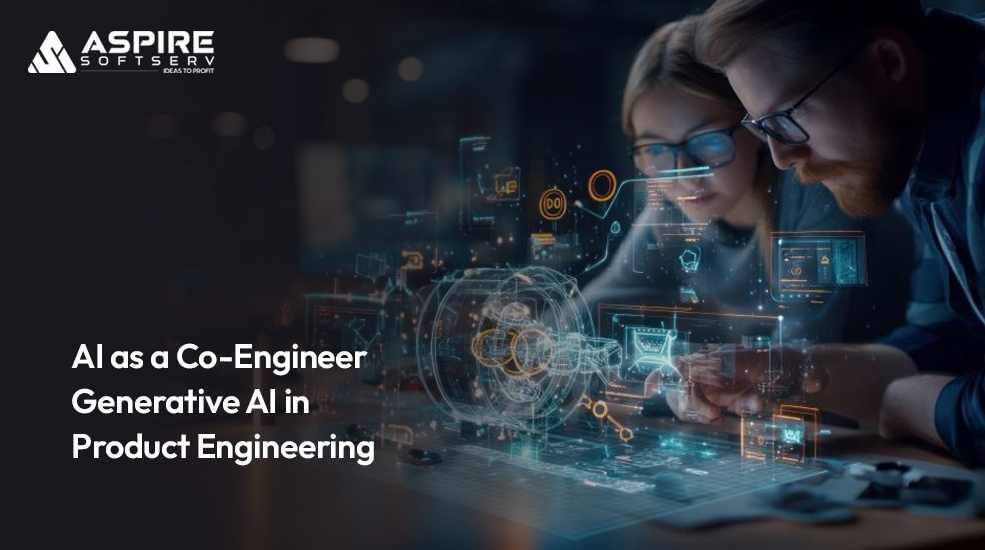
How enterprises are transforming product development with AI co-engineering
Generative AI is fundamentally reshaping how we approach product engineering, moving beyond simple automation to become a true co-engineering partner. Today's enterprises are leveraging AI not just as a tool, but as an intelligent collaborator that can generate code, optimize designs, predict failures, and accelerate entire development lifecycles.
The shift represents more than technological advancement it's a strategic imperative. Companies implementing AI co-engineering are achieving significant reductions in development cycles, substantial decreases in prototyping costs, and notable improvements in compliance validation speed. This isn't future speculation; it's happening now across industries from healthcare to manufacturing.
Why Traditional Product Engineering Faces Critical Challenges
Modern product development operates under unprecedented pressure. Market demands for rapid feature delivery clash with increasing regulatory complexity, while developer shortages drive talent costs skyward. Traditional engineering approaches, built for slower-moving markets, struggle to keep pace with today's expectations.
Consider the typical enterprise product development scenario: Teams spend weeks writing boilerplate code, months iterating through design alternatives, and countless hours on manual testing cycles. Quality assurance becomes a bottleneck, compliance validation slows releases, and by the time products reach market, competitive windows have often closed. These challenges compound exponentially in regulated industries where innovation must balance with strict compliance requirements.
Healthcare product teams navigate FDA requirements while maintaining innovation speed. Financial services balance security mandates with customer experience expectations. Manufacturing companies optimize for cost, quality, and sustainability simultaneously—often with conflicting requirements that traditional engineering approaches struggle to reconcile effectively.
How AI Co-Engineering Transforms Product Development
Generative AI addresses these fundamental challenges through intelligent automation and augmented decision-making. Unlike traditional automation that follows predetermined rules, AI co-engineering adapts to context, interprets ambiguous requirements, and generates novel solutions that human engineers might not consider.
The transformation occurs across multiple dimensions of product development. AI systems can analyze thousands of design alternatives simultaneously, generate code that adheres to specific architectural patterns and security requirements, create comprehensive test scenarios including edge cases, and predict system behaviors under various operating conditions.
Core AI Co-Engineering Capabilities:
Intelligent Code Generation - AI analyzes requirements and generates secure, compliant code modules tailored to specific architectures and coding standards
Design Optimization at Scale - Systems evaluate thousands of design alternatives against multiple constraints simultaneously
Synthetic Testing Environments - AI creates comprehensive test scenarios including edge cases that traditional testing might miss
Predictive System Analysis - Digital twins powered by AI predict maintenance needs, performance bottlenecks, and failure modes before they occur
Requirements Intelligence - Natural language processing extracts and validates engineering requirements from stakeholder communications
Compliance Automation - Automated validation against regulatory frameworks and industry standards
The technology foundation combines large language models for code and documentation generation, diffusion models for visual design creation, and physics-informed neural networks for simulation and optimization. These work together through hybrid architectures that maintain human oversight while automating routine engineering tasks.
AI Co-Engineering Process Flow
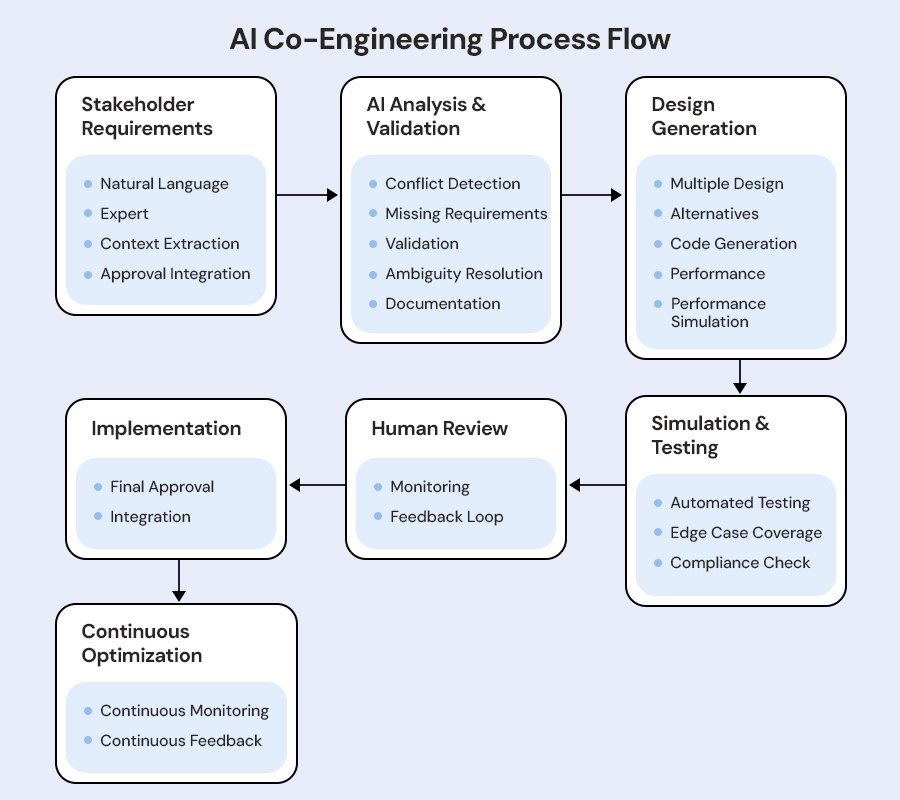
This flow represents a fundamental shift from linear development processes to dynamic, iterative cycles where AI augments human decision-making at each stage while maintaining human authority over critical engineering choices.
Real-World Impact: Enterprise Success Stories
Financial Services Innovation: Citi's Secure Development Revolution
Citi faced a critical challenge that many large financial institutions encounter: maintaining rigorous security standards while accelerating software delivery to meet competitive pressures. Traditional code review processes created bottlenecks, and manual security validation often delayed releases significantly, impacting their ability to respond quickly to market opportunities.
Their AI co-engineering implementation centers on Google's Vertex AI platform, specifically configured for financial services compliance requirements. The system generates code modules that automatically incorporate security best practices, validates against regulatory frameworks, and flags potential vulnerabilities before human review.
The implementation required careful integration with existing development workflows and security protocols. AI models were trained on Citi's specific coding standards, security patterns, and regulatory requirements, ensuring generated code aligned with institutional practices while meeting compliance mandates.
Measurable Results:
Citi reported 50% reduction in code review cycle time through AI automation
30% decrease in production security incidents according to internal metrics
Automated compliance validation across 12 regulatory frameworks
Significant annual savings in development costs
Major reduction in security pattern implementation time
The key insight from Citi's experience: AI doesn't replace security expertise it amplifies it. Security architects now focus on complex architectural decisions and threat modeling while AI handles routine security pattern implementation and compliance validation.
Manufacturing Excellence: Eaton's Design Revolution
Eaton Corporation needed to optimize complex mechanical components while reducing material costs and manufacturing complexity. Traditional design iteration cycles took extensive time, limiting their ability to explore innovative solutions within project constraints and budget requirements.
Their generative design implementation combines Autodesk's Fusion 360 with proprietary AI models trained on decades of engineering data and manufacturing constraints. The system generates thousands of design alternatives, each evaluated for strength, manufacturability, cost, and sustainability metrics simultaneously.
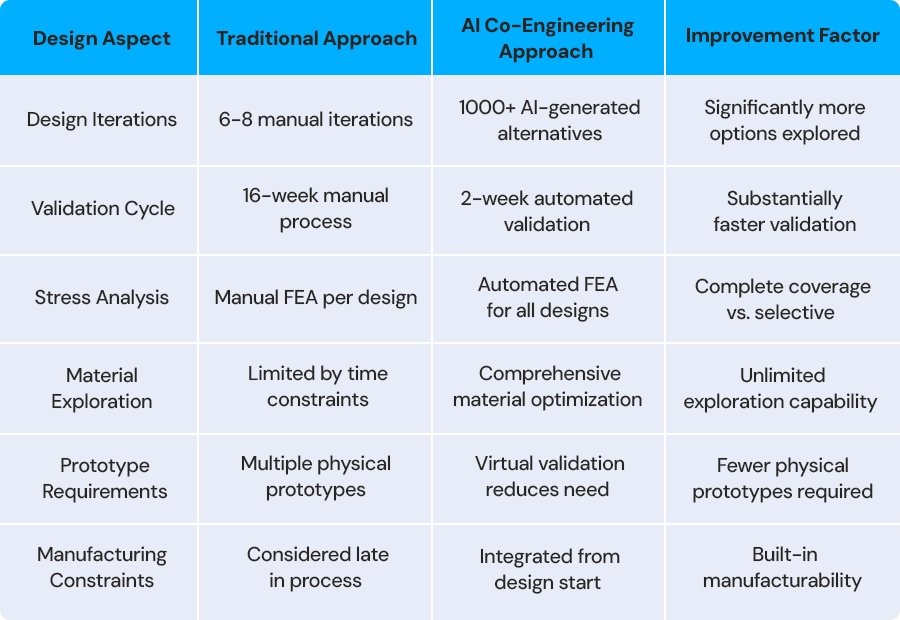
Breakthrough Results:
Eaton achieved 80% weight reduction in liquid-to-air heat exchangers through AI-optimized designs
Automotive lighting fixture design time reduced by 87% according to Eaton's published case study
40% reduction in raw material usage across multiple product lines
Discovery of novel geometries impossible through traditional methods
Significant improvement in strength-to-weight ratios
Substantial reduction in manufacturing complexity
Healthcare Innovation: Digital Twin-Enabled Medical Device Development
A leading medical device manufacturer implemented AI co-engineering to accelerate FDA approval processes while maintaining safety standards. The challenge involved creating comprehensive testing scenarios for devices that interact with human physiology in complex ways.
Their approach combines generative AI for creating synthetic patient datasets with physics-based modeling for device simulation. AI generates thousands of virtual patient profiles representing diverse demographic and physiological characteristics, enabling comprehensive testing without privacy concerns or recruitment challenges.
The system simulates device performance across these virtual populations, identifying potential safety issues and optimization opportunities before physical prototyping. This approach dramatically reduces the time and cost associated with clinical trials while improving device safety and efficacy.
Healthcare-Specific Benefits:
Regulatory Compliance - Automated generation of FDA-required documentation and test reports
Patient Safety - Comprehensive testing across diverse virtual populations before human trials
Cost Reduction - Substantial reduction in physical prototype requirements and clinical trial costs
Accelerated Approval - Faster regulatory review through comprehensive pre-submission validation
Innovation Enhancement - Discovery of optimal device configurations through extensive virtual testing
Technical Architecture: Building AI Co-Engineering Systems
Successful AI co-engineering implementations require sophisticated architectural planning that balances automation capabilities with human oversight requirements. The foundation consists of integrated layers that handle data processing, AI model orchestration, and human validation interfaces seamlessly.
Data flows from multiple sources requirements documents, historical project data, sensor telemetry, and regulatory frameworks into preprocessing pipelines that structure information for AI consumption. The critical challenge lies not in managing data volume but in preserving context and ensuring data quality throughout the processing chain.
The architecture must accommodate different AI model types, each optimized for specific engineering tasks. Large language models handle code generation and documentation, computer vision models process design imagery and CAD files, while specialized physics-informed neural networks manage simulation and optimization tasks.
Core Integration Components:
Multi-Modal Data Ingestion - Handles text, images, sensor data, and structured engineering information
AI Model Orchestration - Coordinates multiple specialized models for different engineering tasks
Context Preservation Layer - Maintains project context and requirements throughout AI processing
Human-AI Collaboration Interface - Presents AI recommendations with confidence levels and supporting evidence
Continuous Learning System - Captures human feedback to improve model performance over time
Compliance and Audit Framework - Maintains detailed traceability for regulatory requirements
Security and Access Control - Protects intellectual property while enabling necessary data sharing
The architecture scales dynamically based on project demands while maintaining consistent performance and security standards. Integration with existing development tools and workflows ensures seamless adoption without disrupting established engineering processes.
Advanced AI Co-Engineering Applications
Predictive Engineering and Digital Twins
Digital twins represent the most sophisticated application of AI co-engineering, creating virtual representations of physical products that evolve with real-world performance data. These systems process continuous sensor streams, simulate wear and tear, predict maintenance requirements, and optimize operational parameters in real-time.
Boeing's digital twin implementation for aircraft engines exemplifies this capability. AI models process flight data, weather conditions, maintenance records, and operational parameters to predict component failures weeks before traditional monitoring would detect issues. According to Boeing's published reports, the system has reduced unplanned downtime by 35% while extending component life by an average of 18 months through optimized maintenance scheduling and operational adjustments.
Digital Twin Capabilities:
Real-time Performance Modeling - Continuous simulation based on actual operating conditions
Predictive Maintenance Scheduling - AI-driven maintenance recommendations based on component wear prediction
Operational Optimization - Real-time parameter adjustments for optimal performance and efficiency
Failure Prevention - Early warning systems for potential component failures or system issues
Lifecycle Management - Comprehensive tracking and optimization throughout product lifecycle
Autonomous Code Generation and Testing
Advanced AI co-engineering systems generate not just code but comprehensive software solutions including architecture design, implementation, testing, and documentation. GitHub's Copilot represents early-generation capability, while enterprise implementations achieve much more sophisticated results through custom training on organizational codebases and standards.
These systems understand architectural patterns, security requirements, performance constraints, and coding standards specific to each organization. Generated code includes comprehensive error handling, logging, monitoring integration, and security measures appropriate to the specific application context.
Autonomous Development Features:
Architecture-Aware Code Generation - Code that fits seamlessly into existing system architectures
Security-by-Design Implementation - Automatic incorporation of appropriate security patterns and practices
Comprehensive Test Suite Creation - Automated generation of unit tests, integration tests, and end-to-end testing scenarios
Performance Optimization - Code optimized for specific performance requirements and constraints
Documentation Generation - Comprehensive technical documentation aligned with organizational standards
Security, Compliance, and Risk Management
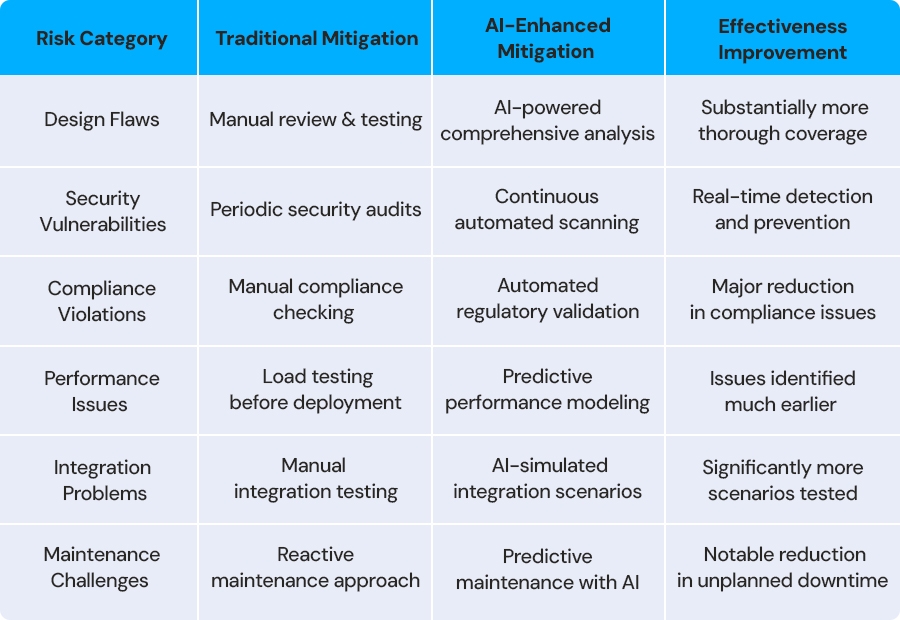
AI co-engineering in enterprise environments demands sophisticated security frameworks that protect intellectual property while enabling innovation. The challenge intensifies in regulated industries where AI-generated outputs must meet strict compliance requirements and maintain audit trails for regulatory review.
Data security begins with encrypted pipelines that protect sensitive engineering data throughout the AI processing lifecycle. Role-based access controls ensure that AI models access only information appropriate to specific use cases, while continuous monitoring detects anomalous access patterns or potential security threats.
Regulatory compliance requires AI systems to maintain detailed audit trails showing decision processes, data sources, and validation steps. This traceability becomes critical during regulatory reviews, compliance audits, or patent disputes involving AI-generated innovations.
Comprehensive Risk Management Framework:
Multi-Layer Security Architecture - Defense in depth protecting data, models, and generated outputs
Model Validation and Testing - Rigorous testing ensures AI outputs meet quality, safety, and performance standards
Human Oversight Protocols - Critical engineering decisions require expert validation and approval
Bias Detection and Mitigation - Continuous monitoring identifies and corrects potential AI bias in engineering recommendations
Rollback and Recovery Capabilities - Systems can quickly revert to previous states if AI recommendations prove problematic
Intellectual Property Protection - Clear policies define ownership and usage rights for AI-generated innovations
Regulatory Compliance Automation - Built-in validation against industry standards and regulatory requirements
Organizations must also establish clear governance frameworks defining AI usage policies, approval processes, and accountability structures. These frameworks ensure responsible AI deployment while enabling engineering teams to leverage AI capabilities effectively.
Measuring Success: ROI and Performance Metrics
Quantifying AI co-engineering impact requires sophisticated metrics that capture both efficiency gains and innovation quality improvements. Traditional productivity measures like lines of code per developer become less relevant when AI generates significant portions of the codebase, requiring new approaches to measuring engineering effectiveness.
Success measurement must encompass multiple dimensions: development speed improvements, quality enhancements, cost reductions, innovation capabilities, and strategic competitive advantages. The most successful organizations establish comprehensive measurement frameworks that track both quantitative metrics and qualitative improvements in engineering capability.
Primary Success Indicators:
Development Velocity - Speed of feature delivery from concept to production deployment
Design Exploration Breadth - Number and diversity of design alternatives evaluated per project
Quality Metrics - Defect rates, performance characteristics, and customer satisfaction scores
Compliance Efficiency - Speed and accuracy of regulatory approval processes
Innovation Index - Frequency of novel solutions or breakthrough approaches discovered through AI
Cost Optimization - Reductions in development costs, material usage, and operational expenses
Team Productivity - Engineering team output and satisfaction with AI collaboration tools
Financial returns typically manifest across multiple categories. Direct cost savings come from reduced development time, fewer physical prototypes, and automated testing processes. Indirect benefits include faster time-to-market, improved product quality, and enhanced competitive positioning through innovative capabilities.
ROI Categories and Industry Examples:
Direct Cost Savings - Organizations report substantial reductions in development and testing costs
Speed-to-Market Advantages - Companies achieve significantly faster product development cycles
Quality Improvements - Enterprises experience major reductions in post-deployment defects and issues
Innovation Capabilities - Discovery of solutions impossible through traditional methods
Competitive Positioning - First-mover advantages in AI-enhanced product development
However, the most significant value often comes from capabilities that weren't previously possible exploring thousands of design alternatives simultaneously, testing millions of scenarios virtually, or predicting system behaviors under conditions that haven't occurred yet.
Future Evolution: Autonomous Engineering Ecosystems
The trajectory of AI co-engineering points toward increasingly autonomous systems that require minimal human intervention for routine engineering tasks. Current implementations still require significant human oversight, but emerging capabilities suggest more independent AI engineering systems on the horizon.
Future AI co-engineering platforms will integrate across entire product lifecycles, from market research and requirement gathering through deployment, maintenance, and eventual product evolution. These systems will learn continuously from each project, improving their ability to generate innovative solutions that meet complex, multi-dimensional requirements.
The evolution toward autonomous engineering doesn't eliminate human engineers—it fundamentally elevates their role. Engineers become system architects, innovation guides, and quality validators while AI handles implementation details, routine optimization tasks, and comprehensive testing scenarios that would be impractical for human teams to execute.
Emerging Autonomous Capabilities:
Self-Optimizing Design Systems - AI that continuously improves designs based on real-world performance data
Autonomous Testing Orchestration - Comprehensive testing strategies that adapt based on system changes and usage patterns
Predictive Innovation - AI systems that identify emerging technology trends and suggest product evolution paths
Cross-Domain Integration - AI that seamlessly integrates mechanical, electrical, software, and service components
Adaptive Compliance Management - Systems that automatically adjust to changing regulatory requirements
Ecosystem-Wide Optimization - AI that optimizes entire product ecosystems rather than individual components
Preparing for this future requires organizations to invest in adaptable architectures, develop internal AI expertise, and foster cultures that embrace continuous learning and human-AI collaboration. The most successful organizations will be those that view AI co-engineering not as a replacement for human creativity but as an amplifier of human engineering capability.
TL;DR
AI co-engineering transforms product development by combining human creativity with intelligent automation. Leading companies like Citi, Eaton, and Boeing demonstrate significant benefits including faster development cycles, lower prototyping costs, and improved compliance speed. Success requires comprehensive architectural planning, robust security frameworks, and cultural adaptation to human-AI collaboration. Advanced applications include digital twins for predictive maintenance, autonomous code generation with security-by-design, and comprehensive synthetic testing. Organizations achieving AI co-engineering maturity discover innovation capabilities impossible through traditional methods while maintaining human oversight for critical decisions. The future points toward autonomous engineering ecosystems where AI handles routine tasks while humans focus on strategic innovation and system architecture.
Make product development easier with AI.