


 Updated on 17 April 2026

Manufacturing businesses operate in one of the most demanding and fast-moving environments in any industry. From raw material intake to final dispatch, products pass through multiple production stages where even a minor deviation can delay the entire cycle, inflate costs, and erode carefully planned margins without anyone noticing until the damage is done.
Without real-time visibility into shop floor activity, work orders pile up, machines sit idle between operations, and supervisors are forced to make critical decisions based on incomplete or outdated data. Quality inconsistencies rise, delivery commitments become unreliable, and the gap between what was planned and what happened only grows wider with every shift.
This is exactly where Odoo Manufacturing ERP makes a measurable difference. By combining real-time work order tracking, live shop floor visibility, integrated inventory control, and embedded quality checkpoints, Odoo brings complete operational clarity to manufacturing businesses of every size replacing confusion with control, and reactive management with proactive decision-making.
What Is WIP Confusion and What Does It Really Cost Manufacturers?
Work-In-Progress, or WIP, refers to any material or product that has entered the production process but has not yet been completed and transferred to finished goods. In a well-run operation, WIP flows steadily through each stage with minimal accumulation. In a struggling one, it stalls building up between work centers and signaling deeper problems in planning, visibility, and coordination.
WIP confusion occurs when no one in the business has a clear, current picture of where each production order stands. A supervisor does not know whether a critical work center is running on schedule or three hours behind. A planner commits to a delivery date based on a status report that was already outdated when it was printed. Materials are consumed without accurate recording, costs drift from what was planned, and by the time management identifies the problem, the delay has already spread across multiple orders.
Here is what WIP confusion is costing your manufacturing business:
Tied-up working capital: Stalled inventory between production stages locks cash that cannot be reinvested or used to fund new orders.
Emergency purchasing at inflated prices: Material shortages caused by inaccurate WIP tracking force unplanned buying at 20–30% above standard supplier pricing.
Rework and scrap costs: Defects caught only at final inspection mean entire batches must be reworked or scrapped, multiplying the original production cost.
Missed delivery commitments: Delivery dates promised on stale production data cannot be met, damaging customer trust and creating penalty exposure.
Compounding operational inefficiency: One unresolved bottleneck at a single work center delays every downstream operation, turning a small problem into a business-wide disruption.
The real cost of WIP confusion is not just a profitability problem. It is a strategic visibility problem that compounds with every passing production cycle, making accurate forecasting, reliable delivery, and scalable growth structurally impossible until the underlying system is fixed.
Key Challenges in Shop Floor Tracking That Odoo Is Built to Solve
Shop floor errors rarely begin with a single catastrophic failure. They accumulate gradually through missed updates, informal communication, and the absence of real-time controls at each production stage. By the time a problem becomes visible to management, it has already moved downstream, taken inventory with it, and affected delivery timelines that cannot easily be recovered.
No real-time visibility into production status Managers rely on shift-end paper reports or phone calls to understand what is happening on the floor. By the time information reaches a decision-maker, the situation has changed and the opportunity to intervene has already passed.
Disconnected production and inventory systems Production, warehouse, and finance each operate from different tools with different data. A work order can be confirmed and started without the required materials being confirmed as available, because no single system checks both simultaneously.
Paper-based or manual work order tracking Operators work from printed sheets or verbal instructions. Updates are recorded manually at the end of a shift, if at all meaning production status visible to management is rarely an accurate reflection of what is actually happening on the shop floor.
Reactive bottleneck detection Without a system tracking capacity against scheduled output in real time, bottlenecks are identified only after delays have already compounded. Production scheduling becomes guesswork built on assumptions rather than live data.
No embedded quality control during production Quality checks happen at final inspection rather than at each operation stage. Defects move forward unchecked through multiple work centers before being caught multiplying rework costs and consuming production time that cannot be recovered.
Odoo Manufacturing ERP addresses every one of these challenges by replacing disconnected, manual processes with a single integrated platform where production data, inventory movements, quality checks, and scheduling information are all connected, live, and visible to every person who needs them in real time.
How Odoo Manufacturing ERP Creates Clarity on the Shop Floor?
Odoo is a fully integrated manufacturing ERP platform that connects production, inventory, purchasing, and quality into one system, ensuring that a change in any area flows automatically to every other area that depends on it giving every team member, from operator to plant manager, a single accurate picture of shop floor reality at all times.
One centralized manufacturing platform: All modules communicate in real time no data silos, no manual syncing, no department working from yesterday's numbers.
Digital work orders with live status tracking: Every work order is tracked stage by stage. Supervisors see live updates across every work center without walking the floor or waiting for shift-end reports.
Automated inventory and BOM synchronization: When a manufacturing order is confirmed, Odoo checks the Bill of Materials against current stock and automatically triggers a purchase request if any component falls below threshold.
Planned versus actual production tracking: Odoo compares scheduled operation time against actual time recorded at shop floor terminals surfacing deviations the moment they occur, not hours later.
Integrated quality control within production routing: Quality checkpoints are embedded directly into work order operations. A failed check automatically pauses the order and raises a corrective action, preventing defects from moving forward unchecked.
Which Odoo Features Give Manufacturers Real-Time Shop Floor Visibility?
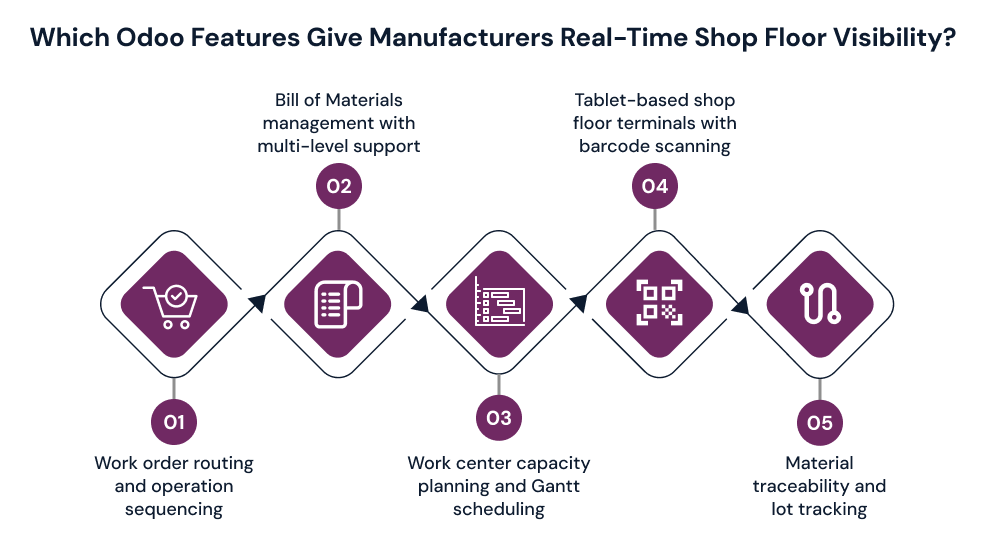
Odoo Manufacturing ERP comes equipped with purpose-built features that eliminate guesswork and give every stakeholder from floor operator to plant manager a live, accurate view of production at every stage. Here are the six core features that make real-time shop floor management software a practical reality, not just a promise.
Work order routing and operation sequencing: Odoo breaks every manufacturing job into a defined sequence of operations across specific work centers. A downstream operation cannot start until the upstream step is formally validated eliminating out-of-sequence work and the rework costs that follow.
Bill of Materials management with multi-level support: Odoo's BOM module tracks complex production structures where a component is itself a sub-assembly. Material consumption, inventory levels, and production costs stay accurate at every level automatically, without manual reconciliation.
Work center capacity planning and Gantt scheduling: Businesses can define machine capacity per shift and visualize the full production schedule on an interactive Gantt view. Scheduling conflicts are visible before they cause delays, and orders can be repositioned with a simple drag and drop.
Tablet-based shop floor terminals with barcode scanning: Operators start and stop tasks on touchscreen terminals, creating a live record of operation time. Barcode scanning validates materials at each stage and quality alerts raised mid-operation allow immediate intervention before defects move forward.
Material traceability and lot tracking: Every material movement receipt, issue, return, or rejection is logged in real time against a specific work order, operator, and timestamp. This gives teams a complete audit trail to pinpoint exactly where a defect originated.
What Manufacturers Gain With Odoo Manufacturing ERP?
Odoo delivers gains that go well beyond fixing individual tracking problems. WIP levels drop, production delays surface before they compound, inventory accuracy improves, and rework costs fall because quality failures are caught at the operation stage not at final inspection. Every department shifts from end-of-day damage control to live, data-driven decisions.
These improvements compound as the business scales. Manufacturers can start with core production tracking and expand progressively into quality control, maintenance, and analytics all within the same platform, without replacing the system or retraining the team.
Conclusion
WIP confusion is not a people problem it is a structural one. Disconnected tools, manual work order processes, and the absence of real-time controls allow margin risk and production delays to accumulate silently every shift. Odoo Manufacturing ERP closes that gap by connecting production, inventory, quality, and scheduling into one live platform.
If your operation is ready to move from reactive to proactive, Odoo gives you the tools to make that shift measurable from the first production cycle. Book a consultation with our Odoo specialists today.
Frequently Asked Questions
Q1. What is WIP in manufacturing and why does it matter?
WIP is any unfinished product still in production. Excess WIP signals bottlenecks, ties up capital, and increases the risk of defects reaching final inspection undetected.
Q2. How does Odoo track work orders in real time on the shop floor?
Operators start and stop tasks on shop floor terminals. Supervisors instantly see every order's live status on the manufacturing dashboard no manual reporting needed.
Q3. How does Odoo reduce excess WIP and waste on the shop floor?
Odoo catches material deviations, machine delays, and QC failures early. Accurate routing and real-time entries prevent waste from accumulating before batches move forward.
Q4. Does Odoo support quality checks during production, not just at final inspection?
Yes. Quality steps are embedded into production routing. Failed checks automatically pause the work order and raise a corrective action stopping defects at the source.
Q5. Can Odoo handle our factory's existing workflow, or do we need to rebuild processes?
Odoo is flexible enough to fit your existing workflow. Most manufacturers adapt their current process into Odoo without rebuilding operations from scratch.
Q6. How does Odoo help with material traceability during production?
Every material movement receipt, issue, return, or rejection is logged in real time, creating a clear audit trail that pinpoints exactly where a defect originated.
Reduce WIP Confusion and Losses from the Start